
smart band supplier: 7 Critical Checks When Selecting a Smart Band Supplier for EU Corporate Wellness Programs
November 13, 2026 · Team Star King

7 Critical Checks When Selecting a Smart Band Supplier for EU Corporate Wellness Programs
Choosing a smart band supplier for a corporate wellness program in the European Union requires verifying CE marking, battery safety documentation, data protection readiness, MOQ flexibility, and after-sales support before contracts are signed. This guide gives procurement teams seven practical checks—from compliance files to sample testing—that separate reliable smart band suppliers from high-risk vendors, so you can shortlist with confidence and protect your program budget.
Table of Contents
Table of Contents
Table of Contents
- Direct Answer: What Should EU Buyers Check First?
- Key Takeaways
- Key Facts for Buyers
- Check 1: Regulatory and Certification Readiness
- Check 2: Battery Safety and Transport Documentation
- Check 3: Data Protection and App Ecosystem
- Check 4: Product Specification Fit for Corporate Use
- Check 5: MOQ, Pricing Structure, and Lead Time Planning
- Check 6: Quality Control and Sample Validation
- Check 7: After-Sales, Warranty, and Spare Parts
- Smart Band Supplier Comparison Table
- Common Mistakes and Buyer Red Flags
- Practical Buyer Checklist
- FAQ
- Conclusion

Direct Answer: What Should EU Buyers Check First?
EU corporate buyers should first confirm that the smart band supplier can provide a complete CE compliance file, UN38.3 battery test reports, and a clear data-processing agreement for the companion app. After that, evaluate MOQ flexibility, sample lead times, and warranty terms. These three areas—compliance, data, and commercial terms—account for most procurement delays in employee wellness deployments.

Key Takeaways
- CE marking, RED compliance, and UN38.3 reports are non-negotiable for EU corporate deployments.
- Corporate wellness programs need app-level data controls, not just hardware features.
- MOQ and lead time should be planned against employee onboarding waves, not warehouse capacity.
- Ask for pre-shipment inspection reports and sample validation data before scaling orders.
- Warranty and spare-parts commitments should be written into the supply agreement.

Key Facts for Buyers
| Factor | Typical EU Corporate Requirement | Why It Matters |
|---|---|---|
| CE marking | Required for radio equipment (RED 2014/53/EU) | Customs clearance and legal sale in the EU |
| Battery transport | UN38.3 test summary + MSDS | Air freight and courier acceptance |
| Data protection | GDPR-aligned data processing agreement | Employee privacy and HR compliance |
| MOQ | Often 500–3,000 units depending on customization | Budget approval and pilot programs |
| Lead time | Typically 25–45 days after sample approval | Aligning with wellness program launch dates |
| Warranty | 12–24 months, parts and labor defined | Total cost of ownership and renewals |
Check 1: Regulatory and Certification Readiness
Any smart band sold in the EU must comply with the Radio Equipment Directive (RED) 2014/53/EU and carry CE marking. The supplier should be able to share a Declaration of Conformity, test reports from an accredited lab, and technical file documentation. For corporate procurement teams, certification is not a one-time checkbox—it must match the exact product configuration, firmware, and packaging you intend to buy. A supplier that cannot produce configuration-specific documents is a risk.
Ask whether the smart band supplier has experience with EU import declarations and whether they can support your authorized representative obligations. For background on EU market surveillance, refer to the European Commission CE marking guidance. Buyers should verify that certification covers the Bluetooth radio module used in the band, which typically requires Bluetooth SIG qualification.
What to Request From the Supplier
- EU Declaration of Conformity for the specific model
- RED test reports covering EMC, radio spectrum, and safety
- RoHS and REACH declarations for materials
- Battery UN38.3 test summary and MSDS
- WEEE and packaging registration support where applicable
[STAR KING TO CONFIRM: certification status per specific smart band SKU]
Check 2: Battery Safety and Transport Documentation
Smart bands contain lithium-polymer or lithium-ion batteries, which are regulated for air transport. A reliable smart band supplier provides UN38.3 test summaries, MSDS, and a battery safety test report covering overcharge, short circuit, and thermal abuse. Without these documents, couriers and freight forwarders may refuse shipments, delaying your corporate rollout.
For EU buyers, battery safety also ties into product liability. Ask whether the battery cell and pack supplier is traceable and whether the band has undergone drop testing, waterproof testing, and aging testing. These tests are relevant for corporate wellness programs where devices are worn daily and charged frequently.
Check 3: Data Protection and App Ecosystem
Corporate wellness programs process employee health data, which falls under the General Data Protection Regulation (GDPR). Procurement teams must evaluate the smart band supplier’s app architecture, data hosting location, and data-processing agreement. A supplier that cannot explain where data is stored or whether data can be exported to your HR platform creates compliance exposure.
Ask for a data flow diagram, confirmation of encryption in transit and at rest, and clarity on whether the app supports role-based access for administrators. If the supplier offers app customization, define who owns the customized app and how updates are managed. The European Data Protection Board guidelines on data protection by design are a useful reference when reviewing supplier documentation.
Check 4: Product Specification Fit for Corporate Use
Corporate wellness deployments often prioritize battery life, comfort during all-day wear, and clear activity tracking over advanced features. When comparing smart band suppliers, build a specification matrix that reflects employee needs rather than consumer marketing claims. Key parameters include display type, water resistance rating, battery capacity, sensor set, and Bluetooth version.
For corporate programs, consider whether the band supports silent alarms, sedentary reminders, and step or heart-rate monitoring suitable for wellness challenges. These features should be verified in samples, not assumed from spec sheets. For related product options, see STAR KING smart bands and the private label OEM/ODM solution for customization scope.
Check 5: MOQ, Pricing Structure, and Lead Time Planning
MOQ and lead time are among the most common friction points in corporate procurement. A smart band supplier may quote a low unit price at high volume but offer limited flexibility for pilot programs. Procurement teams should ask for tiered pricing, sample lead time, production lead time after sample approval, and the impact of customization on both.
Plan orders against employee onboarding waves. A phased rollout may require multiple smaller shipments, which affects freight cost and landed cost. Request a cost breakdown that separates hardware, customization, packaging, and freight. Where MOQ is a concern, discuss whether the supplier offers stock models for pilot phases and customized models for full deployment. [STAR KING TO CONFIRM: available MOQ tiers and lead times]
Check 6: Quality Control and Sample Validation
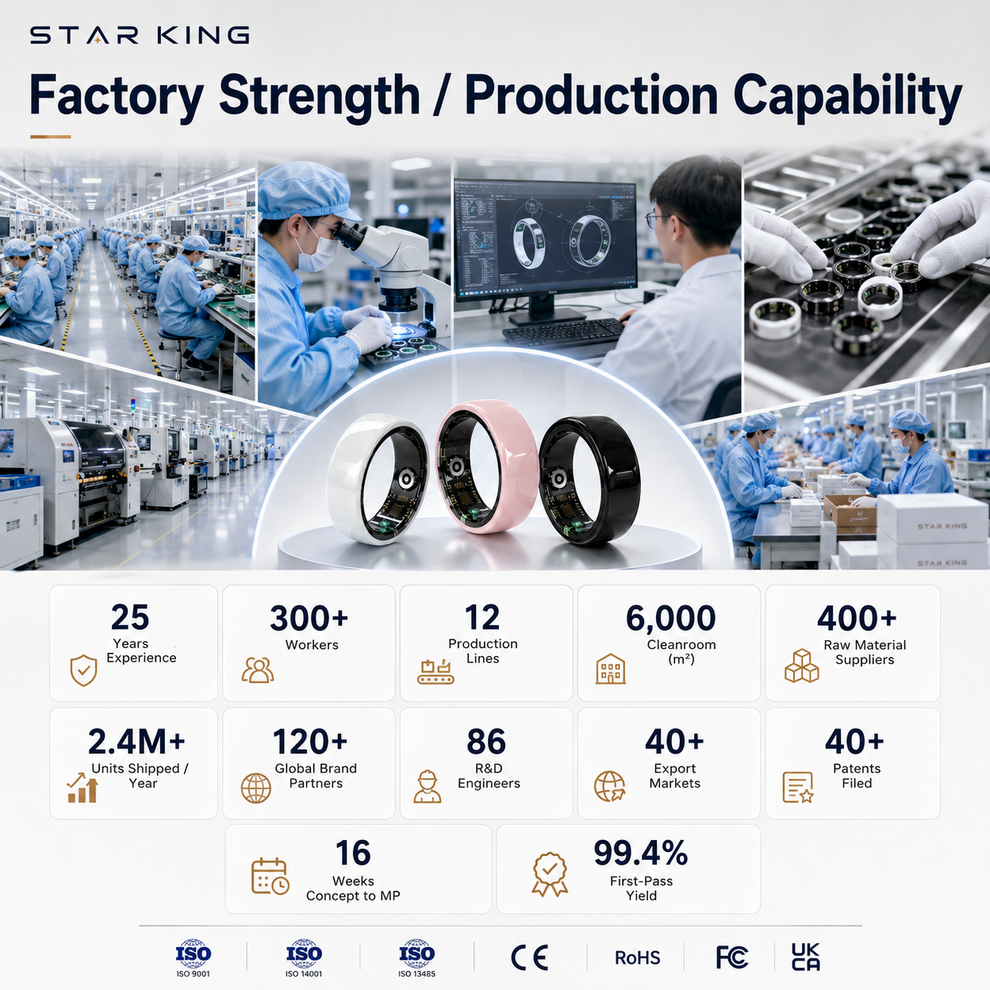
Sample validation is the most reliable way to assess a smart band supplier. Request samples from the actual production line, not engineering prototypes, and test battery life, charging reliability, app pairing stability, and strap durability. Ask for the supplier’s QC process, including incoming material inspection, in-process checks, aging testing, and pre-shipment inspection.
A credible supplier will share AQL levels, test records, and corrective action procedures. Corporate buyers should also confirm whether firmware updates can be pushed after deployment and whether defective units are replaced under warranty. Quality control documentation reduces the risk of mixed batches and field failures during a wellness program.
Check 7: After-Sales, Warranty, and Spare Parts
After-sales support determines the long-term success of a corporate wellness program. Clarify warranty length, what is covered, how returns are processed, and whether spare straps or chargers can be ordered separately. A smart band supplier that offers only limited after-sales support may increase total cost of ownership when devices fail mid-program.
Ask for a sample warranty clause and return authorization process. For EU deployments, consider whether the supplier can support local repair or replacement logistics. Written commitments on response times and spare-parts availability should be part of the supply agreement.
Soft CTA: If you are shortlisting suppliers for an EU wellness rollout, our team can walk you through customization options and help you map compliance documents to your procurement checklist.
Smart Band Supplier Comparison Table
| Evaluation Area | What to Compare | Low-Risk Signal | High-Risk Signal |
|---|---|---|---|
| Certification | CE/RED, RoHS, UN38.3 | Model-specific documents available | Generic certificates only |
| Data protection | GDPR DPA, hosting location | Clear data flow and export options | No DPA or unclear hosting |
| MOQ | Tiered pricing, pilot flexibility | Stock model for pilot phase | Single high MOQ only |
| Lead time | Sample and production timelines | Written schedule with milestones | Vague or verbal only |
| Quality | QC process, AQL, testing | Inspection reports and aging tests | No test documentation |
| After-sales | Warranty, spare parts, RMA | Defined RMA and response time | No written warranty terms |
Common Mistakes and Buyer Red Flags
Common Mistakes
- Approving a supplier based on a catalog price without verifying certification scope.
- Ignoring app data hosting and GDPR obligations until after contract signing.
- Ordering full volume before testing production-line samples.
- Assuming lead times without written confirmation.
- Overlooking spare-parts availability for long programs.
Buyer Red Flags
- Supplier cannot name the lab that issued test reports.
- Certification documents show a different model number than the quoted product.
- No clear data-processing agreement for the companion app.
- Pressure to pay full deposit before sample approval.
- No documented QC process or pre-shipment inspection option.
Practical Buyer Checklist
- ☐ Request EU Declaration of Conformity and RED test reports for the exact model.
- ☐ Verify UN38.3 and MSDS for battery transport.
- ☐ Review GDPR data-processing agreement and app data flow.
- ☐ Compare specifications against employee wellness use cases.
- ☐ Confirm MOQ tiers, sample lead time, and production lead time in writing.
- ☐ Test production-line samples for battery, pairing, and durability.
- ☐ Confirm warranty terms, RMA process, and spare-parts availability.
- ☐ Align delivery schedule with employee onboarding waves.
FAQ
Do smart bands for EU corporate wellness require CE marking?
Yes. Smart bands with Bluetooth or other radio functions fall under the Radio Equipment Directive and require CE marking. Buyers should verify model-specific test reports and a Declaration of Conformity.
What battery documents should a smart band supplier provide?
Typically UN38.3 test summaries, MSDS, and a battery safety test report. These are needed for air freight and courier acceptance.
How should procurement teams evaluate app data privacy?
Request a data flow diagram, data-processing agreement, and confirmation of hosting location. Ensure the app supports role-based access and data export if required by HR systems.
What MOQ is typical for customized smart bands?
MOQ varies by customization level and typically ranges from several hundred to a few thousand units. Ask for tiered pricing and pilot-phase options.
How long does production take after sample approval?
Production lead time is commonly 25–45 days depending on order volume and customization. Confirm in writing and plan against program launch dates.
Can smart bands be branded for a corporate wellness program?
Many suppliers offer logo and packaging customization. Confirm scope, MOQ impact, and whether firmware or app branding is included.
Conclusion
Selecting a smart band supplier for an EU corporate wellness program is a compliance and commercial decision, not just a hardware purchase. By checking certification, battery documentation, data protection, specifications, MOQ and lead time, quality control, and after-sales support, procurement teams can reduce risk and build a program that scales. Use the checklist and comparison table above to structure supplier conversations and compare responses objectively.
STAR KING CTA
Ready to shortlist smart band suppliers for your EU wellness program? Contact our sales team to request product samples, confirm certification requirements for your target markets, and discuss OEM/ODM customization options.
Discuss Your Smart Wearable OEM/ODM Project
Planning a smart ring, smart watch, smart band, AI glasses, AI translator, or AI voice mouse project? Contact STAR KING to discuss product positioning, sample testing, customization scope, certification requirements, lead time, and quotation details.

Team Star King

Scan WhatsApp QR code
Leave a Reply