
Smart Ring OEM Guide 2026: 7 Steps for Private-Label Brands to Evaluate Suppliers
November 4, 2026 · Team Star King
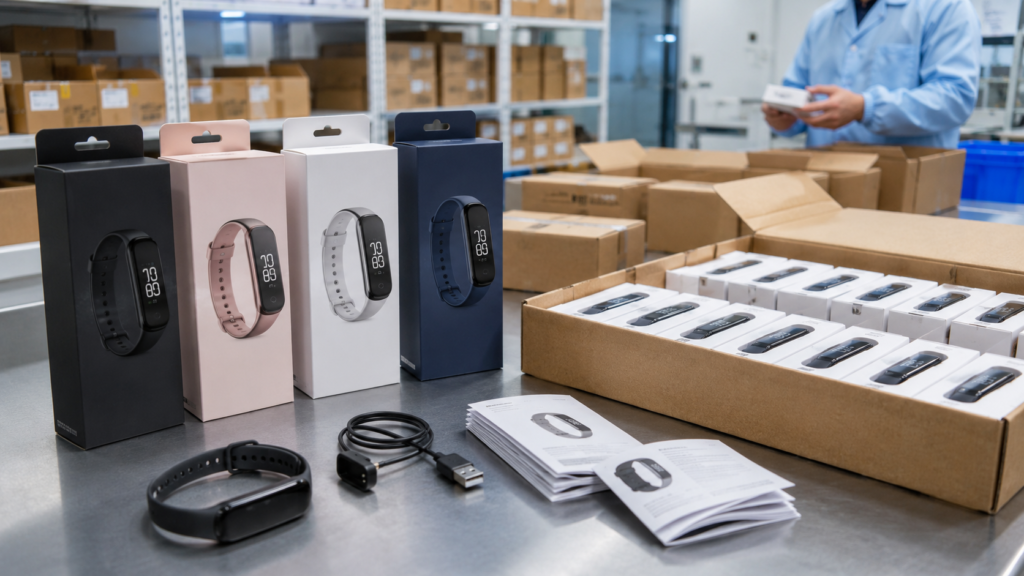
Smart Ring OEM Guide 2026: 7 Steps for Private-Label Brands to Evaluate Suppliers
Short Answer
A smart ring OEM partner designs and manufactures wearable rings that you sell under your own brand. For private-label brands, the fastest route to market is usually to select a proven ring platform, customize the exterior, packaging, firmware and app, then validate samples and certification requirements before committing to mass production. The 7-step evaluation below helps you compare suppliers on capability, compliance, MOQ, cost and supply-chain reliability.
Table of Contents
Table of Contents

Introduction
Smart rings are moving from novelty to a credible wearable category, and private-label brands are asking a practical question: how do I find a smart ring OEM partner that can deliver a sellable product without exposing my brand to quality or compliance risk? This guide answers that question in concrete procurement terms. It is written for brand owners, importers and e-commerce sellers who need a repeatable way to evaluate smart ring manufacturers, not a sales brochure. You will see how to shortlist suppliers, what to test in samples, how MOQ and cost interact, which certifications typically matter, and where buyers most often lose time or money. Each step includes a buyer-focused action you can apply in your next supplier conversation.
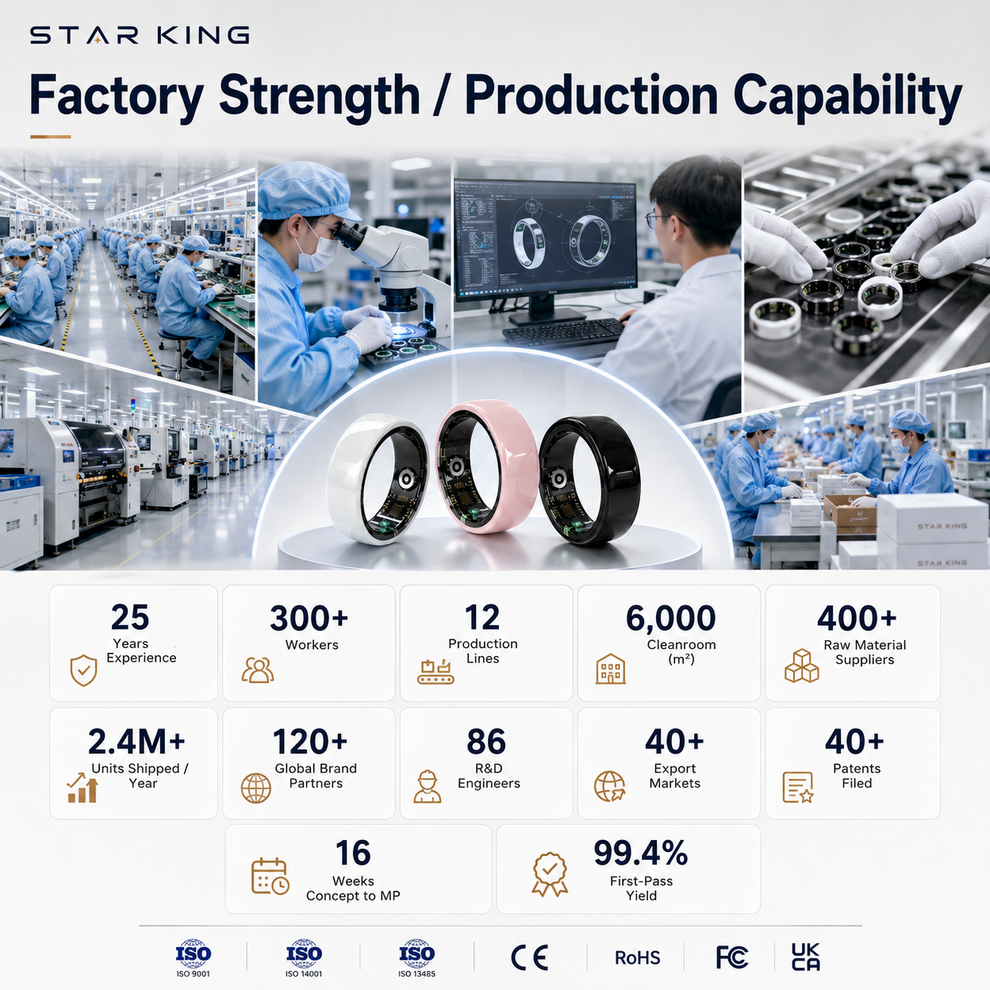
Table of Contents
- What Is Smart Ring OEM and Why It Matters for Private-Label Brands
- Step 1: Define the Product Brief and Target Market
- Step 2: Shortlist Smart Ring OEM Suppliers
- Step 3: Choose Between Proven Platform and Full Custom Development
- Step 4: Request Samples and Run a Structured Validation
- Step 5: Confirm Certification and Target-Market Compliance
- Step 6: Compare MOQ, Pricing and Supply-Chain Terms
- Step 7: Plan Branding, Packaging and Mass Production
- Key Facts for Buyers
- Common Mistakes and Buyer Red Flags
- Practical Buyer Checklist
- FAQ
- Conclusion
Key Takeaways
- Smart ring OEM is a manufacturing and customization model in which a factory builds rings to your brand specification; it is different from simply reselling a finished product.
- Most private-label brands should start from a proven ring platform and customize design, packaging, app branding and select firmware features rather than fund a ground-up industrial design from day one.
- Sample testing, certification planning and MOQ negotiation should happen before you sign a purchase order, not after.
- Certification requirements such as CE, FCC, RoHS, UN38.3 and battery documentation depend on the product configuration and the destination market; buyers should verify current requirements with the supplier and, where needed, an accredited lab.
- A supplier scorecard that weights quality systems, communication, sample performance and compliance evidence will filter out most high-risk partners early.
What Is Smart Ring OEM and Why It Matters for Private-Label Brands
Smart ring OEM means an original equipment manufacturer builds smart rings to your brand’s specification. In practice, the OEM supplies the hardware platform, sensor stack, battery, firmware and companion app, while the brand controls the product positioning, exterior finish, packaging, app identity and go-to-market. A closely related model, ODM (original design manufacturer), means the factory owns more of the design and offers a configurable platform that multiple brands can adapt. For most private-label brands entering the category, ODM-style platform customization is the faster and lower-risk path; full OEM development is appropriate when you need a differentiated form factor or proprietary features.
The distinction matters because it changes your cost structure, timeline and risk profile. A platform-based approach usually shortens development and reduces tooling spend, but it may limit how far you can differentiate. A full custom program gives you more control but requires deeper investment in industrial design, tooling, firmware and validation. This guide focuses on the evaluation steps that apply to both, with emphasis on the platform route that most private-label brands actually use. For a broader view of how STARK KING structures private-label wearable programs, see the Private Label OEM/ODM solution page.
[Image suggestion: smart ring OEM production line | alt: smart ring OEM assembly line for private-label brands | placement: after this section]
Step 1: Define the Product Brief and Target Market
Before you contact suppliers, write a one-page product brief. It should state the target market, the use case, the features you consider essential, the price band you want to sell at, and the sales channels you plan to use. This brief becomes the basis for supplier comparison and prevents you from evaluating quotes that solve different problems.
What to include in the brief
- Target market and regulatory region: for example, EU, US, UK, Australia or multiple regions. This drives certification planning.
- Core features: sleep tracking, heart rate monitoring, blood oxygen monitoring, activity tracking, or app notifications. Be explicit about which are must-haves versus nice-to-haves.
- Form factor: ring size range, material (for example titanium or stainless steel), finish and color options.
- App requirements: white-label app, custom app, or integration with an existing app. App customization affects cost and timeline.
- Commercial targets: expected first-order quantity, target retail price and margin structure.
- Packaging and branding: logo placement, packaging style, language requirements and accessory kit.
A clear brief also helps you ask better questions. For example, if you need blood oxygen monitoring for a wellness use case, you can ask the supplier how the feature is implemented and what disclaimers are appropriate, rather than assuming it is a medical measurement. Consumer wearable health features should be positioned as wellness and lifestyle tools, not diagnostic devices, unless the product has the appropriate regulatory clearance.
Step 2: Shortlist Smart Ring OEM Suppliers
Supplier shortlisting is where most sourcing risk is created or avoided. Start with a structured list of candidate manufacturers and score them against criteria that matter for a private-label wearable program. Avoid selecting a supplier solely on the lowest quote; the cost of a failed launch is far higher than a small unit-price difference.
Supplier evaluation scorecard
| Criterion | What to verify | Why it matters |
|---|---|---|
| Wearable experience | Existing smart ring or wearable programs, references, product portfolio | Reduces development risk and improves realistic timelines |
| Manufacturing scope | In-house assembly, testing and packaging versus outsourced steps | Affects quality control and accountability |
| Quality system | Documented incoming, in-process and final inspection; testing records | Protects brand reputation and reduces returns |
| Compliance support | Ability to provide test reports, battery documentation and certification guidance | Needed for customs clearance and marketplace listing |
| Customization capability | Logo, packaging, app branding, firmware feature requests | Determines how differentiated your product can be |
| Communication | Response time, English documentation, sample turnaround | Predicts how the mass-production phase will go |
| Commercial terms | MOQ, sample cost, payment terms, lead time, warranty | Shapes cash flow and launch planning |
Use the scorecard in your first supplier conversations and ask for evidence, not just answers. For example, request sample test reports, packaging artwork files and a clear statement of which certification documents the supplier can support for your target markets. Where a supplier cannot provide a document, ask how it will be obtained and by whom.
For brands also considering adjacent categories, it is useful to compare how suppliers handle other wearable formats. A manufacturer that already supports smart watches or smart bands often has more mature app and firmware processes than a ring-only supplier.
Step 3: Choose Between Proven Platform and Full Custom Development
This is the most consequential early decision for a private-label brand. A proven platform shortens time to market and lowers upfront cost, while full custom development offers differentiation at higher cost and risk. The table below summarizes the trade-offs.
Platform versus full custom development
| Factor | Proven platform | Full custom development |
|---|---|---|
| Time to market | Typically faster, as core hardware and app already exist | Longer, with design, tooling and validation phases |
| Upfront investment | Lower; mainly customization and branding | Higher; industrial design, tooling, firmware and testing |
| Differentiation | Moderate; exterior, packaging, app and select features | High; proprietary form factor and features possible |
| Risk | Lower; platform has field history | Higher; unproven design and schedule uncertainty |
| Best for | New brands, first wearable launch, test-the-market strategies | Established brands with proven demand and clear differentiation |
Ask the supplier to describe its standard ring platform and the customization options available. Clarify what can be changed at the app level (branding, onboarding, dashboard layout) and what requires firmware work. If firmware customization is offered, ask how changes are tested and how software updates are delivered after launch. For brands planning a broader wearable roadmap, the smart rings product page is a useful baseline for comparing platform specifications.
Step 4: Request Samples and Run a Structured Validation
Samples are your main opportunity to validate a supplier before committing to volume. Treat sample evaluation as a formal step with defined tests and pass/fail criteria. Do not rely on a single sample; request multiple units and, where possible, multiple ring sizes.
Sample validation areas
- Fit and comfort: test ring sizes across your target users; a poor fit leads to returns.
- Battery life: measure real-world usage against the supplier’s stated figures.
- Sensor performance: compare heart rate, blood oxygen and sleep tracking readings across samples for consistency; treat results as wellness indicators, not clinical measurements.
- App experience: check pairing, data sync, onboarding and branding options.
- Build quality: inspect finish, water resistance claims and durability under normal use.
- Packaging: review retail readiness, print quality and language accuracy.
If your product will be sold in markets with specific requirements, ask the supplier for battery test documentation such as UN38.3 and a safety data sheet (MSDS) where applicable. These documents are commonly requested for lithium battery products in air freight and customs processes; the exact requirement depends on the product and the carrier. For general guidance on lithium battery transport requirements, see the IATA Dangerous Goods Regulations.
Document your sample results in a simple scorecard. This gives you a defensible basis for supplier selection and a baseline for comparing production units later.
[Image suggestion: smart ring sample testing | alt: smart ring OEM sample validation for private-label brands | placement: inside this section]
Step 5: Confirm Certification and Target-Market Compliance
Certification is a frequent source of delay for wearable brands. The right approach is to plan it early and confirm responsibility in writing. Requirements vary by product configuration, radio modules, battery and destination market, so buyers should verify current requirements with the supplier and, where appropriate, an accredited testing laboratory.
Certification checklist areas
| Area | Typical documents to discuss | Notes for buyers |
|---|---|---|
| Radio and EMC | CE (EU), FCC (US) and equivalent national requirements | Bluetooth-enabled rings typically fall under radio equipment rules; confirm scope with the lab |
| Hazardous substances | RoHS, REACH and similar declarations | Request current declarations and confirm they cover the exact materials used |
| Battery safety and transport | UN38.3 test summary, MSDS, battery specification | Commonly requested for lithium battery air shipments; requirements depend on carrier and route |
| Marketplace requirements | Product listing documentation and labeling | E-commerce platforms may request additional documents; check platform policy |
| Health and wellness claims | Labeling and marketing language review | Avoid medical claims unless the product has appropriate clearance |
Ask the supplier which certifications are already held for the specific platform and which would need to be obtained for your brand and market. Clarify who holds the certificate, who pays for testing, and how the certificate is transferred or referenced if you sell under your own brand. For Bluetooth-enabled products, it is also worth reviewing the Bluetooth SIG qualification process to understand declaration requirements.
If you sell in multiple regions, build a compliance matrix that maps each market to its required documents. This avoids the common problem of launching in one market and discovering later that another market needs additional testing.
Step 6: Compare MOQ, Pricing and Supply-Chain Terms
Commercial terms should be compared on a like-for-like basis. Pricing is influenced by ring material, sensor configuration, app customization, packaging and order quantity. MOQ is often negotiable for platform-based products but may be fixed for custom tooling. Ask each supplier to itemize the quote so you can see what drives cost.
Commercial comparison table
| Term | Questions to ask | What good looks like |
|---|---|---|
| MOQ | What is the MOQ per SKU, color and size? Is it negotiable for a first order? | Clear MOQ tiers with a realistic trial-order option |
| Unit price | What is included: ring, charger, cable, packaging, manual? | Itemized pricing with assumptions stated |
| Sample cost | Is the sample fee refundable against a bulk order? | Transparent sample policy |
| Tooling and setup | Are there one-time costs for logo, packaging or firmware changes? | Written quotation with ownership terms |
| Lead time | What is the production lead time after sample approval and deposit? | Realistic schedule with buffer for testing |
| Payment terms | Deposit and balance terms; accepted payment methods | Terms that match your cash flow |
| Warranty and spares | Warranty period, defect handling and spare-parts availability | Written after-sales policy |
Pay attention to landed cost, not just unit price. Freight, duties, certification and packaging can change the economics of a launch. If you are new to importing wearables, the STAR KING blog resources include sourcing and market-entry articles that can help you build a more complete cost model.
At this stage, a soft CTA is appropriate: if you have a target specification and volume range, sharing it with a supplier early usually produces a more accurate quotation and a clearer view of customization options.
Step 7: Plan Branding, Packaging and Mass Production
Once the supplier and platform are selected, the project moves into branding and production planning. This phase determines how the product looks and feels to your customer, and how smoothly the first production run goes. Define the branding elements early: logo placement on the ring and charger, packaging structure, insert cards, manual language and app identity.
Branding and production checklist
- Approve final artwork and packaging proofs before tooling or printing.
- Confirm logo application method and durability testing.
- Review the production schedule against your launch date and allow time for pre-shipment inspection.
- Agree on quality control checkpoints and who conducts pre-shipment inspection.
- Confirm documentation package for each destination market.
- Plan spare units and warranty handling before the first shipment.
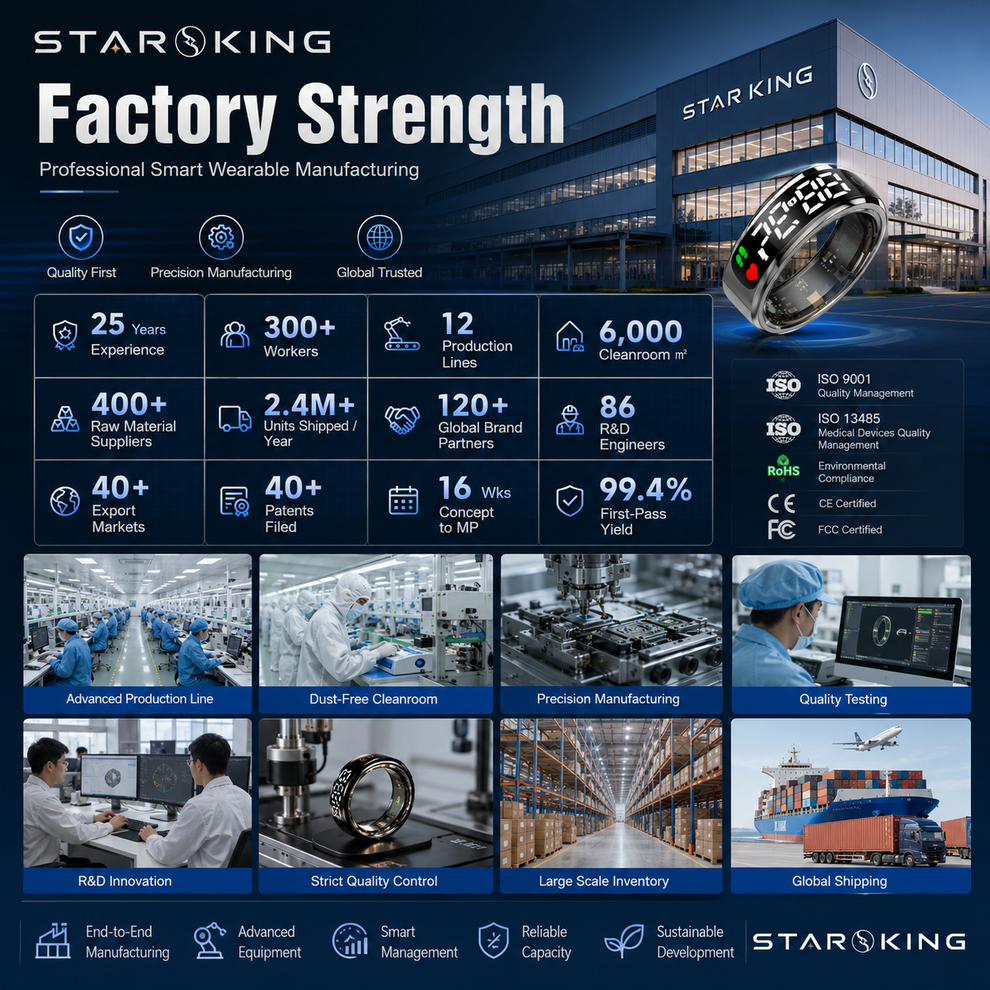
Mass production should include documented quality control at incoming, in-process and final stages. Ask the supplier how defects are handled, how rework is controlled and what records are kept. A supplier that can describe its process clearly is usually easier to work with during scale-up.
[Image suggestion: private-label smart ring packaging | alt: custom smart ring OEM packaging for private-label brands | placement: after this section]
Key Facts for Buyers
| Topic | Key fact for private-label brands |
|---|---|
| OEM vs ODM | OEM is built to your specification; ODM is a configurable platform owned by the factory. Most first-time brands start with ODM-style platform customization. |
| Typical starting point | A proven ring platform with custom exterior, packaging and app branding is usually the fastest route to market. |
| Sample validation | Test multiple units and sizes for fit, battery life, sensor consistency and app experience before committing to volume. |
| Certification | CE, FCC, RoHS, UN38.3 and MSDS requirements depend on product configuration, radio modules and destination market; verify with the supplier and an accredited lab. |
| MOQ and pricing | MOQ and unit price vary with material, customization and quantity; request itemized quotes and compare landed cost. |
| Lead time | Production lead time starts after sample approval and deposit; allow time for testing, packaging and pre-shipment inspection. |
| Health features | Consumer smart ring features are wellness tools, not diagnostic devices, unless the product has appropriate regulatory clearance. |
Common Mistakes and Buyer Red Flags
Most problems in a smart ring OEM project are predictable. The list below covers the mistakes buyers make most often and the supplier behaviors that should prompt additional checks.
Common buyer mistakes
- Selecting a supplier on unit price alone without comparing landed cost and quality evidence.
- Skipping structured sample validation and relying on a single demonstration unit.
- Assuming certification is included without written confirmation of scope, ownership and cost.
- Underestimating app customization and integration time.
- Failing to define warranty and spare-parts terms before mass production.
- Using medical-style marketing language for wellness features.
Buyer red flags
- Vague or evasive answers about testing records or certification documentation.
- Quotes that are not itemized and change significantly between conversations.
- No clear process for sample approval, pre-shipment inspection or defect handling.
- Pressure to place a large first order before samples are validated.
- Reluctance to discuss tooling ownership, firmware updates or app support after launch.
Practical Buyer Checklist
Use this checklist to structure supplier conversations and internal sign-off. It is designed for a first or second smart ring OEM project and can be adapted for larger programs.
- Written product brief with target market, features and commercial targets.
- Supplier scorecard completed for at least three candidates.
- Platform versus custom development decision documented.
- Multiple samples tested across sizes with recorded results.
- Certification matrix mapped to each destination market.
- Written quotation with MOQ, unit price, tooling, sample cost and payment terms.
- Lead time and pre-shipment inspection plan agreed.
- Packaging and branding proofs approved before production.
- Warranty, defect handling and spare-parts terms confirmed in writing.
- After-sales and app support responsibilities defined.
FAQ
What does a smart ring OEM supplier actually provide?
A smart ring OEM supplier typically provides the hardware platform, sensor and battery components, firmware, companion app and manufacturing. The brand provides the specification, branding and go-to-market. Customization scope varies by supplier and should be confirmed in writing.
What MOQ should a private-label brand expect for smart rings?
MOQ depends on the platform, customization and packaging. Platform-based projects often start lower than full custom tooling projects. Ask for MOQ tiers and clarify whether a trial order is possible before committing to volume.
Which certifications are needed for smart rings?
Requirements depend on the product configuration, radio modules, battery and destination market. Common areas include CE for the EU, FCC for the US, RoHS for hazardous substances, and UN38.3 and MSDS for lithium battery transport. Buyers should verify current requirements with the supplier and an accredited lab.
Can I customize the app for my brand?
Many suppliers offer app branding such as logo, colors and onboarding screens. Deeper changes to features or data handling may require firmware and app development, which affects cost and timeline. Clarify what is included in the quotation.
How long does smart ring OEM development take?
Timelines vary with customization. A platform-based project with branding and packaging changes is usually faster than a full custom development. Production lead time typically starts after sample approval and deposit; ask for a written schedule with testing and inspection milestones.
Are smart ring health features medical devices?
Consumer smart ring features such as heart rate, blood oxygen and sleep tracking are generally wellness and lifestyle tools, not diagnostic devices. Medical claims may require regulatory clearance. Position and label features accurately for your market.
Who owns the tooling and molds?
Tooling ownership depends on the agreement. If you fund custom tooling, confirm ownership and transfer terms in writing. For platform-based projects, the supplier typically owns the platform tooling while you own your brand assets.
Conclusion
Evaluating a smart ring OEM partner is a procurement discipline, not a single conversation. The 7 steps in this guide give private-label brands a repeatable way to define the product, shortlist suppliers, choose the right development model, validate samples, plan compliance, compare commercial terms and prepare for mass production. The brands that move fastest are usually the ones that ask for evidence early, test samples thoroughly and document every commercial and compliance assumption before committing to volume. If you are planning a smart ring launch, the next step is to prepare your brief and request samples from a shortlist of suppliers.
Start Your Smart Ring OEM Project
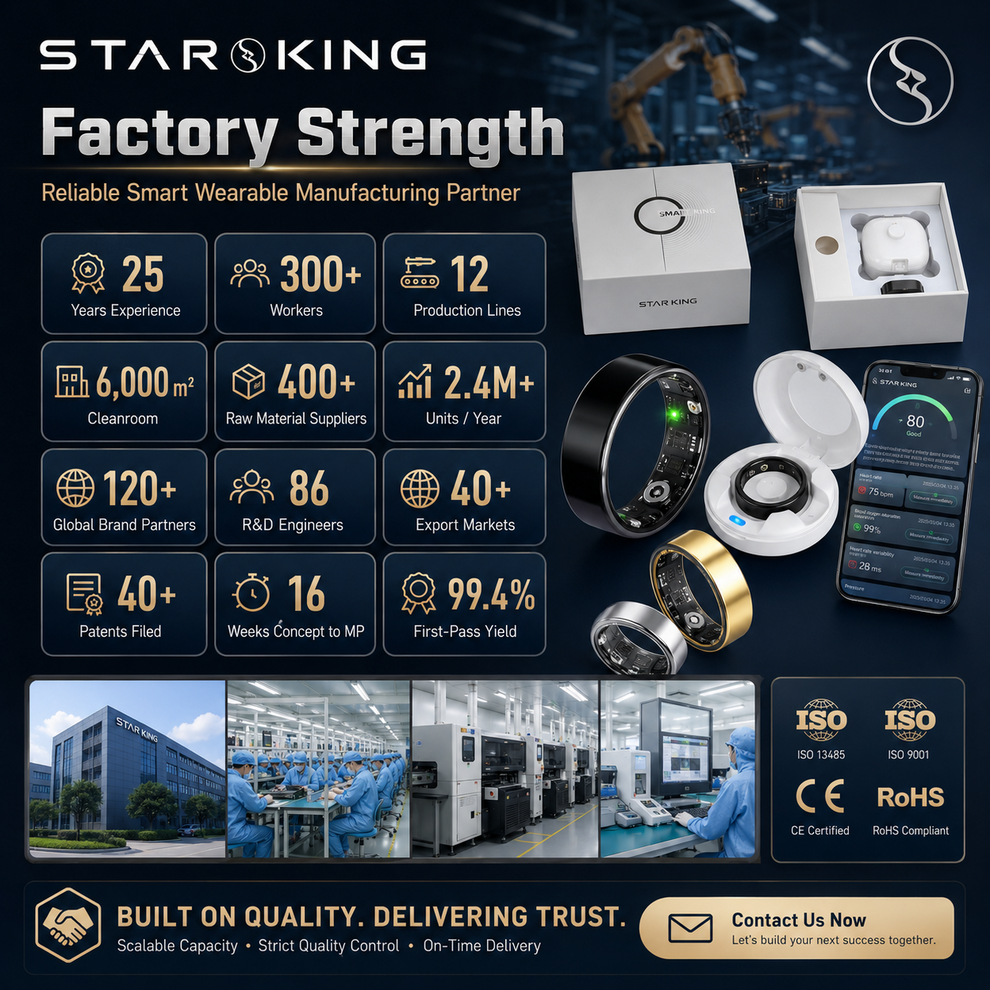
STAR KING supports private-label brands with smart ring platform customization, packaging and branding, sample development and OEM/ODM program planning. To move forward, request product samples and share your target specification so we can confirm customization options and certification requirements for your market.
Discuss Your Smart Wearable OEM/ODM Project
Planning a smart ring, smart watch, smart band, AI glasses, AI translator, or AI voice mouse project? Contact STAR KING to discuss product positioning, sample testing, customization scope, certification requirements, lead time, and quotation details.

Team Star King

Scan WhatsApp QR code
Leave a Reply