
smart ring OEM: 7 Crucial Smart Ring OEM Checks for E-commerce Sellers: A 2026 Sourcing Guide
October 29, 2026 · Team Star King

7 Crucial Smart Ring OEM Checks for E-commerce Sellers: A 2026 Sourcing Guide
Sourcing a smart ring OEM partner is a critical decision for e-commerce sellers entering the wearable market. This guide outlines seven essential checks—from verifying manufacturing capabilities to confirming app integration and certification—that separate reliable suppliers from risky ones. By following these steps, you can avoid costly delays, ensure product quality, and build a brand that customers trust.
Table of Contents
Table of Contents
smart ring OEM: Table of Contents
- Short Answer
- Key Takeaways
- Key Facts for Buyers
- 1. Verify Manufacturing Capabilities
- 2. Evaluate Product Specifications and Features
- 3. Assess App and Firmware Integration
- 4. Understand MOQ and Pricing Factors
- 5. Confirm Certifications and Compliance
- 6. Review Quality Control Processes
- 7. Plan Lead Times and Production Schedules
- Common Mistakes and Buyer Red Flags
- Practical Buyer Checklist
- FAQ
- Conclusion
Short Answer
The most critical smart ring OEM checks for e-commerce sellers are: 1) verifying the supplier’s manufacturing and customization capabilities, 2) confirming product specifications and app integration, 3) understanding MOQ and pricing structures, 4) ensuring certifications for target markets, 5) reviewing quality control processes, and 6) planning realistic lead times. Prioritize suppliers who provide transparent documentation and sample testing before committing to bulk orders.
Key Takeaways
- Always request samples to test hardware and app functionality before placing a bulk order.
- Clarify MOQ, tooling costs, and customization options (logo, packaging, firmware) upfront.
- Verify certifications such as CE, FCC, RoHS, and UN38.3 for your target markets.
- Assess the supplier’s quality control processes, including pre-shipment inspection.
- Plan for lead times that account for production, testing, and shipping.

Key Facts for Buyers
| Factor | Typical Range / Consideration |
|---|---|
| MOQ | 500–1,000 units for custom designs; lower for stock models |
| Tooling Lead Time | 2–4 weeks after design approval |
| Production Lead Time | 4–6 weeks after sample approval and deposit |
| Certifications | CE, FCC, RoHS, UN38.3 (may vary by product and market) |
| App Customization | Logo and color changes typically possible; full app rebranding may require additional fees |
| Battery Life | 3–7 days depending on usage and sensor configuration |
| Water Resistance | IP67 or IP68 common; confirm with supplier |

1. Verify Manufacturing Capabilities
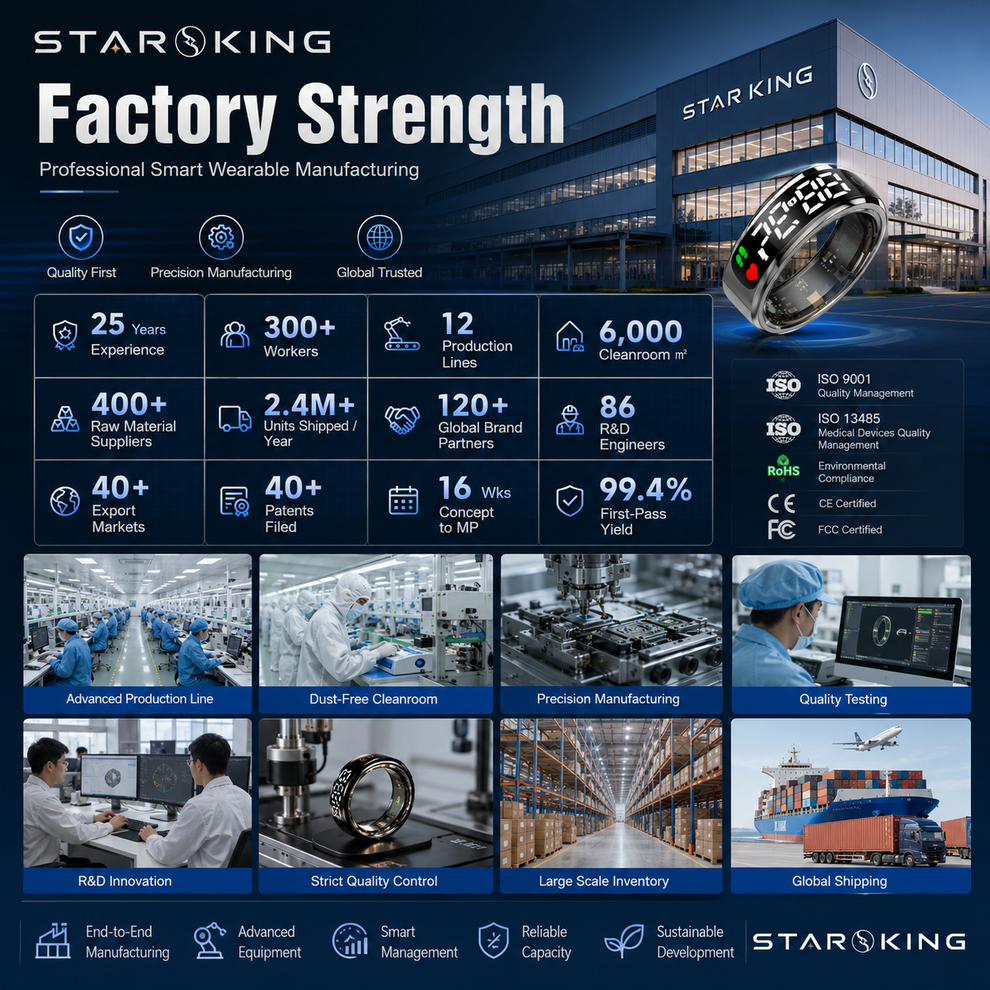
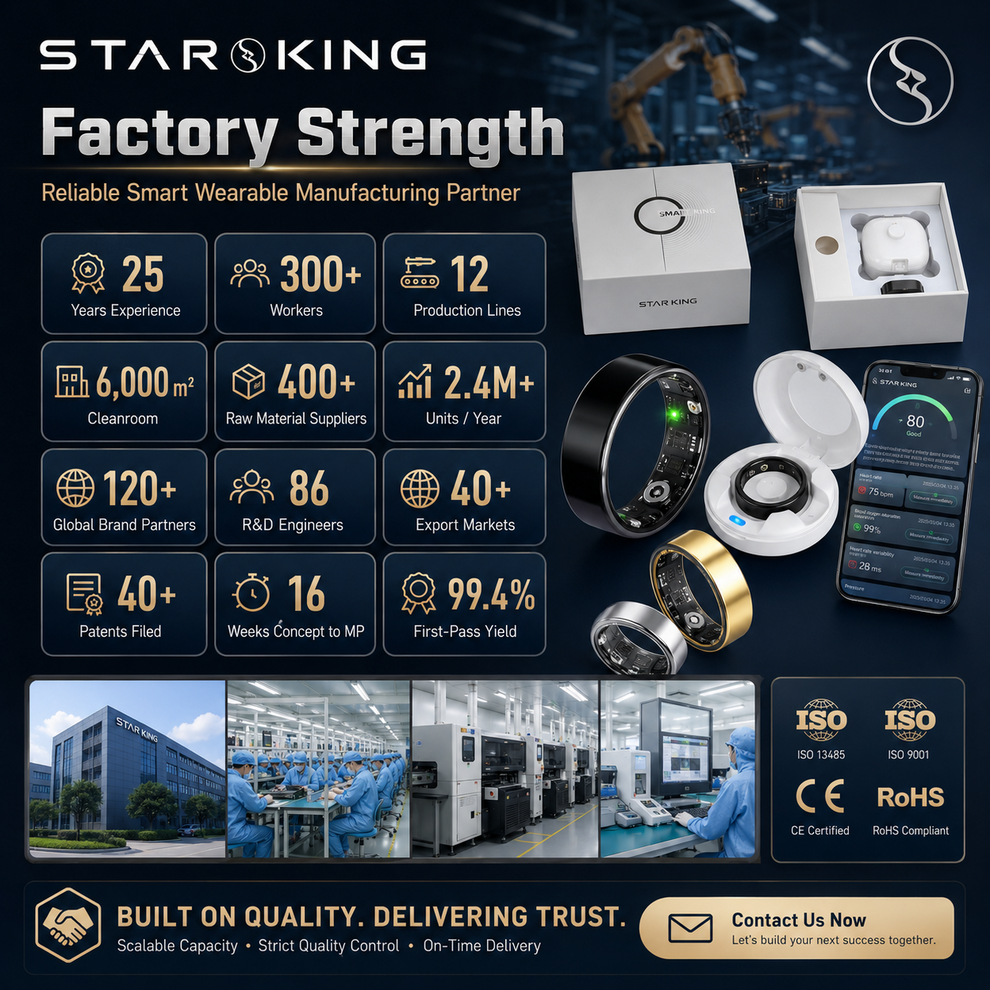
Before discussing specifications, confirm that your potential smart ring OEM partner has the necessary manufacturing capabilities. This goes beyond a factory tour; ask for evidence of in-house production for critical components such as sensors, batteries, and PCBA assembly. A supplier that outsources key modules may have less control over quality and lead times.
Request documentation on their production lines, testing equipment, and capacity. For STAR KING, specific details about factory size and production lines are available upon request. [STAR KING TO CONFIRM]
Additionally, inquire about their experience with smart rings specifically. Wearable technology requires expertise in miniaturization and sensor integration. A supplier with a portfolio of similar products is more likely to deliver a reliable product.
2. Evaluate Product Specifications and Features
Smart rings vary widely in specs. Key features to evaluate include:
- Health sensors: Heart rate, blood oxygen (SpO2), skin temperature, and sleep tracking. Confirm the sensor types and accuracy claims.
- Battery life: Typical usage ranges from 3 to 7 days. Ask for real-world testing data.
- Water resistance: IP67 or IP68 ratings are common; verify the rating and test reports.
- Connectivity: Bluetooth 5.0 or later for reliable syncing.
- Materials: Titanium or stainless steel for durability; ensure biocompatibility.
Request a sample to test these features yourself. Pay attention to app connectivity and data accuracy under different conditions.
3. Assess App and Firmware Integration
The companion app is a critical part of the user experience. For e-commerce sellers, a branded app can enhance customer loyalty, but customization options vary. Ask the supplier:
- Can the app be rebranded with your logo and color scheme?
- Is the source code available for custom development? (This often requires additional fees and a development agreement.)
- Does the app support multiple languages for your target markets?
- Is there an API for integration with third-party platforms?
Test the app’s stability, user interface, and data synchronization during the sample phase. A poorly designed app can lead to negative reviews and returns.
For private label solutions, STAR KING offers app customization options. Explore private label OEM/ODM solutions.
4. Understand MOQ and Pricing Factors
MOQ (Minimum Order Quantity) and pricing are often negotiable but depend on customization. Standard models may have lower MOQs (e.g., 500 units), while custom designs with tooling may require 1,000 units or more. Factors affecting price include:
- Order volume
- Level of customization (logo, packaging, firmware)
- Material choices (e.g., titanium vs. plastic)
- Sensor configuration
- Certification requirements
Always request a detailed quotation that breaks down costs for tooling, samples, production, and certification. Be wary of quotes that seem too low; they may indicate hidden costs or lower quality components.
5. Confirm Certifications and Compliance
Certifications are non-negotiable for selling in regulated markets. Common requirements include:
- CE: Required for the European Union.
- FCC: Required for the United States.
- RoHS: Restricts hazardous substances.
- UN38.3: Required for lithium battery shipping.
- MSDS: For battery safety documentation.
Ask the supplier to provide copies of certificates for the specific product you plan to order. Certifications are product-specific and may require updates for custom designs. Verify with official sources such as the FCC or EU CE marking.
Note that certification requirements vary by market and product configuration. Buyers should confirm with a compliance specialist.
6. Review Quality Control Processes
A robust quality control (QC) system reduces defect rates and returns. Ask about:
- Incoming material inspection
- In-process quality checks
- Final product testing (functionality, battery, waterproof)
- Pre-shipment inspection (PSI) and AQL sampling
- Aging tests and drop tests
Request QC reports from recent production runs. If possible, arrange a third-party inspection before shipment. STAR KING’s QC processes can be detailed during supplier evaluation. [STAR KING TO CONFIRM]
7. Plan Lead Times and Production Schedules
Lead times impact your inventory planning and cash flow. Typical milestones include:
- Sample development: 1–2 weeks
- Tooling: 2–4 weeks
- Production: 4–6 weeks
- Shipping: 3–5 weeks depending on method
Discuss a realistic timeline with your supplier and factor in potential delays. For e-commerce sellers, aligning production with peak seasons (e.g., Q4) is critical.
Common Mistakes and Buyer Red Flags
- Skipping samples: Never order bulk without testing a sample.
- Ignoring app quality: A bad app can ruin the user experience.
- Assuming certifications are included: They often cost extra.
- Not clarifying MOQ: Hidden costs can arise later.
- Choosing a supplier without wearable experience: Smart rings require specialized expertise.
Red flags: Vague answers, reluctance to provide certificates, no references, and prices significantly lower than market average.
Practical Buyer Checklist
| Item | Checked |
|---|---|
| Supplier has proven smart ring manufacturing experience | ☐ |
| Sample tested for hardware and app functionality | ☐ |
| App customization options confirmed | ☐ |
| MOQ and pricing structure understood | ☐ |
| Certifications provided for target markets | ☐ |
| QC processes reviewed | ☐ |
| Lead times and production schedule agreed | ☐ |
FAQ
What is the typical MOQ for a custom smart ring?
MOQs for custom smart rings typically range from 500 to 1,000 units, depending on the level of customization and supplier. Standard models may have lower MOQs.
How long does it take to get a sample?
Sample lead time is usually 1–2 weeks after design approval, plus shipping time.
Are certifications included in the price?
Not always. Certification costs may be separate, especially for custom designs. Clarify with the supplier.
Can I customize the app for my brand?
Many suppliers offer app rebranding (logo, colors) for a fee. Full app customization with source code access is more complex and costly.
What is the typical battery life of a smart ring?
Battery life varies from 3 to 7 days, depending on usage and sensor configuration.
How do I verify a supplier’s quality control?
Request QC reports, arrange a third-party inspection, and ask for references from other e-commerce sellers.
What shipping documents are required for smart rings with lithium batteries?
You will need UN38.3 test reports, MSDS, and possibly a battery statement for air shipping. Confirm with your freight forwarder.
Conclusion
Choosing the right smart ring OEM partner is a process that requires diligence and clear communication. By following these seven checks, e-commerce sellers can mitigate risks and build a successful wearable brand. Remember to start with samples, verify certifications, and plan for realistic lead times. For a reliable smart ring OEM manufacturer, consider STAR KING’s smart ring product line and OEM/ODM services.
Ready to start your smart ring project? Request samples and discuss your OEM requirements with our team.
Discuss Your Smart Wearable OEM/ODM Project
Planning a smart ring, smart watch, smart band, AI glasses, AI translator, or AI voice mouse project? Contact STAR KING to discuss product positioning, sample testing, customization scope, certification requirements, lead time, and quotation details.

Team Star King

Scan WhatsApp QR code
Leave a Reply