
Smart Ring OEM for Startup Brands: 7 Decisions Before You Commit to a Factory in 2026
October 24, 2026 · Team Star King

Smart Ring OEM for Startup Brands: 7 Decisions Before You Commit to a Factory in 2026
Choosing a smart ring OEM partner is the first commercial decision a startup brand makes that is hard to reverse. It sets your MOQ, your unit cost, your certification path, your app roadmap, and how quickly you can restock after launch. This smart ring OEM guide walks startup brands through seven decisions to settle before signing anything, so you compare factories on evidence rather than price alone.
Table of Contents
Table of Contents
Direct Answer
A smart ring OEM project usually begins with a reference design or semi-custom platform, a defined sensor set (heart rate, blood oxygen, temperature, accelerometer), and a companion app. Startup brands should confirm MOQ, tooling ownership, firmware and app customization scope, test evidence, target-market certifications, and lead time before committing. Early-stage buyers should expect to start with a sample order, then a pilot batch, then mass production.
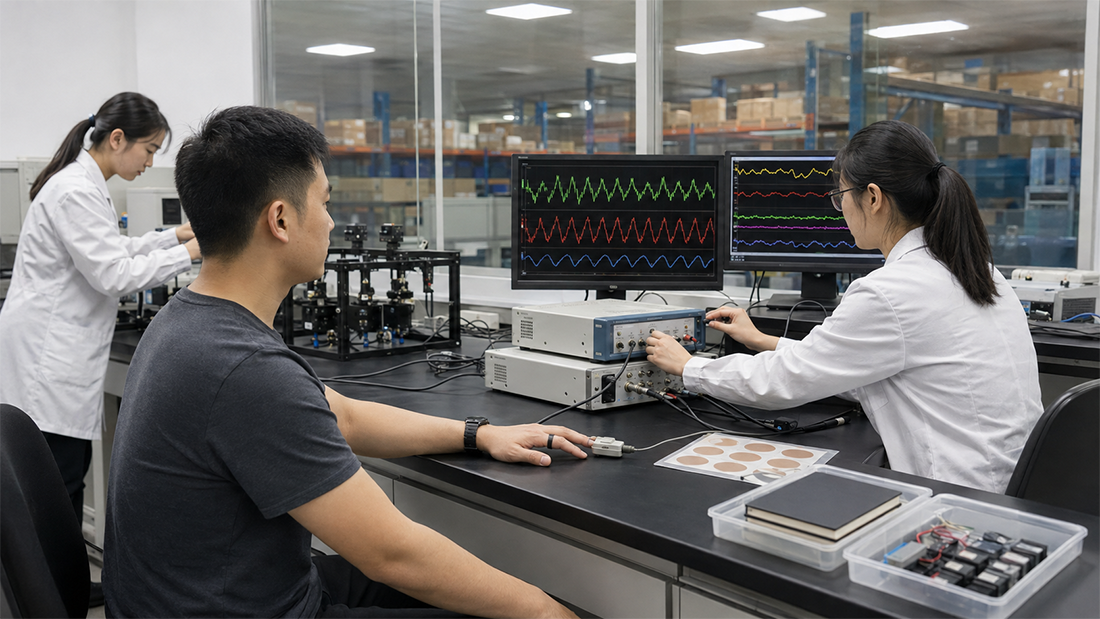
Table of Contents
- Decision 1: Buy vs. Build — Which Smart Ring OEM Model Fits You
- Decision 2: Platform and Sensor Set
- Decision 3: MOQ, Pricing, and the Real Cost Per Unit
- Decision 4: Sample Testing and Validation
- Decision 5: Firmware, App, and Data Handling
- Decision 6: Certification and Target-Market Compliance
- Decision 7: Lead Time, Tooling Ownership, and After-Sales
- Key Facts for Buyers
- Common Mistakes and Buyer Red Flags
- Practical Buyer Checklist
- FAQ
- Conclusion
Key Takeaways
- Most startup smart ring projects should begin with an existing platform, not a fully custom design.
- MOQ and unit price depend on the sensor set, enclosure material, app scope, packaging, and target market.
- Always test samples against the exact features you plan to sell, not a generic demo.
- Certification coverage is product- and market-specific. Buyers must confirm each item in writing.
- The cheapest quote early on is rarely the cheapest landed cost after launch.

What Smart Ring OEM Means for a Startup Brand
Smart ring OEM, in the wearable context, means a manufacturer produces a ring to your brand specification using a design that may be a reference platform, a semi-custom build, or a fully new industrial design. ODM is usually the faster path for a first product because the factory already owns the electronics, firmware, and app shell. OEM is more custom but demands more engineering budget and time.
For startup brands, the practical question is not “which is better” but “which model matches my launch timeline and cash flow”. A brand planning an 8- to 12-month launch with limited capital typically starts ODM with logo, packaging, and app-skin customization. A brand with a proven concept and funding can move toward semi-custom hardware. STAR KING supports both paths through its private label OEM/ODM program.
Decision 1: Buy vs. Build — Which Smart Ring OEM Model Fits You
Before walking into a factory, decide how much of the product you actually own. This affects cost, timeline, and how much of the product you control after launch.
| Model | What You Get | Typical Best Fit | Cost and Time |
|---|---|---|---|
| Private label on existing platform | Logo, packaging, color, basic app skin | First-time brand testing a channel | Lowest development cost, fastest |
| ODM with customization | Firmware options, app branding, packaging, sensor tuning | Startup with a defined audience | Moderate cost, medium timeline |
| Semi-custom / OEM tooling | New enclosure, tooling, custom PCB | Funded brand with differentiation goals | Higher NRE and tooling cost, longer timeline |
Most startup brands overestimate how much differentiation they need at launch. Sensors, battery life, and app reliability decide most reviews. Buyers should confirm with the vendor which elements are modular and which trigger new tooling costs. STAR KING can outline which options fall under customization versus new tooling: [STAR KING TO CONFIRM].
Decision 2: Platform and Sensor Set
The sensor architecture drives unit cost, battery life, and what you can claim in marketing. Compare rings on the following axes before advancing.
- Sensor set: heart rate, blood oxygen, temperature, accelerometer, and skin-contact quality.
- Battery life: typically trades off against sensor sampling rate and ring size.
- Ring sizes and shell material: titanium, stainless steel, and coated options affect cost and durability.
- Water resistance: buyers should verify the actual IP rating and test method for their SKU.
Sensor performance varies by fit and finger size. Buyers should validate on real users rather than a single test unit. A dedicated sleep and recovery application is often a stronger launch story than a broad wellness claim, because it focuses the sensor and app on one measurable experience.
[Image placement 1: Smart ring OEM sensor platform diagram]
Decision 3: MOQ, Pricing, and the Real Cost Per Unit
MOQ and unit price are the two numbers startup brands ask about first, and the two most likely to change once details are confirmed. Factory quotes usually assume a particular sensor set, enclosure, packaging, and app scope. When any variable changes, so does the price.
| Cost Driver | What Moves the Number | Buyer Action |
|---|---|---|
| MOQ | Platform availability, ring sizes, packaging batch | Confirm per-SKU MOQ, not just overall |
| Sensor set | Extra sensors, higher accuracy modules | Match sensors to app features you will sell |
| Enclosure | Material, finish, new tooling | Ask which materials are stock vs. custom |
| Packaging | Structure, print process, inserts | Confirm packaging MOQ separately |
| Certification | Target market, radio module, battery | Ask what is included vs. extra |
| Freight | Battery shipping, incoterms, destination | Request landed cost, not FOB only |
Buyers should ask for a landed-cost breakdown, not just FOB. A factory price quoted in isolation hides freight, duties, and certification gaps. MOQ ranges vary by platform and configuration; ask directly: [STAR KING TO CONFIRM]. For a broader view of options, the smart rings product range shows available form factors and configurations.
Soft CTA: If you are still comparing platforms, a sample order and a landed-cost request often settle the decision faster than another catalog.
Decision 4: Sample Testing and Validation
Samples are not a formality; they are your only early signal of what customers will experience. Buyers should define a test plan before requesting samples, so results are comparable across suppliers.
- Fit and comfort: test multiple ring sizes on different users.
- Sensor accuracy: compare against a reference device across rest, sleep, and light activity.
- Battery life: measure real charge cycles under the features you plan to market.
- App performance: paired device compatibility, sync reliability, and user onboarding.
- Water resistance: verify the stated rating with a documented test.
- Durability: check scratch resistance and finish wear after a few weeks of daily use.
Ask whether samples are pulled from mass production or from an engineering run. Production-representative samples reduce the risk of surprises later. STAR KING sample development scope and typical lead time: [STAR KING TO CONFIRM].
Decision 5: Firmware, App, and Data Handling
For startup brands, the app is often where reviews are decided. A ring with decent sensors and a confusing app loses to a cleaner competitor. Buyers should settle these points before production:
- What level of app customization is available — logo, color, dashboard layout, or deeper feature changes?
- Is the app white-label, branded, or fully custom, and who maintains it after launch?
- Does the vendor offer an SDK or API for integration into other systems?
- Where does health data live, and how is it stored and shared with third parties?
- What is the update process for firmware bugs and app releases?
Data handling matters for consumer trust and, in some markets, regulatory expectations. Buyers should confirm privacy and data-retention practices with the vendor and, where relevant, with independent legal counsel. App customization scope is a common source of cost surprises; confirm what is included in the quoted price: [STAR KING TO CONFIRM].
Decision 6: Certification and Target-Market Compliance
Certification is the item most often assumed to be included and most often not. Buyers should confirm each certification for their specific SKU and each target market.
| Item | Typical Requirement | Buyer Action |
|---|---|---|
| Radio emissions | FCC in the US; CE/RED in the EU | Confirm test reports for the exact module |
| Chemical / materials | RoHS, REACH where applicable | Ask for current declarations |
| Safety | IEC/EN safety standards depending on market | Confirm applicable standard per device |
| Battery shipping | UN38.3 test summary and MSDS for lithium cells | Request documents before freight booking |
| Labeling | Market-specific labeling and language | Check artwork before print |
Certification is not uniform across products or markets. A ring sold in one country may require different testing than the same ring sold elsewhere, and the requirement typically depends on the radio module, power source, and claimed features. Review the FCC equipment authorization process and the EU CE marking framework for official reference points. FCC certification and CE status per STAR KING smart ring configuration: [STAR KING TO CONFIRM].
Health-related claims deserve particular care. Consumer smart rings are generally positioned as wellness and lifestyle devices, not medical diagnostic devices. If a brand intends to make medical claims, buyers should consult regulatory counsel and confirm the classification pathway for each market.
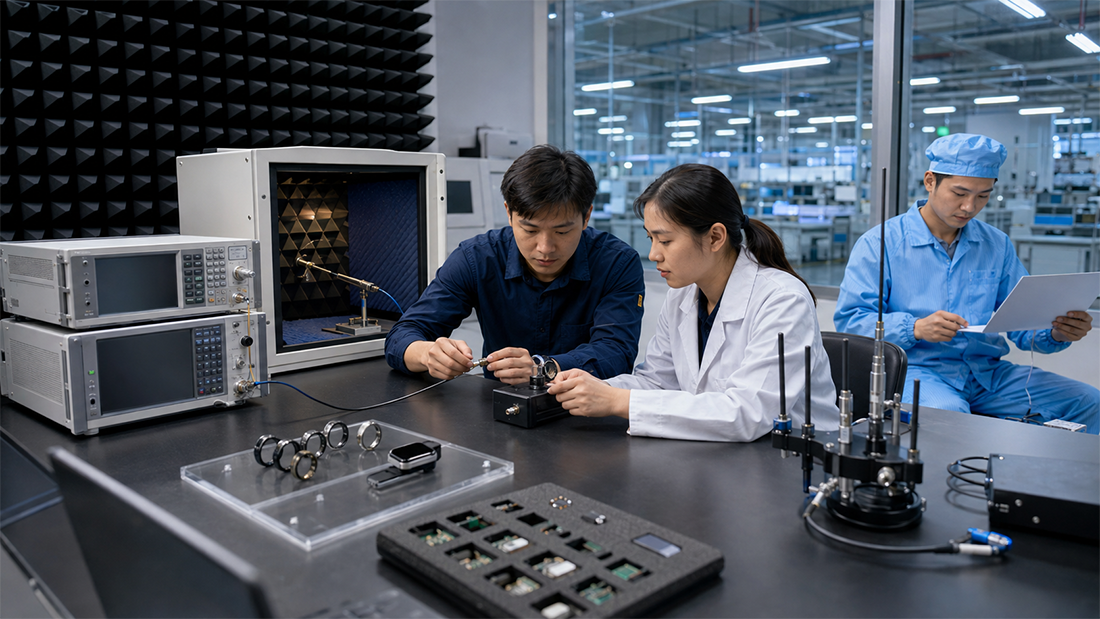
[Image placement 2: Smart ring OEM quality and compliance testing setup]
Decision 7: Lead Time, Tooling Ownership, and After-Sales
Lead time has three parts: sample time, production time, and freight time. Buyers should ask for each separately and confirm whether any new tooling is required.
- Sample lead time: how soon you receive production-representative samples.
- Production lead time: stated in working days, tied to confirmed MOQ.
- Freight: battery-containing products may require specific shipment handling.
- Tooling ownership: confirm in writing who owns custom molds and fixtures.
- Warranty and spare parts: confirm policy and replacement process.
Typical lead time varies by configuration; buyers should confirm in writing: [STAR KING TO CONFIRM]. STAR KING maintains a resources library that covers sourcing, quality, and OEM topics in more depth.
Key Facts for Buyers
| Question | What to Confirm |
|---|---|
| What does smart ring OEM usually include? | Reference platform, sensor set, app shell, packaging, logo customization; scope varies by factory and SKU |
| How is MOQ set? | Per platform, per ring size, per packaging batch; confirm per SKU |
| What certifications are needed? | Depends on target market, radio module, and battery; confirm each in writing |
| How long does development take? | Depends on customization depth; sample, production, and freight timelines should be quoted separately |
| Who owns the tooling? | Contract-specific; confirm in writing before paying NRE |
Common Mistakes and Buyer Red Flags
Startup buyers often repeat the same mistakes in their first OEM project. Watch for these patterns on both sides of the negotiation.
- Quoting without specification: a unit price without a defined sensor set and app scope is not comparable.
- Skipping the sample stage: relying on a demo video instead of a tested sample.
- Assuming certification is included: confirming only after production starts.
- Over-customizing at launch: new tooling before the product has any market feedback.
- Ignoring landed cost: comparing FOB prices only, then discovering freight and duty surprises.
- Vague app ownership: not confirming who maintains the app after launch.
Manufacturer red flags include refusing to share test reports, giving quote changes that do not match specification changes, and unclear tooling ownership. Buyers can verify a Chinese manufacturer through public business registries and by asking for references matched to their product category. Startup brands should treat any supplier that discourages a documented sample test as a warning sign.
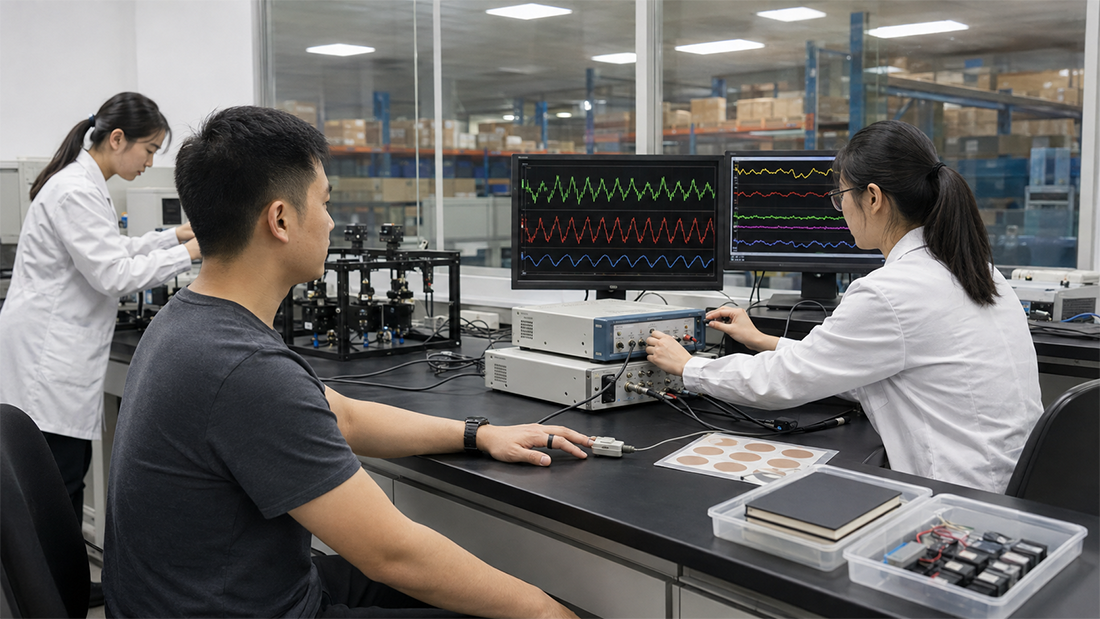
[Image placement 3: Startup brand smart ring sample testing on wrist]
Practical Buyer Checklist
- Define the product model: private label, ODM customized, or semi-custom OEM.
- Specify sensor set, battery target, ring sizes, and enclosure material.
- Request MOQ per SKU and a landed-cost breakdown.
- Order production-representative samples and run a defined test plan.
- Confirm app customization scope, ownership, and post-launch support.
- Confirm certification coverage for each target market, in writing.
- Confirm tooling ownership, lead time, warranty, and spare-part process.
- Request references from brands with similar product categories.
FAQ
What is the typical starting MOQ for a smart ring OEM project?
MOQ depends on the platform, ring sizes, and packaging batch. Buyers should ask for MOQ per SKU rather than a single overall number, because individually sized rings often carry their own minimums.
Can a startup brand customize the app for a private label smart ring?
App customization ranges from logo and dashboard skin to deeper feature changes. Buyers should confirm which level is included in the quoted price and who maintains the app after launch.
Are CE and FCC certification automatically included in a smart ring order?
Not necessarily. Certification coverage depends on the target market, radio module, and battery. Buyers must confirm which certifications apply and who holds the test reports for the exact SKU.
How long does it take from sample approval to mass production?
Timelines vary by customization depth. Sample time, production time, and freight time should be quoted separately so the buyer can plan the launch schedule realistically.
Who owns custom tooling for a smart ring design?
Tooling ownership is a contract term. Buyers should confirm in writing whether they own the molds and fixtures after paying NRE, and whether ownership transfers on final payment.
Do smart rings require special shipping documentation for the built-in battery?
Products with lithium batteries typically require UN38.3 test documentation and an MSDS before freight booking. Requirements can depend on the carrier, destination, and shipment mode, so buyers should confirm with the freight forwarder.
Are smart rings medical devices?
Consumer smart rings are generally positioned as wellness and lifestyle devices, not medical diagnostic devices. Any health-related claims should be reviewed with regulatory counsel for the intended market.
Conclusion
For a startup brand, the smart ring OEM decision comes down to matching product scope to the launch timeline and cash flow you actually have. Start with a reference platform, confirm samples against your real features, and get certification and landed cost in writing before you commit to mass production. The factories that answer these questions in writing are usually the ones that can carry a first product through launch. Compare your options against a concrete health and fitness wearable solution before you place a production order.
STAR KING CTA
Ready to move from comparison to a real test? Request smart ring samples from STAR KING and review customization options for logo, packaging, and app scope. Samples and quotations are prepared against your target market and launch timeline.
Discuss Your Smart Wearable OEM/ODM Project
Planning a smart ring, smart watch, smart band, AI glasses, AI translator, or AI voice mouse project? Contact STAR KING to discuss product positioning, sample testing, customization scope, certification requirements, lead time, and quotation details.

Team Star King

Scan WhatsApp QR code
Leave a Reply