
smart watch suppliers: 7 Steps to Evaluate Smart Watches for Corporate Wellness Programs: A 2026 B2B Buyer’s Guide
October 14, 2026 · Team Star King

smart watch suppliers buyers need a supplier evaluation process that checks product fit, OEM/ODM capability, compliance documents, quality control, pricing, lead time, and after-sales support before placing a bulk order.
Table of Contents
Table of Contents
7 Steps to Evaluate Smart Watches for Corporate Wellness Programs: A 2026 B2B Buyer’s Guide
Selecting smart watches for corporate wellness programs is a procurement decision that affects employee adoption, data privacy, IT workload, and long‑term program ROI. This guide gives corporate procurement teams a structured 7‑step evaluation framework covering technical specifications, vendor due diligence, compliance, total cost of ownership, and pilot planning. By following these steps, you can shortlist reliable suppliers and avoid common pitfalls that derail wellness initiatives.
smart watch suppliers: Table of Contents
- Direct Answer: What Should Corporate Buyers Look For?
- Key Takeaways
- Key Facts for Buyers
- Why Smart Watches for Corporate Wellness Programs Are Gaining Traction
- 7 Steps to Evaluate Smart Watches for Corporate Wellness Programs
- Step 1: Define Program Goals and Employee Use Cases
- Step 2: Evaluate Hardware Specifications That Matter
- Step 3: Assess Software, App Integration, and Data Security
- Step 4: Choose the Right Sourcing Model (OEM, ODM, or Private Label)
- Step 5: Qualify Manufacturers and Verify Capabilities
- Step 6: Understand MOQ, Lead Time, and Total Cost of Ownership
- Step 7: Plan a Pilot and Scaling Strategy
- Comparison Table: Sourcing Models for Corporate Wellness Wearables
- Decision Checklist: Key Procurement Questions
- Common Mistakes and Buyer Red Flags
- Practical Buyer Checklist
- FAQ
- Conclusion
- Next Step: Request Samples or a Quote
Direct Answer: What Should Corporate Buyers Look For?
Corporate buyers should prioritize smart watches that offer reliable health tracking (heart rate, sleep, activity), long battery life, secure app integration, and enterprise‑grade data privacy. Evaluate suppliers on their OEM/ODM experience, quality control processes, compliance support, and ability to scale with clear MOQ and lead times. A pilot with 20–50 employees helps validate both hardware and software before full deployment.

Key Takeaways
- Smart watches for corporate wellness programs must balance employee appeal with IT and compliance requirements.
- Focus on battery life, sensor accuracy, water resistance, and app ecosystem compatibility.
- Vendor selection should include factory audits, sample testing, and verification of certifications.
- Understand the trade‑offs between OEM, ODM, and private‑label models to match your branding and budget.
- MOQ, lead time, and landed cost directly impact program scalability and ROI.
- Always pilot before mass rollout and plan for device management, support, and replacement.

Key Facts for Buyers
| Consideration | Typical Requirement | Why It Matters |
|---|---|---|
| Battery Life | 5–7 days minimum | Reduces charging friction and increases adoption. |
| Water Resistance | IP67 or 5 ATM | Withstands daily wear and hand washing. |
| Sensor Suite | Heart rate, SpO2, accelerometer | Enables basic wellness metrics; not medical‑grade. |
| App Compatibility | iOS and Android, optional SDK | Ensures wide employee adoption and data integration. |
| Data Privacy | GDPR/CCPA alignment, encryption | Protects employee data and reduces legal risk. |
| Compliance | FCC, CE, RoHS, UN38.3 (varies) | Required for US import and battery shipping. |
| MOQ | 500–1,000 units (typical) | Affects initial investment and pilot feasibility. |
| Lead Time | 30–60 days after sample approval | Impacts program launch timeline. |

Why Smart Watches for Corporate Wellness Programs Are Gaining Traction
Corporate wellness programs increasingly include wearables to encourage physical activity, monitor sleep, and reduce sedentary behavior. Smart watches provide a familiar form factor, continuous heart rate monitoring, and integration with wellness platforms. For procurement teams, the challenge is selecting devices that meet employee expectations while satisfying IT security, data privacy, and budget constraints. Unlike consumer purchases, corporate deployments require vendor stability, consistent quality, and the ability to support hundreds or thousands of units.
7 Steps to Evaluate Smart Watches for Corporate Wellness Programs
Step 1: Define Program Goals and Employee Use Cases
Start by clarifying what the wellness program should achieve: increased step counts, better sleep, stress reduction, or team challenges. These goals determine required features. For example, a sleep‑focused program needs accurate sleep tracking and comfortable overnight wear, while a fitness challenge prioritizes GPS and heart rate zones. Involve HR, IT, and a sample of employees to build consensus. Document use cases and translate them into technical requirements.
Step 2: Evaluate Hardware Specifications That Matter
Not all smart watches are equal. For corporate wellness, focus on:
- Battery life: At least 5–7 days to avoid daily charging.
- Display: Always‑on or high‑brightness for outdoor readability.
- Sensors: Heart rate, SpO2, accelerometer, and optional GPS.
- Water resistance: IP67 or 5 ATM for daily wear.
- Comfort: Lightweight design and interchangeable straps.
- Connectivity: Bluetooth 5.0+ for stable syncing.
Remember that consumer‑grade sensors are not medical devices and should not be marketed as diagnostic tools.
Step 3: Assess Software, App Integration, and Data Security
The companion app is critical for engagement. Check whether the vendor offers:
- White‑label or customizable app with your branding.
- API or SDK for integration with existing wellness platforms (e.g., corporate wellness portals).
- Data encryption in transit and at rest.
- Compliance with data privacy regulations such as GDPR or CCPA. For US programs, consult legal counsel on HIPAA applicability if health data is involved.
Ensure the vendor can provide documentation on data handling and retention policies.
Step 4: Choose the Right Sourcing Model (OEM, ODM, or Private Label)
Your sourcing model affects cost, customization, and time to market:
- OEM: You provide design and specifications; manufacturer builds to your requirements. Highest customization, higher upfront investment.
- ODM: Manufacturer offers existing design that you can rebrand. Faster and lower cost, but less differentiation.
- Private Label: Off‑the‑shelf product with your logo and packaging. Quickest, but minimal hardware customization.
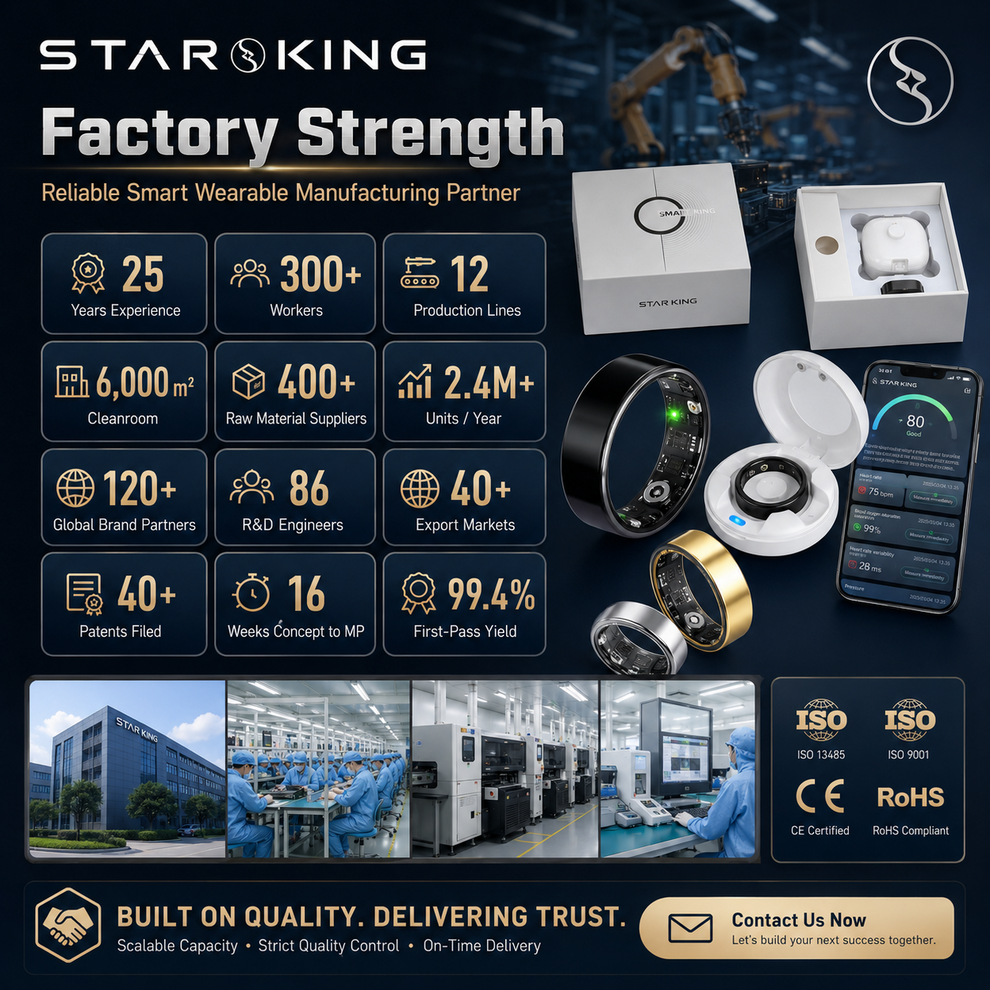
For corporate wellness, private label or ODM often suffice unless you need unique features or deep integration. Discuss your needs with suppliers like STAR KING’s private label OEM/ODM team.
Step 5: Qualify Manufacturers and Verify Capabilities
Request the following from potential suppliers:
- Company registration and factory audit reports.
- Quality management certifications (e.g., ISO 9001).
- Product test reports (e.g., FCC, CE, RoHS, UN38.3 for batteries).
- References from similar B2B clients (if available).
- Sample units for hands‑on evaluation.
Verify certifications directly with issuing bodies when possible. Note that certification requirements depend on product configuration and target market; not all products may be certified. See FCC equipment authorization for US requirements.
Step 6: Understand MOQ, Lead Time, and Total Cost of Ownership
MOQ and lead time vary by supplier and customization level. Typical MOQs for private‑label smart watches range from 500 to 1,000 units, but OEM projects may require higher volumes. Lead time is often 30–60 days after sample approval, plus shipping. Calculate total cost of ownership including:
- Unit price and tooling costs (if applicable).
- Shipping, duties, and taxes (landed cost).
- App development or licensing fees.
- Customer support and warranty.
- Replacement and spare parts.
Request a detailed quotation that itemizes these costs.
Step 7: Plan a Pilot and Scaling Strategy
Before committing to a large order, run a pilot with 20–50 employees across departments. Collect feedback on comfort, battery life, app usability, and data accuracy. Measure engagement metrics and IT support tickets. Use pilot results to refine specifications and negotiate final terms. Plan for device management, including enrollment, updates, and troubleshooting. Consider a phased rollout to manage support load.
Comparison Table: Sourcing Models for Corporate Wellness Wearables
| Model | Customization | Upfront Cost | Time to Market | Best For |
|---|---|---|---|---|
| OEM | High (design, hardware, firmware) | High | Long (6–12 months) | Unique features, large scale |
| ODM | Medium (branding, app skin) | Medium | Medium (3–6 months) | Balanced customization and speed |
| Private Label | Low (logo, packaging) | Low | Short (1–3 months) | Quick deployment, limited budget |
Decision Checklist: Key Procurement Questions
- Does the smart watch meet our required battery life and water resistance?
- Is the app available in the languages our employees speak?
- Can the vendor provide FCC, CE, RoHS, and UN38.3 documentation?
- What is the MOQ, and can we start with a pilot order?
- What is the lead time for production and shipping?
- How is employee data stored and protected?
- What warranty and support are included?
- Are spare parts and replacement units available?
Common Mistakes and Buyer Red Flags
- Ignoring data privacy: Failing to review data handling can lead to legal issues.
- Choosing on price alone: Low‑cost devices may have poor battery life or sensor accuracy, hurting adoption.
- Skipping the pilot: Deploying thousands of units without testing can result in costly returns.
- Not verifying certifications: Assuming a product is certified without documentation risks customs delays.
- Overlooking app integration: A disconnected app reduces engagement and data value.
- Underestimating support: Without a support plan, IT tickets can overwhelm your team.
Practical Buyer Checklist
- Define program goals and success metrics.
- List must‑have hardware features (battery, sensors, water resistance).
- Evaluate app functionality and data security.
- Decide on sourcing model (OEM/ODM/private label).
- Request samples and test with a small group.
- Verify supplier certifications and factory audits.
- Negotiate MOQ, pricing, lead time, and warranty.
- Plan pilot, rollout, and support.
Buyers can also review STAR KING Smart Watches OEM/ODM options to compare product positioning, customization scope, and sample planning.
Useful Official References for Buyers
- FCC equipment authorization guidance
- European Commission CE marking information
- Bluetooth SIG specifications
FAQ
What is the typical MOQ for private‑label smart watches?
MOQs often range from 500 to 1,000 units, but can be higher for custom designs. Some suppliers may offer lower MOQs for standard models. Confirm with your vendor.
How long does it take to receive samples?
Sample lead time is usually 7–15 days, depending on customization. Shipping adds 3–7 days for express courier.
Are corporate wellness smart watches FDA‑cleared?
Most consumer smart watches are not FDA‑cleared medical devices. They are general wellness products. If you require medical‑grade monitoring, look for FDA‑cleared devices and consult regulatory experts.
What certifications are needed to import smart watches into the US?
Smart watches with Bluetooth typically require FCC certification. Batteries require UN38.3 test reports for shipping. RoHS and CE may apply for EU, but for US, FCC and UN38.3 are key. Always verify with a customs broker.
Can we integrate the smart watch data with our existing wellness platform?
Many suppliers offer APIs or SDKs for integration. Check compatibility with your platform’s requirements. STAR KING can discuss integration options: [STAR KING TO CONFIRM].
What is the typical warranty period?
Warranties vary; 12 months is common. Clarify what is covered (manufacturing defects vs. accidental damage) and the process for replacements.
How do we ensure employee data privacy?
Choose devices with encryption and clear data policies. Consult legal counsel to ensure compliance with applicable laws like CCPA. Avoid collecting unnecessary personal data.
Conclusion
Evaluating smart watches for corporate wellness programs requires a structured approach that balances employee needs, IT requirements, and procurement realities. By following these 7 steps, you can select a reliable supplier, manage costs, and launch a successful program. Remember to pilot before scaling and verify all compliance documentation.
Next Step: Request Samples or a Quote
Ready to move forward? Request samples of our smart watches to test with your team. Or contact us to discuss your OEM/ODM requirements and receive a tailored quotation. We support corporate buyers with flexible MOQs and customization options. Let’s build a wellness program that works for your organization.
Discuss Your Smart Wearable OEM/ODM Project
Planning a smart ring, smart watch, smart band, AI glasses, AI translator, or AI voice mouse project? Contact STAR KING to discuss product positioning, sample testing, customization scope, certification requirements, lead time, and quotation details.

Team Star King

Scan WhatsApp QR code
Leave a Reply