
smart band manufacturer: How to Choose a Smart Band Manufacturer in 2026: 7-Step OEM/ODM Guide for EU Startup Brands
October 10, 2026 · Team Star King

How to Choose a Smart Band Manufacturer in 2026: 7-Step OEM/ODM Guide for EU Startup Brands
Choosing the right smart band manufacturer for an EU launch comes down to this: shortlist factories that can ship a documented, chargeable product with the firmware and app behavior your brand can actually control. For most startup brands, the practical shortlist is five to eight factories, narrowed to two to four after video and physical sample review, then one engaged for a paid pilot order. The decision hinges on OEM/ODM capability, CE/RoHS documentation, UN38.3 lithium battery files, MOQ and lead time, and realistic branding scope — not on catalog photos.
Table of Contents
Table of Contents
Direct Answer: What Should an EU Startup Brand Look for in a Smart Band Manufacturer?
A qualified smart band manufacturer should offer documented OEM/ODM options, publicly confirm CE and RoHS pathways, hold UN38.3 reports for any rechargeable battery pack, quote clear MOQ and lead time, and agree to pre-production samples before mass production. For EU launches, the supplier should also support EU importer disclosure, app privacy documentation, and a written quality plan. If any of these items is missing at the quotation stage, treat it as a warning sign rather than a negotiation talking point.

Table of Contents
- 1. Why EU Startup Brands Need a Different Smart Band Supplier Checklist
- 2. Step 1 — Define Your Smart Band Product Specification First
- 3. Step 2 — Separate True OEM/ODM Capability from Catalog Browsing
- 4. Step 3 — Verify EU Compliance Documentation, Not Just Claims
- 5. Step 4 — Pressure-Test MOQ, Pricing Levers, and Payment Terms
- 6. Step 5 — Run a Structured Sample and Validation Round
- 7. Step 6 — Audit App, Firmware, and Data-Handling Boundaries
- 8. Step 7 — Confirm Lead Time, Logistics, and After-Sales Realistically
- 9. Key Facts for Buyers Table
- 10. Comparison Table: Catalog Supplier vs. OEM/ODM Partner
- 11. Common Mistakes and Buyer Red Flags
- 12. Practical Buyer Checklist
- 13. FAQ
- 14. Conclusion
- 15. Next Step with STAR KING

Key Takeaways
- Define your band’s use case before comparing manufacturers; spec clarity reduces cost and risk faster than supplier haggling.
- Ask for OEM/ODM evidence (engineering team, tooling, firmware scope, app control), not just product images.
- For EU sales, treat CE, RoHS, and UN38.3 as documentation you must be able to retrieve, not as marketing logos.
- MOQ should be renegotiable when you commit to a roadmap rather than a single SKU.
- A paid sample build with a written validation report is worth more than three free samples without documentation.
- Firmware and app access terms decide whether you own your brand experience or rent it.
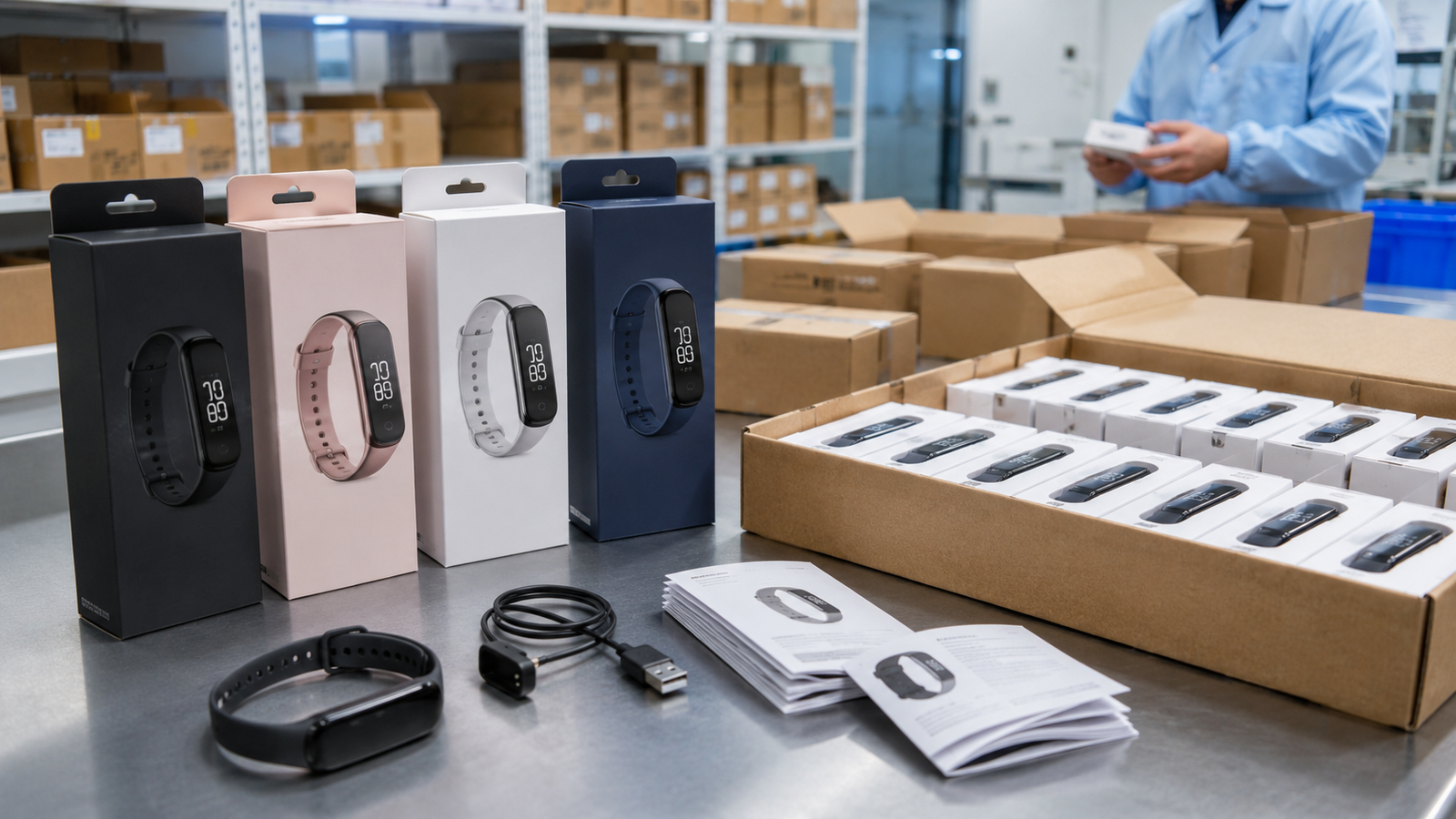
1. Why EU Startup Brands Need a Different Smart Band Supplier Checklist
Startup brands in the EU face a specific combination of constraints: limited working capital, low initial volumes, mandatory conformity documentation, and consumers who compare your product to established wearable brands. That changes the evaluation criteria.
An established importer may accept a 10,000-piece MOQ and absorb a 60-day lead time. A startup typically needs 300 to 3,000 units per SKU first, a small pilot to validate sell-through, and a manufacturer who treats that first run as a partnership test. If the factory’s default commercial terms are built for big importers, you will pay for that mismatch in deposit size, tooling commitments, or slow responsiveness.
At the same time, EU buyers cannot trade away compliance for price. Consumer wearables with rechargeable lithium batteries touch multiple regulatory frameworks, and the documentation burden sits primarily with the importer. That makes documentation readiness a supplier selection criterion, not a post-purchase task. See the STAR KING overview of smart bands for OEM and private label programs for a reference point on typical product configurations.

2. Step 1 — Define Your Smart Band Product Specification First
Before you evaluate any smart band manufacturer, write a one-page product brief. Suppliers price based on ambiguity, so the clearer your brief, the more comparable your quotes.
Minimum specification items to fix before supplier calls
- Display type and size: OLED vs. AMOLED, 0.96″ to 1.47″ typical ranges.
- Sensors: heart rate (PPG), SpO2, accelerometer; note whether continuous or on-demand.
- Battery capacity and target runtime in typical use.
- Water resistance rating target (IP67 / IP68 / 5ATM).
- Connectivity: BLE version and companion app platform (iOS / Android).
- Materials: TPU, silicone, metal frame, or mixed.
- Target packaging and language pack for EU distribution.
Once this list exists, you can compare quotes apples to apples. Without it, you will compare marketing sheets.
3. Step 2 — Separate True OEM/ODM Capability from Catalog Browsing
Many companies describe themselves as a smart band manufacturer while offering only rebranded catalog items. That is not necessarily bad — it may be the right fit for a fast first launch — but you should understand which model you are buying.
How to test OEM/ODM depth in a first call
- Ask which team performs firmware changes (in-house, partner, or chipset vendor).
- Ask who owns the tooling and molds, and what the tooling transfer or retention policy is.
- Ask for the customization matrix: logo, packaging, UI theme, app skin, sensor configuration.
- Ask whether new firmware builds require new certification documentation.
For a startup brand, the ideal supplier falls somewhere between full ODM and light OEM: you control branding, packaging, app skin, and a limited UI layer, while the factory keeps the core hardware stable. This keeps time-to-market predictable. If you want to compare this approach with broader catalog-based sourcing, review the Private Label OEM/ODM solution page as a structural reference.
4. Step 3 — Verify EU Compliance Documentation, Not Just Claims
Compliance is where startup brands lose the most time. A supplier saying “we are CE certified” is not a substitute for retrievable technical files.
Documentation to request at quotation stage
- EU Declaration of Conformity (DoC) template covering the specific SKU and radio configuration.
- Test reports supporting CE marking, typically covering EMC and RED directives for wireless devices.
- RoHS documentation relevant to the exact BOM.
- UN38.3 test summary for the lithium battery cell or pack.
- Safety Data Sheet (MSDS) for the battery in transport-relevant form.
- REACH-relevant statements for materials contacting skin (bands, housing).
- Product packaging artwork with importer identification requirements.
Rules and interpretations evolve. For CE marking and RED obligations, reference the official European Commission and EU legislation pages, such as the EU CE marking overview. For radio equipment specifics, review the Radio Equipment Directive materials on the EU RED page. For battery transport rules, the IATA Dangerous Goods Regulations are the practical reference point for air freight. Buyers should verify current requirements with their EU importer of record, testing lab, and freight forwarder.
If your team needs a documentation checklist to compare suppliers, STAR KING can prepare a SKU-level compliance pack as part of an OEM/ODM discussion. It is a useful way to see how a supplier organizes files before you commit to sampling.
Where startups commonly misjudge compliance
- Assuming a certificate image equals a report valid for your SKU configuration.
- Forgetting that changing the radio module or battery may require updated testing.
- Skipping the importer’s name, address, and EU Responsible Person coordination.
- Treating SpO2 and heart rate features as medical-grade without review of intended use claims.
Consumer smart band measurements are wellness features, not diagnostic tools. Packaging, app copy, and marketing claims must reflect that distinction in the EU.
5. Step 4 — Pressure-Test MOQ, Pricing Levers, and Payment Terms
MOQ is rarely a single number. It is a bundle of decisions: colorways, packaging runs, app branding, and firmware variants each carry their own minimums.
Pricing levers to negotiate, in order of leverage
- Single SKU, single colorway, single packaging design.
- Committed yearly roadmap instead of a one-off PO.
- Standard firmware with light branding instead of a custom feature set.
- Standard packaging with a printed sticker sleeve vs. fully custom box.
- Flexible delivery window (buffer vs. deadline-specific shipping).
Typical startup-friendly MOQ ranges start in the hundreds of units per SKU for standard configurations and rise when custom tooling, custom app surfaces, or non-standard sensors are required. Payment terms usually involve a deposit and balance before shipment; terms vary by factory, order size, and history. Verify the exact structure for your SKU in writing.
6. Step 5 — Run a Structured Sample and Validation Round
Sampling is where most startup brands either derisk their launch or discover hidden problems. A structured round beats a casual “send me one” request.
Sample validation sequence
- Request a standard sample for baseline feel and app pairing.
- Request a branded sample (logo, packaging mockup) once the baseline passes.
- Test sensor continuity, sync stability, charge cycles, and app language packs.
- Log discrepancies in a written validation sheet and send it to the factory.
- Confirm the pre-production sample matches what mass production will ship.
Pay for samples. A factory that charges for samples but returns clear documentation is usually more reliable than one that ships free units with no paperwork. For context on how wearable testing is typically organized, see the STAR KING health and fitness wearable solution overview.
7. Step 6 — Audit App, Firmware, and Data-Handling Boundaries
For an EU startup, the companion app is not a technical accessory — it is part of the product and part of the compliance story.
Questions to settle before signing
- Can the app be white-labeled with your brand name, icon, and launch screen?
- Is there a documented firmware update mechanism, and who can trigger firmware releases?
- Where is user data stored, and what is the retention policy?
- Is a Data Processing Agreement available if the factory or its app partner processes EU user data?
- Can optional features (cloud sync, account creation) be disabled for markets that prefer local-only data?
GDPR implications for health-adjacent data are meaningful. Buyers should verify the data flow with their legal counsel and confirm that app copy reflects actual data practices. Do not accept a generic privacy statement that does not match the shipped app behavior.
8. Step 7 — Confirm Lead Time, Logistics, and After-Sales Realistically
Lead time in wearables has three layers: sample and pre-production, mass production, and shipping. Startups often underestimate the first layer.
Realistic planning ranges
- Sample and revision rounds: often 2–5 weeks depending on scope.
- Mass production after PO confirmation and deposit: typically 3–6 weeks for standard SKUs.
- Air freight from China to EU gateways: usually days plus customs and inland delivery.
- Seasonal peaks (Q4, Chinese New Year) extend timelines; plan buffers.
Lithium battery shipping requires UN38.3 documentation and correct labeling. Confirm who arranges the transport classification, and coordinate with your forwarder early. On after-sales, agree on defect rate thresholds, replacement policy, spare-parts availability window, and a return address inside the EU if feasible.
Key Facts for Buyers
| Buyer Decision | What to Verify | Why It Matters for EU Startups |
|---|---|---|
| OEM/ODM depth | In-house firmware/app capability, tooling ownership, customization matrix | Determines how much of the brand experience you control |
| Compliance | CE DoC, RED/EMC reports, RoHS, REACH-relevant statements, UN38.3, MSDS | Importer obligations fall on you, not the factory |
| MOQ and pricing | Per-SKU MOQ, colorway minimums, packaging minimums, payment terms | Working capital planning and staged launches |
| Sampling | Paid samples with a written validation report | Reduces risk of mass-production mismatch |
| Lead time | Sample, production, and shipping timelines in writing | Protects launch dates and marketing spend |
| App and data | White-label scope, data location, DPA availability | GDPR alignment and app-store acceptance |
| After-sales | Defect thresholds, spares, repair path | Protects reviews and repeat purchase |
Comparison Table: Catalog Supplier vs. OEM/ODM Partner
| Dimension | Catalog / Trading Supplier | OEM/ODM Partner |
|---|---|---|
| Customization scope | Logo on case, box sticker | Logo, packaging, UI skin, app branding, sensor config options |
| Firmware control | Limited or none | Documented release path and versioning |
| Documentation | Shared PDFs, sometimes reused | SKU-level files, traceable test reports |
| MOQ flexibility | Fixed by catalog | Negotiable based on roadmap |
| Lead time predictability | Depends on third parties | Internally scheduled with buffers |
| After-sales | Case-by-case | Contractual thresholds and spares |
Common Mistakes and Buyer Red Flags
Common mistakes
- Choosing a supplier before freezing a one-page specification.
- Accepting certificate images without SKU-level test reports.
- Over-customizing the app on the first order, extending timelines.
- Ignoring the importer’s EU Responsible Person and labeling requirements.
- Underestimating lithium battery transport documentation.
Buyer red flags
- Refusal to provide paid samples with documentation.
- Vague answers about who owns the app and firmware.
- Price quotes that change materially between catalog and PO stage.
- No clear answer on UN38.3 or CE file retrieval.
- Pressure to skip sample validation to “lock a production slot.”
Practical Buyer Checklist
- One-page specification signed off internally.
- Shortlist of 5–8 candidates, narrowed to 2–4 after video review.
- Written OEM/ODM scope including firmware and app boundaries.
- CE DoC, RED/EMC, RoHS, REACH-relevant, UN38.3, MSDS files retrievable.
- MOQ, colorway minimums, packaging minimums, and payment terms in writing.
- Paid sample build with a validation report.
- Data handling, DPA, and app store readiness reviewed.
- Lead time plan with buffers and shipping documentation plan.
- After-sales thresholds, spares, and repair path agreed.
FAQ
1. What MOQ should an EU startup expect from a smart band manufacturer?
Standard configurations frequently start in the hundreds of units per SKU. Custom tooling, custom app surfaces, or non-standard sensors typically raise the minimum. Confirm the exact figure for your SKU configuration in writing.
2. Are CE, RoHS, and UN38.3 automatically included when I order?
Not automatically as new testing. Suppliers may hold existing reports for standard SKUs; changes to the radio module, battery, or BOM can require updates. Buyers should verify which files apply to their exact configuration and target market.
3. Can I white-label the companion app on a smart band?
Often yes, but scope varies. Some suppliers support naming, iconography, and UI theme changes; others support deeper customization. Ask which layer is customizable, who maintains the app, and how updates are released.
4. How long does a first production run usually take?
After sample approval and deposit, standard SKUs commonly ship from the factory within three to six weeks. Holiday seasons and Chinese New Year extend timelines. Plan a buffer and confirm in writing.
5. What compliance issue most often delays an EU wearable launch?
Missing or mismatched test reports for the shipped configuration, plus incomplete importer identification on packaging. Both are avoidable with a documented file review before mass production.
6. Should I buy a rebranded catalog band first?
For a fast market test, it can work, as long as you understand the trade-offs in customization, firmware control, and documentation. Many startups use a catalog launch to validate demand, then move to an OEM/ODM program.
7. What warranty structure is reasonable for startup volumes?
Common structures include a defined defect rate allowance and a replacement policy with a fixed window. Spare bands, chargers, and packaging materials should be quotable separately. Terms depend on the product and factory.
Conclusion
Selecting a smart band manufacturer for an EU launch is a documentation and scope exercise as much as a price negotiation. The startups that ship on time are the ones that freeze specifications early, verify OEM/ODM depth in writing, and treat CE, RoHS, REACH-relevant statements, and UN38.3 as retrievable files rather than logos. MOQ, lead time, app control, and after-sales terms then become predictable variables instead of surprises. For a broader view of the product family behind these decisions, review the STAR KING smart watch and wearable lineup or read more sourcing notes on the STAR KING resources blog.
Next Step with STAR KING
If you are comparing smart band manufacturers for an EU private label launch, STAR KING can review your specification, outline supported OEM/ODM scope, and prepare a SKU-level compliance and MOQ summary. Share your target configuration and EU distribution plan via the STAR KING contact sales form to start a sample and quotation discussion. Note that whether specific certifications are applicable depends on the final product configuration and target market; buyers should verify requirements with their importer of record.
Discuss Your Smart Wearable OEM/ODM Project
Planning a smart ring, smart watch, smart band, AI glasses, AI translator, or AI voice mouse project? Contact STAR KING to discuss product positioning, sample testing, customization scope, certification requirements, lead time, and quotation details.

Team Star King

Scan WhatsApp QR code
Leave a Reply