private-label smart watches: 7 Critical Checks for Private-Label Smart Watches: A 2026 US Buyer’s Evaluation Guide
7 Critical Checks for Private-Label Smart Watches: A 2026 US Buyer’s Evaluation Guide
Private-label smart watches are existing smartwatch platforms that a manufacturer customizes with your brand, packaging, app identity, and selected specifications, then produces under your label. For a US private-label brand, the seven evaluation checks that matter most are platform maturity, spec-to-price trade-offs, MOQ, sample validation, app and firmware ownership, FCC and battery compliance, and supply continuity. This guide explains how to run each check before you pay a tooling deposit.
Table of Contents
Table of Contents
If you are comparing suppliers right now, the goal is not to find the lowest quote. It is to find a private-label smart watches program you can still sell, service, and reorder twelve months after launch. The checks below are written for buyers in the evaluation stage who already have a rough price target and need a defensible way to shortlist manufacturers.
private-label smart watches: Table of Contents
- Short Answer
- Key Takeaways
- Key Facts for Buyers
- Check 1: Platform maturity and product generation
- Check 2: Spec-to-price trade-offs
- Check 3: MOQ, tooling, and deposit structure
- Check 4: Sample validation and test plan
- Check 5: App, firmware, and data ownership
- Check 6: FCC, battery, and US market compliance
- Check 7: Supply continuity and after-sales
- Comparison table: OEM versus ODM versus ready platform
- Common mistakes and buyer red flags
- Practical buyer checklist
- FAQ
- Conclusion

Short Answer
The fastest way to evaluate private-label smart watches is to ask for three things in writing before any deposit: the exact platform and generation, a sample with your logo and app skin, and the compliance file for the specific SKU you intend to import. Buyers who validate these three items first avoid most of the cost overruns that appear later in tooling, re-testing, and app rework.
Key Takeaways
- A mature smartwatch platform shortens development time, but it also limits how much you can differentiate from other brands using the same base.
- Display, battery, sensor set, and GPS are the four specification levers that move unit cost the most.
- MOQ usually depends on branding method: logo and packaging customization carries lower minimums than new tooling or a custom housing.
- Compliance is SKU-specific. FCC authorization, UN38.3 test summaries, and MSDS documents should be requested per model and configuration.
- App and firmware ownership should be defined in the contract, not agreed verbally, because it affects your ability to switch suppliers later.
- Total landed cost includes freight, duties, compliance testing, and returns, not just the quoted FOB price.
Key Facts for Buyers
| Evaluation area | What to request | Why it matters |
|---|---|---|
| Platform | Model name, chipset generation, firmware version, release date | Determines feature ceiling and how long the platform stays serviceable |
| Customization scope | Logo, packaging, app skin, watch face, boot animation | Sets realistic differentiation versus off-the-shelf competitors |
| MOQ | Minimum order per model and per color, plus reorder minimum | Affects cash flow and inventory risk for a first run |
| Sampling | Golden sample, test report, sample lead time and cost | Reduces the risk of mass-production drift |
| Compliance | FCC ID or test report, UN38.3 summary, MSDS | Required or expected for US import and retail listing |
| App and cloud | App ownership, data hosting region, API availability | Affects data handling, privacy review, and future migration |
| After-sales | Defect rate definition, spare parts availability, warranty terms | Protects your marketplace rating and support cost |
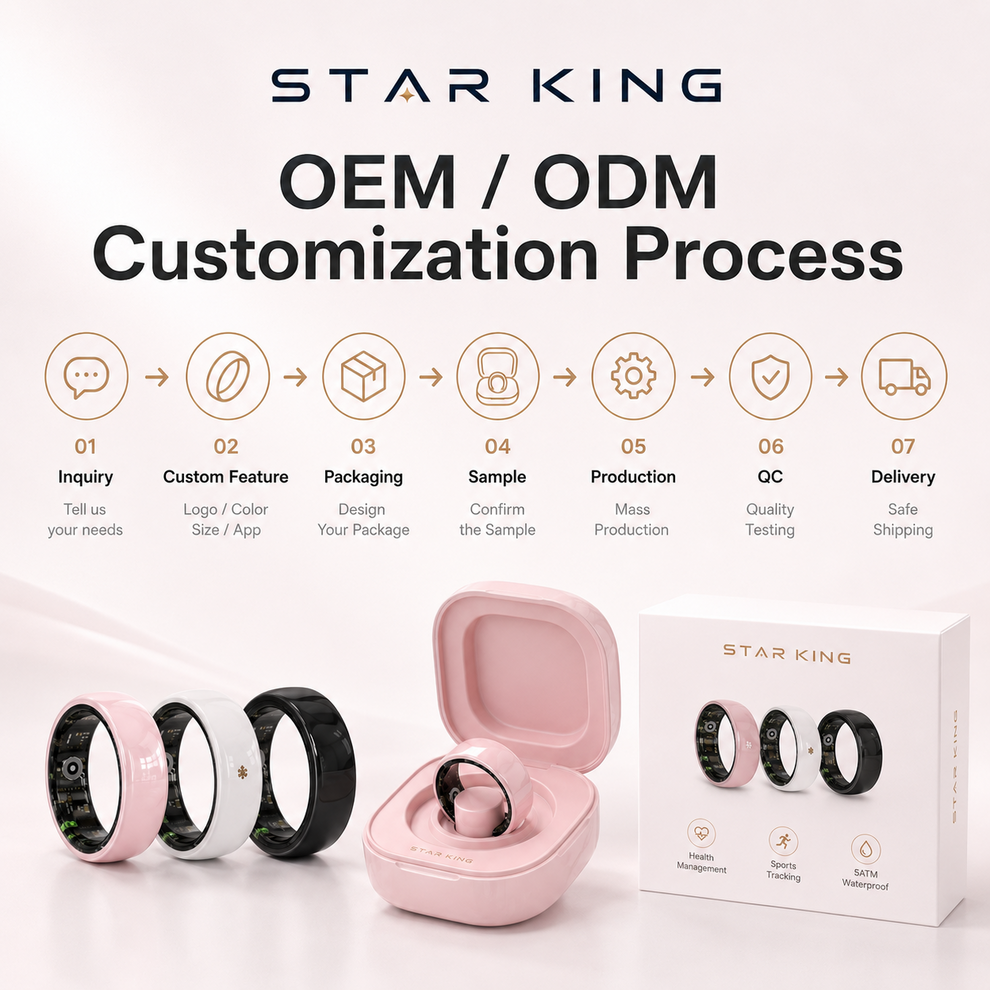
If you want to see how STAR KING structures these options across its wearable lineup, review the smart watches product page and compare it against your current shortlist. For buyers who need help with branding structure, the private-label OEM/ODM solution overview covers logo, packaging, and app customization at a program level.
Check 1: Platform Maturity and Product Generation
Most private-label smart watches are built on a platform that the manufacturer already produces. That is good news for speed and cost, and a constraint for differentiation. Before you commit, ask which chipset generation the platform uses, when the firmware was last updated, and how long the supplier expects to support it.
What to ask
- Model name, chipset family, and the year the platform entered mass production.
- Firmware version currently in production and the cadence of security updates.
- Whether the platform supports your target features natively or through app-side processing.
How to verify
Request the firmware release notes and a sample device from current production stock, not a hand-built demo unit. Compare the sample’s menus, sensor behavior, and charging behavior against the specification sheet. If the platform is more than a few years old, confirm that replacement components remain available, since an end-of-life display or sensor can force an unplanned redesign mid-project.
Check 2: Spec-to-Price Trade-offs
Unit price for private-label smart watches is largely driven by four components. Understanding which lever you are pulling keeps a supplier conversation honest and makes quotes comparable across vendors.
| Specification lever | Lower-cost option | Higher-cost option | Typical buyer impact |
|---|---|---|---|
| Display | Smaller LCD or entry AMOLED | Larger, higher-brightness AMOLED | Perceived premium, outdoor readability |
| Battery | Smaller cell, shorter run time | Larger cell, longer standby | Return rate, review sentiment |
| Sensors | Basic optical heart-rate set | Additional SpO2 and refined algorithms | Feature claims and app value |
| Connectivity | Bluetooth only | Bluetooth with GPS variants | Use case fit and price segment |
Ask for a written breakdown by configuration so you can model two or three tiers rather than a single SKU. Many private-label brands launch one hero model and one value model, which gives retailers a price ladder without doubling tooling investment.
For context on how consumer health monitoring features are positioned, see the FDA medical device pages, which clarify the line between general wellness products and regulated medical devices. Features such as heart rate and SpO2 tracking on consumer wearables are typically wellness features, not diagnostic tools, and your marketing claims should reflect that distinction.
Check 3: MOQ, Tooling, and Deposit Structure
MOQ for private-label smart watches is not a single number. It usually varies by customization layer:
- Logo and packaging only: lowest minimums, because no new injection tooling is required.
- Custom watch face, boot animation, app skin: moderate minimums, often tied to a one-time setup fee.
- Custom housing or new mechanical design: highest minimums, with tooling cost, mold ownership terms, and longer lead time.
Ask how reorders are treated. A supplier that accepts a small first order but requires a much larger reorder can create a cash-flow trap after your launch. Also confirm whether the deposit is tied to tooling ownership, and who holds the mold if the relationship ends.
Budget planning should include a first-run contingency. Buyers typically reserve a portion of the program budget for re-testing, packaging revisions, or a second colorway after the sample stage. Treat the first quote as a starting structure, then refine it once the sample is approved.
Check 4: Sample Validation and Test Plan
A sample is not a souvenir. It is the reference unit your mass production will be measured against. Build a simple validation plan before the sample arrives so you evaluate it the same way every time.
Sample evaluation plan
- Sync the watch with the branded app and confirm pairing stability over several days.
- Measure battery behavior under your intended use profile, not the supplier’s best-case demo.
- Check sensor consistency by comparing readings across sessions and against a known reference.
- Test charging, waterproofing claims appropriate to the rating, and strap comfort.
- Review packaging print quality, language accuracy, and barcode placement.
- Document every deviation from the specification sheet in writing.
Approve a golden sample and ask the supplier to retain a signed copy. This single step resolves most disputes about color, finish, and firmware version later in the program.
Check 5: App, Firmware, and Data Ownership
This is where private-label smart watches programs succeed or stall. Many suppliers provide a white-label app that you rebrand but do not own. That can be acceptable, but you should understand the limits before signing.
Questions that reveal the real arrangement
- Is the app fully white-labeled, or does it carry co-branding or supplier references?
- Who hosts user data, and in which region?
- Is there an API or SDK for future integrations with your own platform?
- What happens to app updates and server costs if you change suppliers?
- Is source code escrow available if the supplier discontinues the platform?
If data portability and app control are central to your brand, treat them as commercial terms, not technical details. Buyers who plan a subscription or wellness program should confirm in writing whether the firmware and app can be exported or transitioned. For programs built around engagement and retention, see how corporate wellness applications structure device-plus-app deployment.
Check 6: FCC, Battery, and US Market Compliance
Compliance requirements for private-label smart watches depend on the specific product configuration, the radio modules used, and your sales channel. A supplier cannot simply state that a product is “FCC certified” on behalf of every SKU.
Documents to request per SKU
- FCC authorization documentation covering the radio configuration you will import.
- UN38.3 test summary for the lithium battery, plus MSDS documentation.
- Any applicable RoHS or REACH declarations relevant to your channel.
- Evidence that labeling and user manual content match the tested configuration.
Verify the FCC identifier directly in the FCC database rather than relying on a scanned certificate. The FCC Equipment Authorization database lets you search by FCC ID and confirm the grantee, product description, and frequency bands. If a supplier cannot provide a matching FCC ID for the configuration you are buying, treat that as a stopping point until it is resolved.
For battery transportation requirements, review the IATA Dangerous Goods Regulations framework, since lithium batteries in consumer devices are subject to specific packing and documentation rules for air freight. Your freight forwarder can confirm the exact paperwork for your shipment, and requirements may change, so verify before booking.
Retail platforms often add their own documentation requests. Compliance for the US market is not one certificate; it is a file that matches your exact SKU, packaging, and labeling. Certified configurations may differ from your chosen one, so buyers should verify what the supplier has actually tested.
Check 7: Supply Continuity and After-Sales
Your second order is where the relationship is tested. Ask how the supplier handles component changes, and require notification if a display, sensor, or battery supplier changes. Silent substitutions are one of the most common causes of marketplace complaints after launch.
- Request a change-notification clause and a definition of a major change requiring re-approval.
- Confirm spare parts availability, including straps, chargers, and screens.
- Define the defect rate threshold and the replacement process.
- Clarify warranty duration and who bears return freight.
- Ask for the expected lead time for reorders and the seasonal capacity pattern around major holidays.
If you plan to sell on marketplaces, ask the supplier for packaging that supports your listing requirements and returns process. For brands building an online channel, smart retail and e-commerce solutions show how device packaging and app onboarding can be aligned with a digital storefront.
Comparison Table: OEM versus ODM versus Ready Platform
| Model | Customization level | Typical MOQ direction | Best fit | Main trade-off |
|---|---|---|---|---|
| Ready platform private label | Logo, packaging, app skin, watch faces | Lowest | Brands testing the category quickly | Less hardware differentiation |
| ODM with modifications | Spec selection, firmware and app adjustments | Moderate | Brands with a defined position | Longer development, higher setup cost |
| Full OEM | New housing, mechanical design, custom firmware | Highest | Established brands with volume | Tooling investment and longer timeline |
Common Mistakes and Buyer Red Flags
- Buying on price alone. The lowest quote often excludes compliance documents, packaging upgrades, or a second colorway.
- Accepting a verbal app ownership promise. Put data hosting, app control, and any escrow terms in the contract.
- Using a certificate from a different SKU. Compliance documents must match your exact configuration.
- Skipping the golden sample. Without a signed reference unit, quality disputes become subjective.
- Ignoring reorder terms. A small first order with a large mandatory reorder can strain cash flow.
- Marketing wellness features as medical. Heart rate and SpO2 tracking on consumer devices are generally wellness features; claims should match that positioning.
Practical Buyer Checklist
- Platform generation and firmware support window confirmed in writing.
- Two or three price tiers modeled by specification.
- MOQ per model, per color, and reorder minimum documented.
- Tooling ownership and mold retention terms clarified.
- Golden sample approved and retained by both parties.
- App branding, data hosting region, and API access defined.
- FCC ID verified in the public database for your configuration.
- UN38.3 summary and MSDS available for the battery.
- Change-notification and spare-parts terms included.
- Landed cost calculated with freight, duty, and testing.
FAQ
What is a realistic MOQ for private-label smart watches?
It depends on the customization layer. Logo and packaging programs generally carry the lowest minimums, while custom housings or tooling push minimums higher. Ask for the MOQ per model, per color, and the reorder minimum, since those three numbers often differ.
Do private-label smart watches need FCC certification for the US?
Devices with intentional radio transmitters generally require FCC equipment authorization for the US market, but the exact requirement depends on the configuration and module used. Request the FCC ID for the specific SKU you intend to import and verify it in the FCC database.
Can I use my own app instead of the supplier’s white-label app?
Sometimes, depending on whether the supplier exposes an SDK or API. Many programs use a rebranded app. If app control matters to your brand, define ownership, hosting, and data migration terms in the contract before production.
How long does a private-label smart watch program take?
Timelines vary by customization depth. Logo and packaging projects move faster than firmware or housing changes. Sampling, tooling, mass production, and compliance documentation each add time, so ask for a schedule that separates sample lead time from production lead time.
What should I check on a smart watch sample?
Test app pairing stability, battery behavior under your use profile, sensor consistency, charging, strap comfort, and packaging print quality. Document every deviation from the specification sheet and approve a golden sample before mass production.
How do I calculate landed cost for a smart watch order?
Start with the quoted unit price, then add freight, duties, compliance testing, packaging if quoted separately, and a returns allowance. Comparing FOB prices alone can hide meaningful differences between suppliers.
Who owns the mold if I pay for tooling?
That is a contractual point. Buyers who fund tooling should confirm ownership, storage, and transfer terms in writing, including what happens if the relationship ends or the supplier changes facilities.
Conclusion
Evaluating private-label smart watches comes down to sequencing. Confirm the platform and its support window, model the specification trade-offs, understand the real MOQ structure, validate a golden sample, define app and firmware ownership, verify SKU-specific compliance documentation, and lock down reorder and after-sales terms. Buyers who complete these seven checks before paying a deposit usually spend less time firefighting after launch and more time building the brand.
STAR KING CTA
Ready to move from shortlist to sample? Request product samples to evaluate the smart watch platform against your specification and branding plan, or discuss an OEM/ODM project with our team to compare customization options, MOQ structure, and compliance documentation for your target configuration.
Request smart watch samples and OEM/ODM customization options
Discuss Your Smart Wearable OEM/ODM Project
Planning a smart ring, smart watch, smart band, AI glasses, AI translator, or AI voice mouse project? Contact STAR KING to discuss product positioning, sample testing, customization scope, certification requirements, lead time, and quotation details.

Team Star King

Scan WhatsApp QR code