Smart Ring Integration Guide 2026: 7 Proven Steps for System Integrators to Build Custom OEM and ODM Wearable Solutions
Smart Ring Integration Guide 2026: 7 Proven Steps for System Integrators to Build Custom OEM and ODM Wearable Solutions
A smart ring integration guide for system integrators explains how to source, adapt, and deploy OEM/ODM smart rings into client platforms without assuming consumer-grade assumptions. In 2026, integrators must evaluate SDK access, sensor validation, app-layer customization, compliance documentation, and minimum order quantity (MOQ) before committing to a supplier. This guide walks through seven steps to de-risk a smart ring OEM project and deliver a reliable, private-label wearable solution.
Table of Contents
Table of Contents
smart ring integration guide: Table of Contents
- Introduction
- Short Answer: How Should System Integrators Evaluate a Smart Ring OEM Partner?
- Key Takeaways
- Key Facts for Buyers
- Step 1: Define the Integration Use Case Before Selecting a Smart Ring
- Step 2: Choose the Right Engagement Model: OEM, ODM, or Private Label
- Step 3: Evaluate Firmware, SDK, and App Integration Capabilities
- Step 4: Validate Sensor Accuracy and Health Data Output
- Step 5: Confirm Compliance, Battery Safety, and Target-Market Certification
- Step 6: Plan MOQ, Tooling, Lead Time, and Landed Cost
- Step 7: Structure Sampling, Pilot Deployment, and Mass Production
- OEM vs. ODM vs. Private Label Smart Ring Comparison Table
- Common Mistakes and Buyer Red Flags
- Practical Buyer Checklist
- Frequently Asked Questions (FAQ)
- Conclusion
Introduction
System integrators evaluating smart rings in 2026 face a different problem than consumer buyers: the ring is rarely the final product. Instead, it becomes a data source inside a larger solution — a corporate wellness platform, a senior monitoring service, a clinical research tool, or a premium private-label retail line. That shift changes the procurement conversation. You are not asking “which ring has the best app?”; you are asking “which supplier can support a stable SDK, consistent sensor output, documented compliance, and repeatable production at a defined MOQ?”
This smart ring integration guide is written for that second question. It covers seven steps — from use-case definition to mass production — and includes comparison tables, red flags, and a buyer checklist you can bring into supplier conversations.
Short Answer: How Should System Integrators Evaluate a Smart Ring OEM Partner?
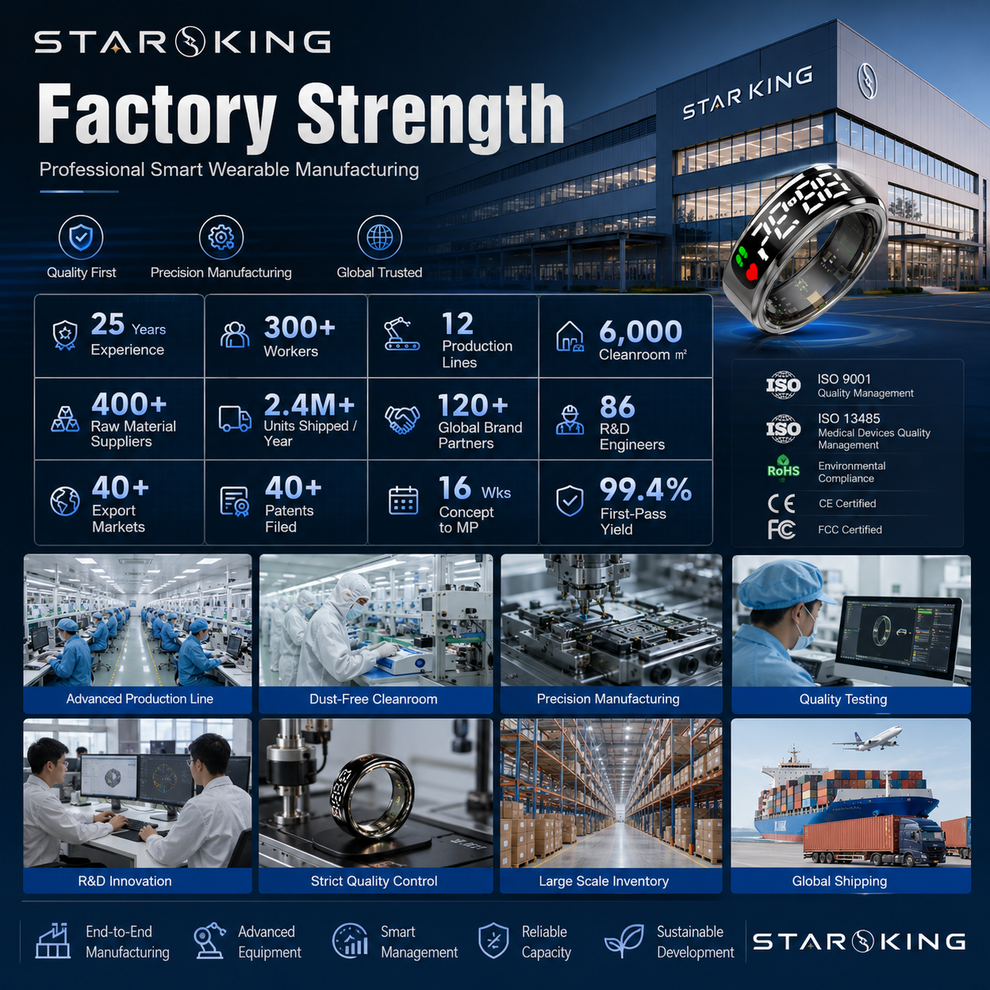
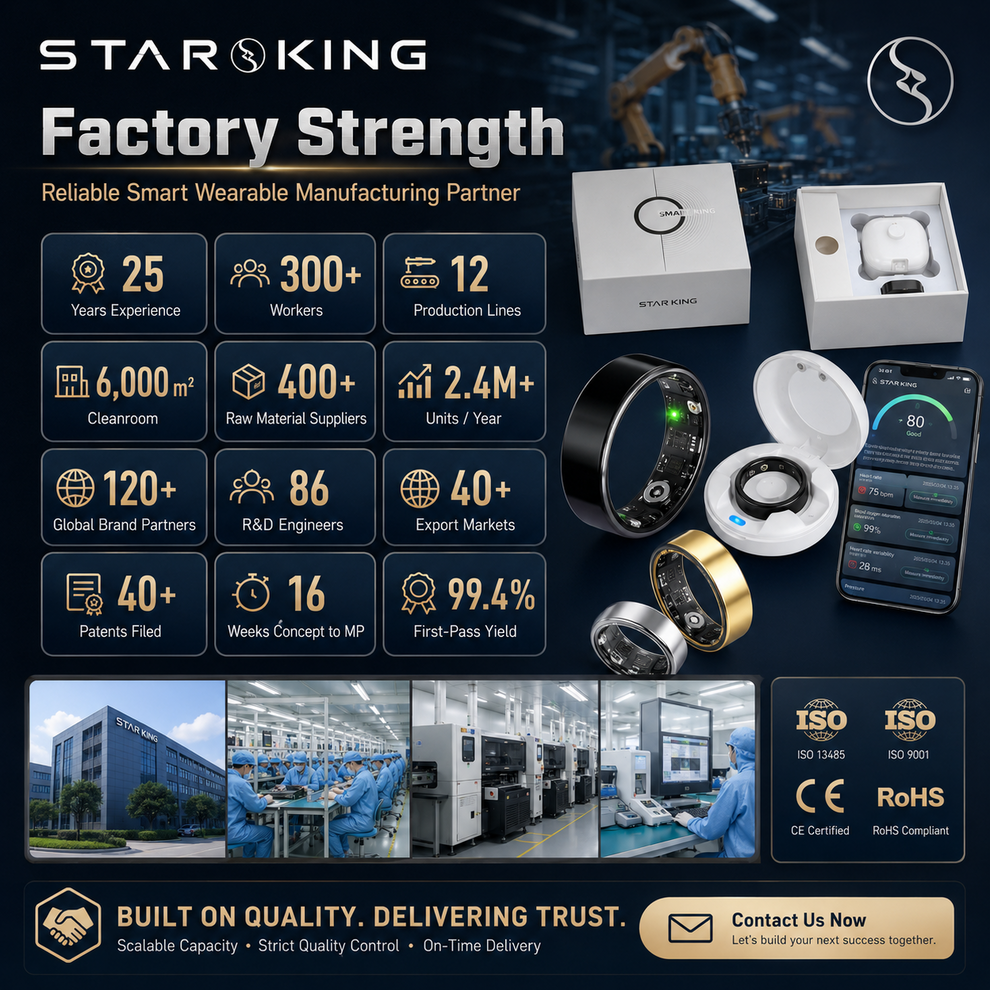
System integrators should evaluate a smart ring OEM partner on five axes: (1) SDK and API access for your platform, (2) documented sensor validation for the specific health metrics you rely on, (3) compliance files appropriate to each target market, (4) realistic MOQ and lead time, and (5) ability to support private-label branding and app customization. The strongest supplier is rarely the cheapest per unit; it is the one that reduces integration risk and after-sale support load across your client base.
Key Takeaways
- Start from the integration use case (data required, latency, client platform), not from ring form factor.
- Clarify whether your project fits OEM, ODM, or private-label engagement — each has different tooling, IP, and MOQ implications.
- Request SDK documentation, sample firmware, and data export formats before signing any NDA-heavy commitment.
- Treat health metrics as wellness data, not diagnostic data; align language with your client’s regulatory exposure.
- Budget for compliance per market — CE, FCC, RoHS, UN38.3, and battery documentation typically differ by configuration and region.
Key Facts for Buyers
| Item | Typical range (verify per project) |
|---|---|
| Engagement models | OEM / ODM / Private Label |
| Typical sampling lead time | 7–20 days after spec freeze [STAR KING TO CONFIRM] |
| Typical MOQ | Project-dependent; often 300–1,000 units for private label [STAR KING TO CONFIRM] |
| Certification scope | Depends on configuration and destination market |
| Battery shipping | UN38.3 test summary and MSDS typically required for lithium cells |
| App customization | White-label app or SDK into your existing app |
Step 1: Define the Integration Use Case Before Selecting a Smart Ring
Before you compare rings, write down four things: the metrics you actually need (e.g., heart rate, SpO₂, sleep staging, temperature), the client-facing platform that will consume them, the data refresh interval acceptable to your client, and the environments the ring will operate in. A corporate wellness rollout has very different constraints than a senior health monitoring pilot.
For buyer context on how these use cases map to product features, review STAR KING’s Private Label OEM/ODM solutions and the Corporate Wellness application page.
Why use-case definition comes first
Integrators who skip this step often commit to a ring with an incompatible SDK or a form factor that does not fit their client’s demographic. Redefining the use case after tooling has begun is expensive and slow.
Step 2: Choose the Right Engagement Model: OEM, ODM, or Private Label
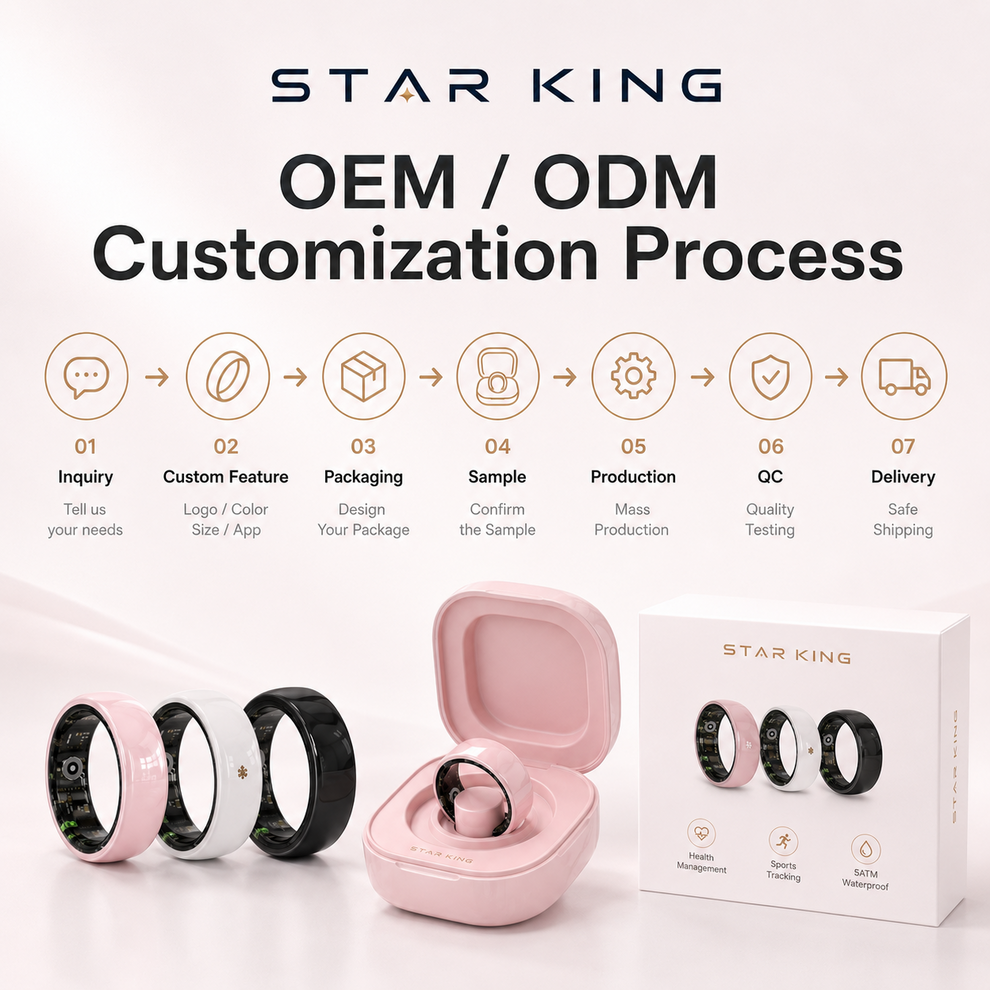
There is no universal best model. OEM suits integrators with in-house hardware design and firmware teams. ODM suits integrators who need a stable, pre-validated platform and want to focus on software and services. Private label suits integrators who want branded rings quickly with minimal engineering.
For a broader view of OEM/ODM patterns for wearables, see STAR KING’s smart rings product page and the OEM/ODM solution overview.
Questions to ask your supplier at this stage
- Which parts of the stack are already built, and which parts will be custom?
- Who owns the tooling and industrial design IP?
- Can we license your app, or must we integrate via SDK?
- What is the smallest viable production run?
Step 3: Evaluate Firmware, SDK, and App Integration Capabilities
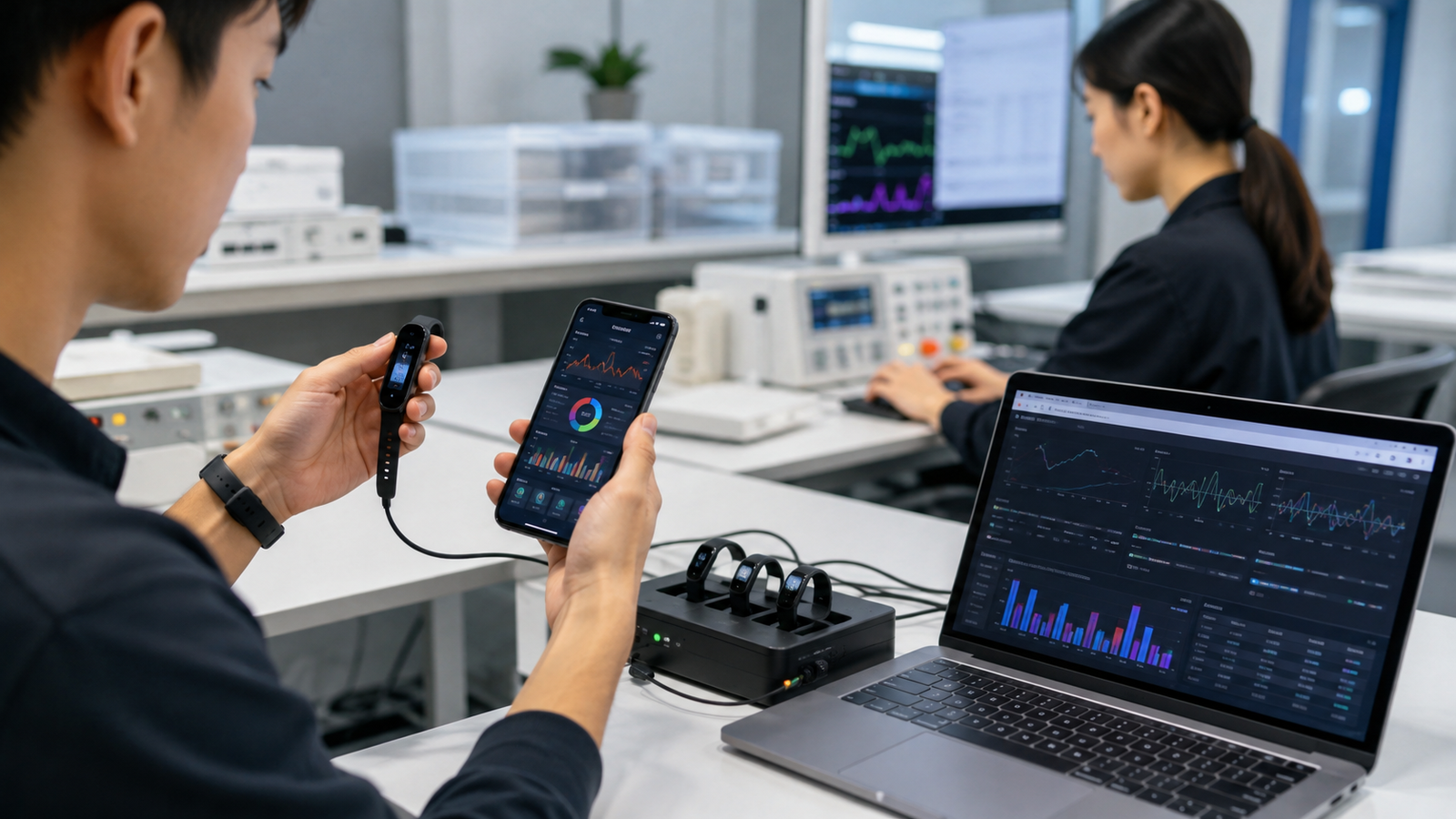
For system integrators, the SDK is often the make-or-break element. Ask for SDK documentation before you ask for pricing. Specifically look for: supported platforms (iOS, Android, Windows, Linux), data schemas, sample code, and update cadence.
What a usable SDK looks like
- Documented data models for each metric, including raw vs. processed values.
- Clear error states and reconnect behavior for BLE drops.
- Versioning policy so an OTA firmware update does not break your integration.
- Support channel with defined response expectations.
App integration paths
Two paths are common: (a) white-label app with your branding and your back-end endpoints; (b) SDK into your existing application. The first is faster to launch; the second gives more control over UX and data flow. See Health & Fitness Wearables solutions for a worked example of both.
Step 4: Validate Sensor Accuracy and Health Data Output
Do not assume that two rings with the same sensor specification produce equivalent data. Validation depends on firmware algorithms, sampling rates, and calibration. For integration projects, request a validation protocol that matches your client’s context (e.g., resting heart rate, overnight SpO₂ trend, sleep staging agreement).
Keep the language clinical-grade only if your supplier provides documented clinical evidence — otherwise describe metrics as wellness indicators. This protects you and your client from compliance exposure.
How to run a small validation pilot
- Select 10–30 users that reflect your target demographic.
- Benchmark against a reference device or your client’s existing method.
- Record variance, drop-outs, and app-side data gaps.
- Document findings for your supplier and for your client’s review.
Step 5: Confirm Compliance, Battery Safety, and Target-Market Certification
Certification is configuration-specific. A ring shipped to the EU with one sensor configuration may require CE marking, while the U.S. version may require FCC authorization. Lithium cells in small wearables typically require UN38.3 test summaries and an MSDS for transport. Do not accept a blanket statement that “all products are certified”; ask for the specific certificates tied to the exact model you will import.
For reference, see the FCC equipment authorization page and the European Commission CE marking overview. UN38.3 testing is described by the IATA lithium battery guidance.
Documentation to request per shipment
- Test reports specific to model and SKU.
- Declaration of Conformity (where applicable).
- UN38.3 test summary and MSDS for battery cells.
- Packaging and labeling artwork for your destination market.
Step 6: Plan MOQ, Tooling, Lead Time, and Landed Cost
MOQ is not a number — it is a function of tooling, components, packaging, and firmware variant count. For system integrators, landed cost should include unit price, tooling amortization, compliance testing, freight, duties, and post-sale support reserve.
Cost drivers to discuss early
- Ring shell material and finish options.
- Sensor set and firmware variants.
- App white-label vs. SDK integration.
- Packaging customization and localized manuals.
- Warranty and spare ring policy.
Step 7: Structure Sampling, Pilot Deployment, and Mass Production
A clean pilot phase protects your client relationship and your reputation. Structure sampling in at least two stages: engineering samples (fit, firmware, SDK) and pre-production samples (matching mass-production components and packaging). Only move to mass production after the pilot confirms SDK stability and data consistency.
Operational tips for integrators
- Freeze the specification in writing before tooling.
- Define acceptance criteria for each sample stage.
- Agree on OTA update policy and rollback plan.
- Document spare-parts and replacement-ring logistics for your client.
OEM vs. ODM vs. Private Label Smart Ring Comparison Table
| Model | Best for | Engineering load | Typical MOQ | IP / Tooling ownership |
|---|---|---|---|---|
| OEM | Integrators with in-house HW/FW teams | High | Project-dependent | Usually buyer |
| ODM | Integrators focusing on software and services | Medium | Lower than OEM | Usually supplier |
| Private Label | Fast branded launch | Low | Often 300–1,000 units | Supplier |
Note: MOQ ranges are illustrative and should be confirmed per project. [STAR KING TO CONFIRM]
Common Mistakes and Buyer Red Flags
- Red flag: Supplier cannot show an SDK schema or sample code.
- Red flag: Blanket claims that “all products are CE/FCC certified” without model-level evidence.
- Red flag: No documented battery test summary for lithium cells.
- Red flag: Verbal-only MOQ and lead time commitments.
- Red flag: No clarity on tooling and IP ownership.
Practical Buyer Checklist
- ☐ Use case, metrics, and latency defined in writing.
- ☐ Engagement model selected (OEM / ODM / Private Label).
- ☐ SDK documentation reviewed by your engineering team.
- ☐ Sensor validation protocol agreed and piloted.
- ☐ Certification files specific to model and market received.
- ☐ MOQ, lead time, and landed cost modeled in a spreadsheet.
- ☐ Sampling stages and acceptance criteria documented.
- ☐ Warranty, spares, and OTA policy confirmed.
Frequently Asked Questions (FAQ)
1. Can a smart ring be integrated into our existing healthcare platform?
Yes, if the supplier provides an SDK with documented data schemas and reconnect logic. Ask for sample code and a versioning policy before committing.
2. Do we need CE and FCC before our pilot?
Not necessarily for a pilot, but you will need them before commercial shipment. Confirm model-level certification timing early to avoid launch delays.
3. What is a realistic MOQ for private-label smart rings?
MOQ depends on tooling, packaging, and firmware variants. Many projects start in the hundreds to low thousands of units; confirm with your supplier.
4. Can the app be white-labeled?
Yes. Many suppliers offer a white-label app with your branding and endpoints; alternatively, integrate the SDK into your own app.
5. What battery documentation is required for international shipping?
Lithium cells typically require a UN38.3 test summary and an MSDS. Requirements may vary by carrier and destination.
6. How long does a smart ring OEM project take?
Timelines vary from a few months for private label to longer for full OEM. Sampling, validation, and compliance are the main time drivers.
7. How do we protect our tooling and IP?
Define ownership in a written agreement before tooling begins. If you fund the tooling, ownership typically belongs to you.
Conclusion
For system integrators, a smart ring is rarely a standalone purchase — it is a component in a solution. The seven steps in this smart ring integration guide are designed to reduce risk across SDK, sensor validation, compliance, MOQ, and production. The most reliable path is a staged engagement: define the use case, select the right model (OEM, ODM, or private label), validate the SDK and sensors, secure market-specific compliance, and pilot before mass production.
If you are evaluating a supplier now, start with samples and technical documentation rather than marketing decks. The integration questions above will tell you more about a supplier’s capability than any brochure.
STAR KING CTA
Ready to evaluate smart ring OEM/ODM options for your integration project? Request product samples or discuss your customization and SDK requirements with STAR KING’s team.
Discuss Your Smart Wearable OEM/ODM Project
Planning a smart ring, smart watch, smart band, AI glasses, AI translator, or AI voice mouse project? Contact STAR KING to discuss product positioning, sample testing, customization scope, certification requirements, lead time, and quotation details.

Team Star King

Scan WhatsApp QR code