Smart Rings for Distributors: 7 Critical Checks Before You Commit in 2026
Smart Rings for Distributors: 7 Critical Checks Before You Commit in 2026
Direct answer: When sourcing smart rings for distributors, the seven checks that determine whether a program succeeds are target use case and SKU mix, supplier capability and ownership, MOQ and landed cost, app and firmware control, sensor and battery claims, certification and battery shipping paperwork, and warranty and spare-part terms. Get all seven right before signing a purchase order; getting two or three wrong usually surfaces as returns, chargebacks, or unsellable inventory within two quarters.
Table of Contents
Table of Contents
Introduction: Why Distributors Are Adding Smart Rings
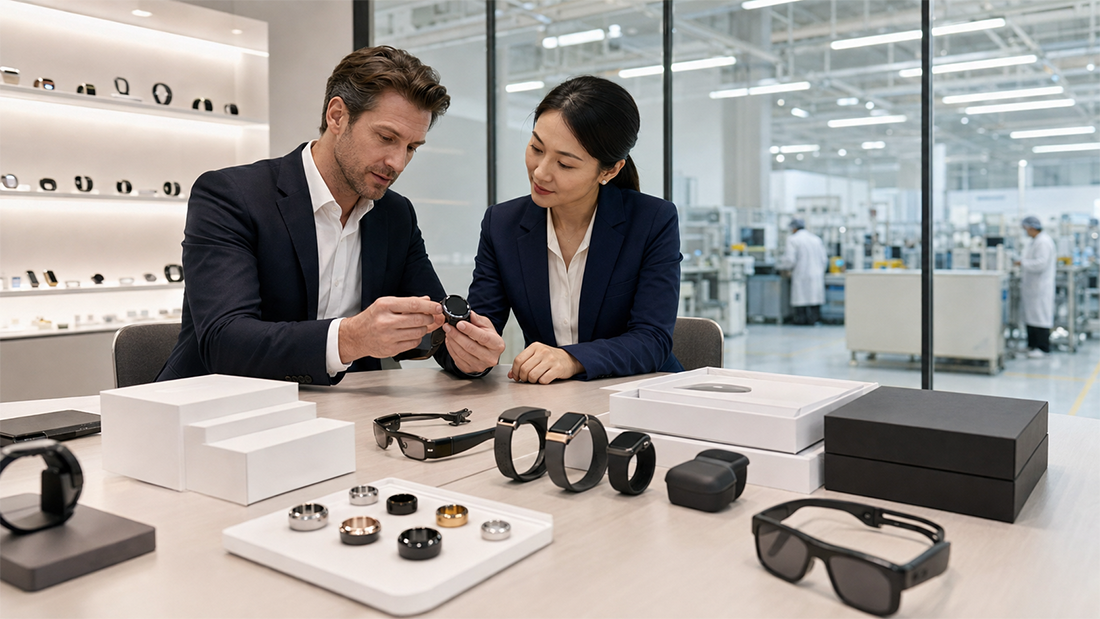
Smart rings have moved from novelty to a defined category in the wearable channel. For distributors, they solve a specific shelf problem: a wearable that does not compete head-on with the smartwatch lines you already carry, has a lower return profile than consumer audio, and attracts customers who want sleep, recovery, and continuous heart-rate data without a screen. That combination is commercially attractive, but it is also operationally different from importing watches or bands.
A smart ring is a sealed, battery-powered medical-adjacent device with a companion app. That means your exposure is not just the hardware BOM. It is the firmware lifecycle, the app store listing, the privacy policy, the lithium battery documentation, and the warranty return path. This guide is written for distributors, importers, and private-label sellers who are at the awareness and early evaluation stage for smart rings for distributors and want a structured way to screen suppliers before committing volume.
Table of Contents
- Short Answer
- Key Takeaways
- Key Facts for Buyers
- What Are Smart Rings for Distributors?
- Check 1: Use Case and SKU Mix
- Check 2: Supplier Capability and Ownership
- Check 3: MOQ, Pricing, and Landed Cost
- Check 4: App, Firmware, and Data Control
- Check 5: Sensor and Battery Claims
- Check 6: Certification and Battery Shipping
- Check 7: Warranty, Spares, and Returns
- Supplier Comparison Table
- Common Mistakes and Buyer Red Flags
- Practical Buyer Checklist
- FAQ
- Conclusion
Short Answer
Smart rings for distributors should be evaluated on seven variables: use case fit, supplier ownership of tooling and firmware, realistic MOQ and landed cost, app and data control, verifiable sensor and battery performance, market-specific certification and UN38.3 battery documentation, and a workable warranty and spares policy. The supplier that answers all seven with documents and not adjectives is the one to trial first. None of these checks require a factory visit to start; they require a written specification, a sample, and an honest answer about what is and is not certified.
Key Takeaways
- Smart rings are a wearable category with low display-competition but higher app, firmware, and battery-documentation overhead than bands or watches.
- MOQ and unit cost matter less than landed cost and return rate; a ring that fails on sizing or app pairing erases margin fast.
- Ownership of tooling, firmware, and the companion app determines your long-term leverage; ask who controls the app store listing.
- Health metrics on consumer smart rings are wellness features, not medical diagnostics; claim language must reflect that.
- Lithium battery shipping requires UN38.3 test summaries and MSDS; air freight acceptance depends on carrier and documentation.
- Certification is configuration- and market-specific. Ask for certificates that match the exact ring size, color, and radio modules you will import.
- A 30-day distributor pilot with one SKU and a written defect-rate target is a low-risk way to test a supplier.
Key Facts for Buyers
| Item | Typical Range / Requirement | Why It Matters to Distributors |
|---|---|---|
| Ring sizes offered | US 6–13 typical | Size coverage drives fit returns |
| Battery life claim | 3–7 days typical | Must match marketing copy to avoid returns |
| Charging | Dock or case | Affects accessory attach rate |
| App | iOS + Android | Dual coverage is required for most markets |
| Certification | CE, FCC, RoHS depending on market | Customs and platform listing requirement |
| Battery shipping | UN38.3 + MSDS | Air freight and platform requirement |
| MOQ | [STAR KING TO CONFIRM] | Cash tied up in first order |
| Lead time | [STAR KING TO CONFIRM] | Channel timing and launch planning |
| Warranty | Typically 12 months | Sets your returns reserve |
What Are Smart Rings for Distributors?
What are smart rings? A smart ring is a sealed wearable worn on a finger that uses optical and motion sensors to estimate metrics such as heart rate, heart-rate variability, blood oxygen, skin temperature, and sleep stages, and transmits that data to a companion smartphone app over Bluetooth Low Energy. For distributors, the relevant definition is broader: it is a finished consumer product plus a firmware platform plus a mobile app plus a lithium battery documentation package, sold through a channel you control.
How should distributors evaluate smart rings? Treat the ring as a system, not a component. Evaluate the hardware, the app, the data flow, the documentation, and the after-sales path as one package. A supplier that is strong on hardware but weak on app maintenance will cost you more over 24 months than a supplier with a slightly higher unit price and a stable software roadmap.
If your channel already sells fitness or recovery products, smart rings extend the category naturally. If you are new to wearables, the health and fitness wearables solution overview is a useful starting point for understanding how the category is positioned at retail.
Check 1: Use Case and SKU Mix
Before you discuss MOQ, decide what the ring is for. The same hardware is often sold into very different channels, and the use case determines which sizes, finishes, and app features you stock.
Common Distributor Use Cases
- Sleep and recovery — appeals to wellness retailers and DTC brands. Review sleep and recovery applications.
- Fitness tracking — pairs with gym, running, and outdoor channels.
- Women’s health — requires careful claim language and privacy positioning.
- Corporate wellness — bulk channel with different packaging and admin requirements.
- Senior monitoring — requires a clear statement that the device is not a medical device.
Each use case implies a different SKU mix, a different app onboarding flow, and often a different warranty conversation. Distributors who stock a single generic SKU across all channels usually end up with weak sell-through in every one of them.
Check 2: Supplier Capability and Ownership
The most important question a distributor can ask is: who owns what? Tooling, firmware, app source, brand, and documentation can sit with the supplier, with a third party, or with you. That ownership determines your leverage in year two.
Questions to Ask
- Does the supplier own the tooling, or is it shared with other buyers?
- Can the firmware be customized for your brand, and is there an SDK?
- Who holds the app store developer account?
- Is the app white-labelable, or is it a single shared app?
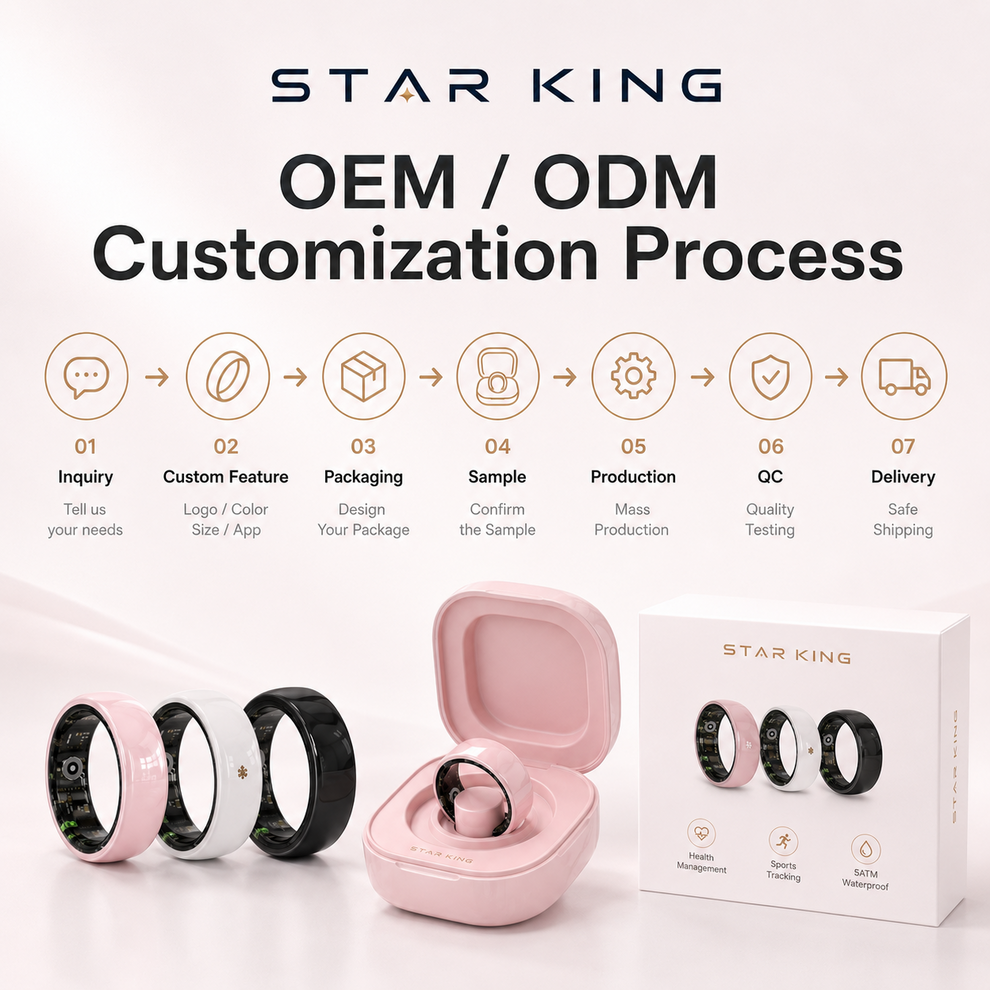
Shared apps are cheaper and faster to launch but weaken differentiation and make you dependent on the supplier’s update schedule. White-label or dedicated apps cost more upfront but protect brand equity. If you are planning a private-label program, review the private label OEM/ODM solution to understand how branding, packaging, and firmware customization are typically scoped.
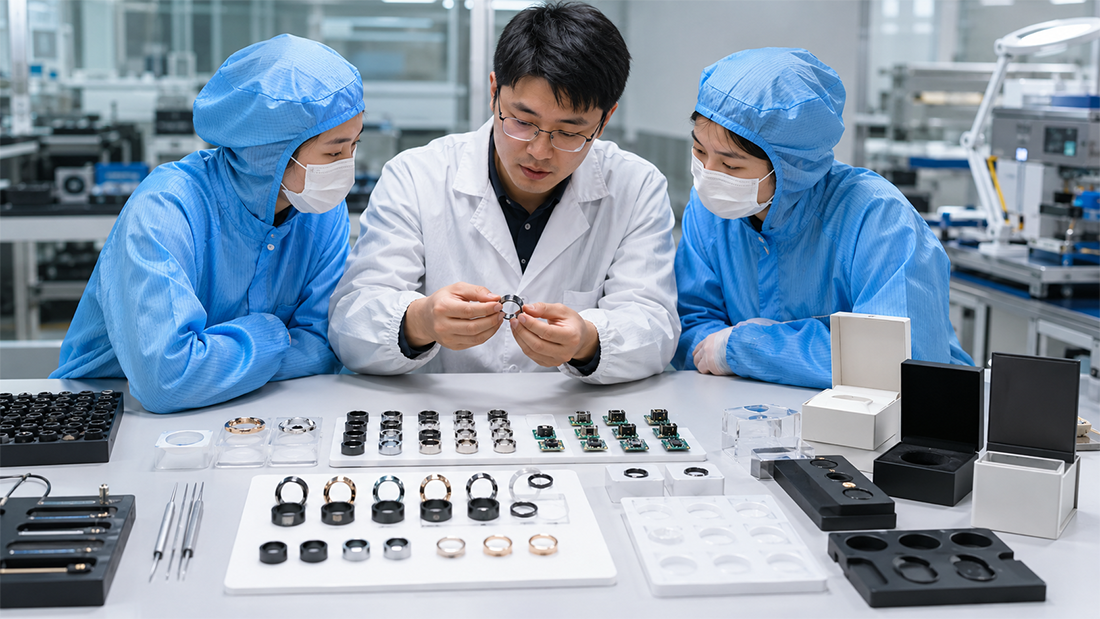
Capability is also a production question. Ask how many ring sizes the supplier molds, whether it controls its own sensor calibration, and what share of production is in-house versus outsourced. A supplier that does its own calibration and final test is generally easier to hold to a defect-rate target.
Check 3: MOQ, Pricing, and Landed Cost
MOQ is the least useful number in isolation. What matters is landed cost per sellable unit after freight, duty, defect allowance, and size-mix returns.
Cost Factors Distributors Should Model
- Ex-works or FOB unit price by size and finish.
- Tooling or mold amortization if you want a custom shell.
- Freight mode and lithium battery handling surcharges.
- Import duty and tax by destination market.
- Defect and return allowance (typically 2–5% depending on category experience).
- Warranty reserve.
STAR KING MOQ, sample pricing, and volume tiers are [STAR KING TO CONFIRM]. Ask for a written quotation that separates tooling, unit price, packaging, and freight so you can compare suppliers on the same basis. A supplier that quotes a single blended number is harder to audit and usually hides the flexibility you need for a pilot order.
Example Landed Cost Worksheet (Illustrative)
| Cost Line | Basis | Notes |
|---|---|---|
| Unit price | FOB, per size | Confirm by ring size and finish |
| Tooling | One-time | Only if custom shell required |
| Freight | Air or sea | Lithium battery rules apply |
| Duty/tax | Destination | Verify with your customs broker |
| Defect allowance | % of units | Set from pilot data |
| Warranty reserve | % of revenue | Set from return data |
If the pilot order economics are unclear, the program will not scale. Ask suppliers to quote the same quantity and specification so the comparison is meaningful. If you want STAR KING to quote a specific quantity, the fastest path is to request samples and confirm the configuration first.
Check 4: App, Firmware, and Data Control
The app is where most distributor programs live or die. It is also the part suppliers most often under-describe.
What to Verify in the App
- iOS and Android availability, with store approval status.
- Onboarding flow: pairing, sizing, account creation, permissions.
- Data export and account deletion (relevant to privacy regulation).
- Language support for your target markets.
- Update cadence and who responds when an OS update breaks pairing.
Data control is a compliance issue as well as a commercial one. Under the EU General Data Protection Regulation, health-related data carries a higher protection standard, and distributors selling into the EU or UK should understand where user data is stored and who the data controller is. The official European Commission data protection portal is the correct starting reference for your legal review. Never accept a supplier’s verbal assurance on data flows; ask for the privacy policy and the data processing terms.
Check 5: Sensor and Battery Claims
Marketing often overstates what a smart ring measures. Distributors should insist on the underlying sensor set and the claim language that accompanies it.
Sensor Reality Check
- Photoplethysmography (PPG) sensors estimate heart rate; they do not diagnose.
- Blood oxygen estimates on consumer rings are wellness indications, not clinical measurements.
- Skin temperature trends are useful for recovery context, not diagnosis.
- Sleep staging is algorithm-dependent and varies between suppliers.
Consumer wearables in the United States that make general wellness claims typically fall under the FDA’s general wellness guidance rather than device regulation. The FDA general wellness policy for low-risk digital health products is the correct reference to read before writing any claim in your marketing or packaging.
Battery Claims
Battery life is the single most quoted and least comparable specification. Ring battery life depends on ring size, sensor sampling rate, notification load, and ambient temperature. Ask the supplier to define the test protocol behind any battery claim — for example, continuous heart-rate plus nightly sleep tracking, screen-free. Realistic distributor planning ranges are typically 3–7 days. STAR KING battery capacity and rated life per ring size are [STAR KING TO CONFIRM].
Consider inserting an image here:
Image suggestion (see image_seo_suggestions): smart ring size comparison chart with component callouts.
Check 6: Certification and Battery Shipping
Certification is the area where inexperienced distributors get stuck at customs. Requirements depend on the market, the radio module, and the exact configuration.
Certification by Market
- United States — radio-frequency devices require FCC authorization. The FCC Equipment Authorization page explains the rules for intentional and unintentional radiators.
- European Union — CE marking, RED for radio, and RoHS restrictions on hazardous substances may apply. The EU’s CE marking portal is the authoritative starting point.
- Other markets — additional national certifications may be required. Buyers should verify with their customs broker and local regulator.
Certification is configuration-specific. A certificate for one ring size, color, or radio module does not automatically cover another. Ask for certificates that name the exact model and variant you will import, and confirm the certificate holder.
Lithium Battery Documentation
Smart rings use lithium cells, so air freight requires documentation. In practice, this means a UN38.3 test summary and an MSDS. The IATA Dangerous Goods Regulations govern how lithium batteries are declared and packed for air transport, and carriers apply them strictly. Distributors should request these documents before booking freight, not after.
Related content on this site: wearable sourcing resources covers packaging and documentation workflows in more depth.
Check 7: Warranty, Spares, and Returns
A sealed ring cannot be repaired in the field, so your warranty model is really a replacement model. That changes the economics.
Warranty Terms to Negotiate
- Warranty duration and what voids it.
- Whether replacement units ship from the supplier or from a regional depot.
- Spare chargers and charging cases, and how they are priced.
- Defect rate threshold that triggers supplier credit.
- Process for the first 30 days versus months 2–12.
Negotiate a replacement ratio, not just a percentage. For example, a supplier may agree to replace units failing within the first 60 days at no charge up to an agreed percentage. The exact ratio should reflect the supplied defect rate from your pilot. STAR KING’s standard warranty and spares terms are [STAR KING TO CONFIRM].
Consider inserting an image here:
Image suggestion (see image_seo_suggestions): ring packaging and charging case with private-label branding.
Supplier Comparison Table
Use this table to score suppliers consistently. Weight each row by how much it matters for your channel.
| Criteria | What to Look For | Weight |
|---|---|---|
| Hardware ownership | In-house tooling and calibration | High |
| App strategy | Dedicated or white-label option | High |
| Documentation | Certificates and test summaries named to the exact model | High |
| MOQ flexibility | Pilot order possible before full volume | Medium |
| Lead time | Written and repeatable | Medium |
| Warranty ratio | Replacement commitment | Medium |
| Sample responsiveness | Sample shipped within a defined window | Low/Medium |
If you are evaluating STAR KING alongside other suppliers, use the same scoring table and the same requested specification. Standardizing the questionnaire is the fastest way to get comparable answers.
Common Mistakes and Buyer Red Flags
Common Mistakes
- Buying on unit price before modeling landed cost and returns.
- Accepting a shared app without understanding who controls updates.
- Treating a generic certificate as valid for every ring size and color.
- Using medical language in marketing copy for a wellness device.
- Skipping a pilot and ordering full container volume on a first sample.
Buyer Red Flags
- A supplier who cannot name the certificate holder.
- A battery life claim with no described test protocol.
- MOQ that changes after the specification is finalized.
- Reluctance to provide a UN38.3 summary or MSDS.
- An app with no published privacy policy.
- Firmware update responsibility that is described only verbally.
None of these red flags are unique to any one supplier; they are common in the wearable sourcing category. Their presence simply means you should ask for documentation before moving to a purchase order.
Practical Buyer Checklist
Use the following checklist as a gate before issuing a purchase order.
- Confirm the intended use case and channel for each SKU.
- Get the size range and finish options in writing.
- Confirm who owns tooling, firmware, and the app account.
- Request a written quotation separating tooling, unit, packaging, and freight.
- Run a 30-day pilot with defect-rate and pairing-success metrics.
- Request the app privacy policy and data terms.
- Validate battery and sensor claims against a described test protocol.
- Collect certificates that name the exact model and configuration.
- Collect UN38.3 summaries and MSDS before booking freight.
- Agree on warranty duration, replacement ratio, and spares pricing.
- Confirm packaging artwork and barcode requirements for your market.
- Verify import duty and any local registration requirement with your broker.
Frequently Asked Questions
What MOQ should a distributor expect for smart rings?
MOQ varies by supplier, finish, and whether the order is a stock model or a private-label configuration. Stock-color programs generally carry lower MOQs than custom-shell programs. STAR KING’s specific MOQ by configuration is [STAR KING TO CONFIRM]. Ask for a pilot quantity before committing to a full order.
Are smart ring health metrics medical measurements?
No. Consumer smart rings provide wellness estimates such as heart rate, heart-rate variability, blood oxygen, and sleep-stage trends. They are not medical devices and should not be marketed as diagnostic tools. Claim language should always reflect a general wellness positioning.
Do I need separate certification for each ring size?
Not always, but the certificate must cover the exact configuration you import. Radio and safety approvals are tied to specific models and radio modules. Buyers should verify with the supplier and their customs broker whether the certificate you are shown covers your SKU.
How long does shipping documentation take for lithium battery products?
UN38.3 test summaries and MSDS are typically prepared by the cell or pack supplier and expire or change with cell changes. Allow extra lead time for the first shipment and confirm the carrier accepts your documentation before booking. Requirements depend on the carrier and the destination market.
Can I white-label the companion app?
Some suppliers offer a dedicated or white-label app; others publish a single shared app. White-label apps usually require additional development time and cost. STAR KING’s app customization options are [STAR KING TO CONFIRM]. Confirm app store ownership and update responsibilities in writing.
What defect rate is normal for a first smart ring order?
There is no universal figure. Establish a baseline through a 30-day pilot and use that data to set a warranty reserve and a replacement ratio with your supplier. A written agreement on defect handling is more valuable than an advertised defect percentage.
Which markets require the most documentation?
The EU and US generally require the most formal documentation for radio devices and lithium batteries. Other markets may add local registration. Requirements typically depend on the product configuration and the destination, so buyers should verify with a customs broker and the local regulator.
Conclusion
Smart rings are a workable addition to a wearable distribution portfolio, but only for buyers who treat the product as a system. The seven checks in this guide — use case, supplier capability, MOQ and landed cost, app control, sensor and battery claims, certification and battery shipping, and warranty terms — are the same checks your competitors are running. Doing them in writing, before the purchase order, is the difference between a program that scales and one that returns to the warehouse in month three.
Start with a defined pilot, insist on model-specific documents, and keep the app and firmware conversation commercial rather than technical. That posture gets you a supplier relationship built on evidence.
STAR KING CTA
If you are evaluating smart ring programs for your channel, STAR KING can provide product samples, configuration options, and OEM/ODM terms for private-label programs. Request samples and confirm the specification for your target market so we can quote MOQ, lead time, and customization scope accurately.
Request product samples and confirm your smart ring configuration →
Discuss Your Smart Wearable OEM/ODM Project
Planning a smart ring, smart watch, smart band, AI glasses, AI translator, or AI voice mouse project? Contact STAR KING to discuss product positioning, sample testing, customization scope, certification requirements, lead time, and quotation details.

Team Star King
Scan WhatsApp QR code