smart ring manufacturer: How Startup Brands Choose the Right Smart Ring Manufacturer: 7 Critical Steps for 2026
How Startup Brands Choose the Right Smart Ring Manufacturer: 7 Critical Steps for 2026
Short Answer: To select a smart ring manufacturer, startups should evaluate seven critical areas: technical and manufacturing capability, OEM/ODM flexibility, MOQ and pricing, sample validation, quality control, certifications, and communication/supply chain transparency. Prioritizing partners with proven wearable experience, clear IP policies, and scalable production reduces launch risk.
Table of Contents
Table of Contents
smart ring manufacturer: Direct Answer
Choosing a smart ring manufacturer requires balancing technical feasibility, cost, and compliance for your target market. The right partner provides transparent MOQs, rigorous quality control, and a clear path to certifications. Focus on manufacturers with experience in miniaturized wearables and a track record of supporting startup brands. Use a structured evaluation—request samples, audit factories, and verify certifications—to avoid common pitfalls.
Introduction
Selecting the right smart ring manufacturer is a make-or-break decision for startup brands entering the wearable market. Unlike sourcing standard accessories, smart rings involve complex engineering, miniature batteries, biometric sensors, and tight tolerances. A wrong partner can delay your launch, inflate costs, or expose you to compliance failures. This guide walks startup founders and product managers through a proven seven-step framework to evaluate smart ring manufacturers. You will learn what to ask, which red flags to avoid, and how to structure a partnership that scales with your brand. By the end, you will have a actionable checklist to shortlist and verify suppliers confidently.

Key Takeaways
- Focus on manufacturers with demonstrated experience in miniaturized wearable electronics, not general electronics.
- OEM and ODM models offer different trade-offs: OEM gives you design control; ODM speeds time-to-market but limits customization.
- MOQs for smart rings typically range from 500 to 2,000 units, but can be lower for pilot runs. Pricing is volume-dependent and influenced by sensor selection, battery, and materials.
- Always request pre-production samples and validate fit, finish, app connectivity, and battery performance before mass production.
- Certifications (CE, FCC, RoHS, UN38.3) are critical for market access; confirm which are included and which you must fund.
- Insist on clear IP ownership terms and a supply chain contingency plan.

Key Facts for Buyers
| Factor | Typical Range / Considerations |
|---|---|
| MOQ (smart rings) | 500 – 2,000 units; lower for pilot runs (may be 100-300). Confirm per model. |
| Tooling lead time | 4 – 8 weeks after design freeze. |
| Sample lead time | 2 – 4 weeks for existing designs; 6 – 10 weeks for custom. |
| Mass production lead time | 6 – 10 weeks after sample approval, depending on order size. |
| Key certifications | CE, FCC, RoHS, UN38.3, MSDS for battery shipping. |
| App development | Often provided by manufacturer or third party; customization possible. |
Note: Actual figures depend on specific product configuration, order volume, and manufacturer capabilities. Always request a detailed quotation.
Step 1: Assess Technical & Manufacturing Capability
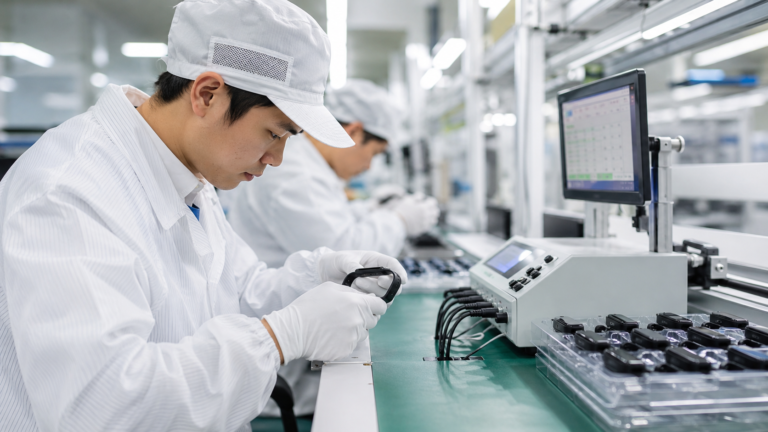
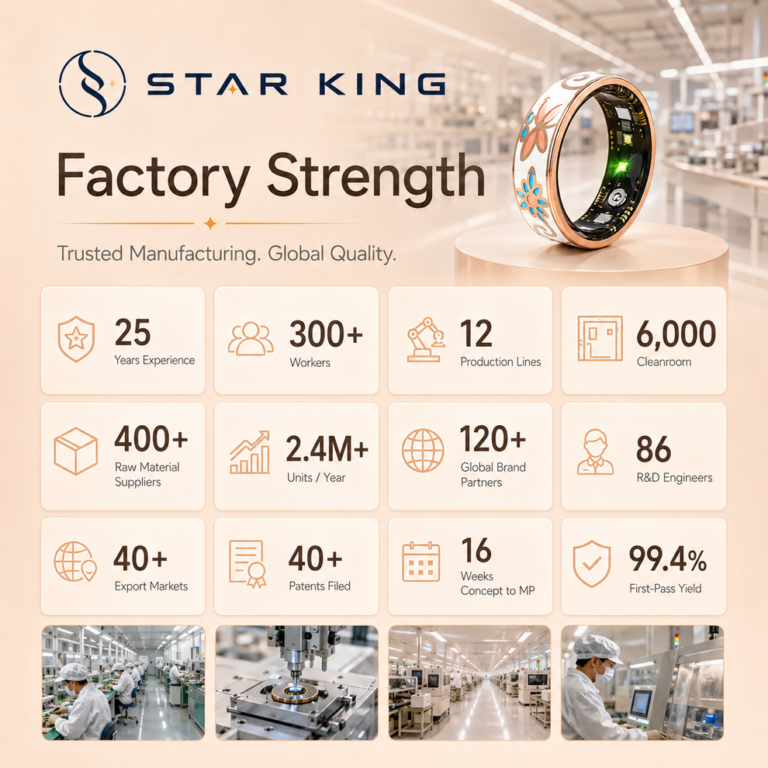
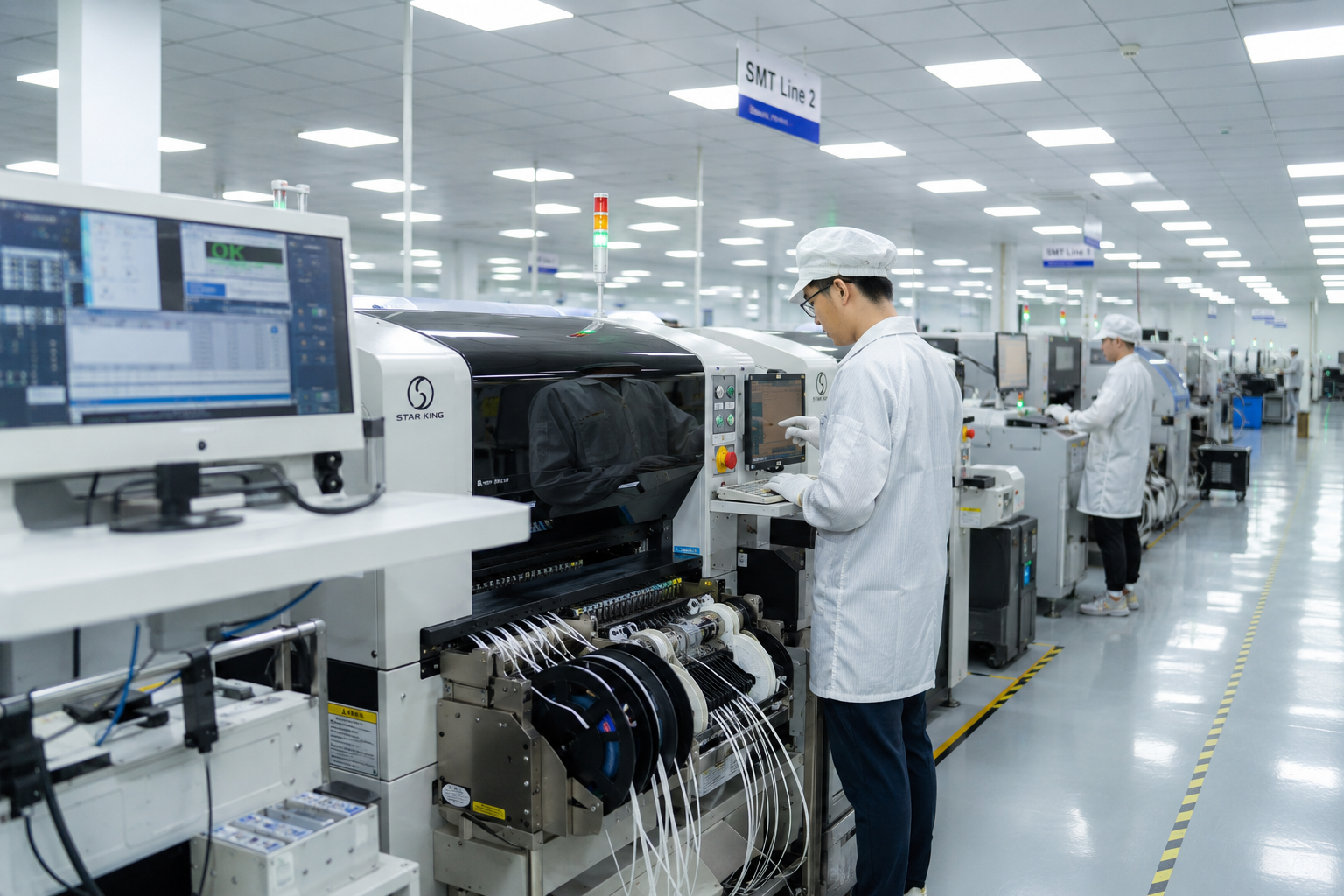
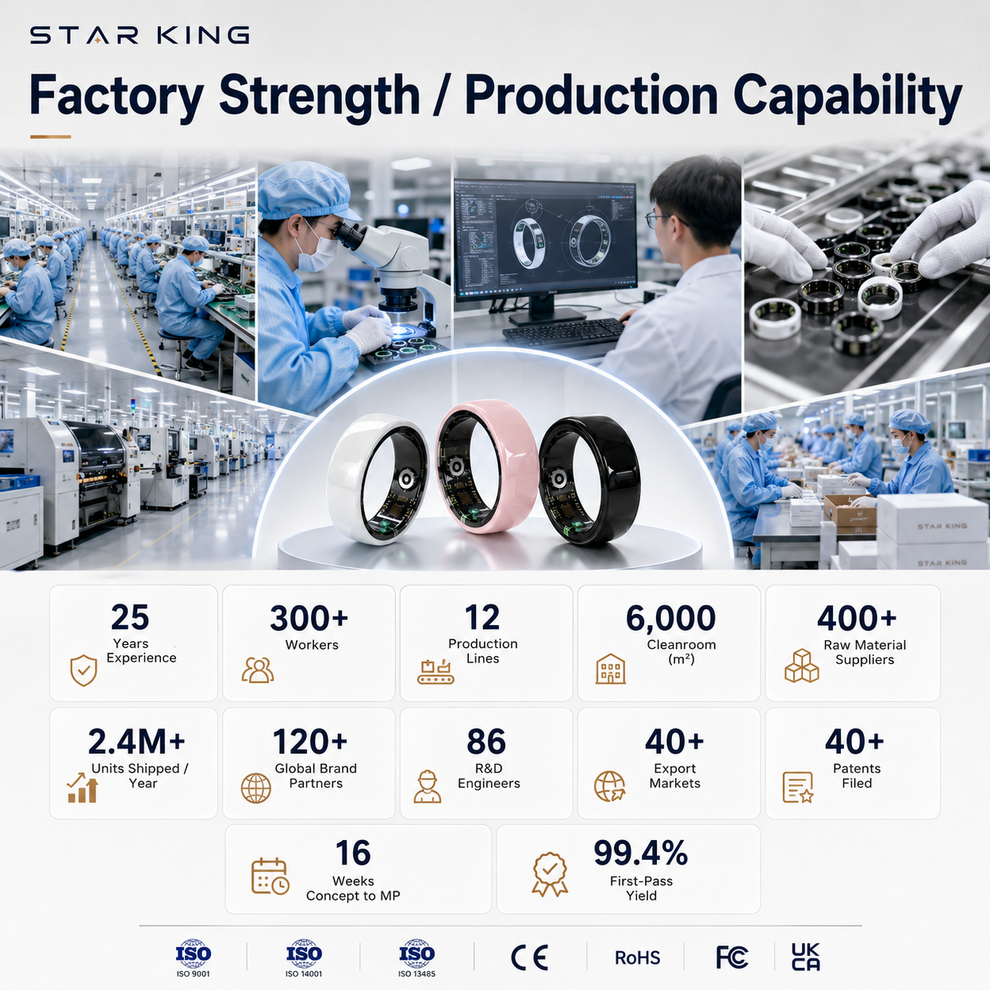
Smart rings are not simple gadgets. They pack a battery, sensors (heart rate, SpO2, temperature), a Bluetooth chip, and an antenna into a space smaller than a wedding band. Not every electronics manufacturer can handle the miniaturization, waterproofing, and biocompatible materials required. When evaluating a smart ring manufacturer, ask for evidence of past projects in wearable rings or similarly miniaturized devices. Look for in-house capabilities in PCB assembly, antenna tuning, and waterproof testing. A supplier that only assembles modules from third parties may struggle with quality control and customization.
What to verify:
- Engineering team with RF and sensor integration experience.
- Cleanroom or controlled environment for sensitive assembly.
- In-house testing for waterproofing (IP rating) and drop.
- Case studies or references from other wearable brands (respecting NDAs).
If a manufacturer cannot explain how they tune antennas or manage battery thermal limits, that is a red flag. Startup brands should prioritize partners who can co-develop solutions, not just execute orders. STAR KING’s smart rings showcase our expertise in compact wearable design, and we support startups with technical guidance from concept to production.
Step 2: Clarify OEM vs ODM Options
Your business model determines whether OEM or ODM is the right fit. OEM (Original Equipment Manufacturer) means you bring your own design and specifications; the manufacturer builds to your requirements. ODM (Original Design Manufacturer) means you select from existing designs and customize branding, packaging, and sometimes features. For startups, ODM can accelerate time-to-market and reduce upfront engineering costs. However, OEM offers greater differentiation if you have a unique value proposition.
Comparison: OEM vs ODM for Smart Rings
| Aspect | OEM | ODM |
|---|---|---|
| Design ownership | You own the design; manufacturer builds to spec. | Manufacturer owns base design; you license/brand it. |
| Upfront cost | Higher (tooling, engineering, certification). | Lower (no tooling, shared certification). |
| Time to market | Longer (6-12 months). | Shorter (2-4 months). |
| Differentiation | High; you control features and form factor. | Lower; design may be similar to others. |
| MOQ | Typically higher (1,000+ units). | Often lower (500+ units). |
| IP ownership | You retain IP; ensure contract states this. | Manufacturer retains base IP; you get license for branding. |
Discuss your long-term roadmap with the manufacturer. If you plan to scale and differentiate, OEM may be worth the investment. If speed and low risk are priorities, ODM with private label customization can be effective. STAR KING offers both Private Label OEM/ODM solutions tailored to startup brands.
Step 3: Understand MOQs, Pricing & Lead Times
MOQs (Minimum Order Quantities) and pricing are often the first questions startups ask. For smart rings, MOQs vary widely. Some manufacturers require 2,000 units per model; others accept 500 for initial runs. Pricing depends on volume, sensor package, battery capacity, materials (titanium, ceramic, plastic), and customization. Always request a detailed quotation that breaks down unit cost, tooling, certification, packaging, and shipping.
Cost drivers:
- Sensor suite: Basic heart rate vs. multi-sensor (SpO2, temperature, ECG).
- Battery: Capacity affects size and cost; UN38.3 certification adds cost.
- Materials: Titanium or ceramic drives up cost vs. plastic.
- Tooling: Custom molds for unique designs are a one-time cost.
- Certification: CE, FCC, RoHS, etc., can be significant; confirm who pays.
Lead times typically include tooling (4-8 weeks), sample production (2-4 weeks), and mass production (6-10 weeks). Plan for a total of 4-6 months from PO to delivery for a custom smart ring. For ODM, you can cut 2-3 months. Be wary of manufacturers promising unrealistic timelines; hardware development takes time.
Step 4: Validate Samples & Design for Manufacturing
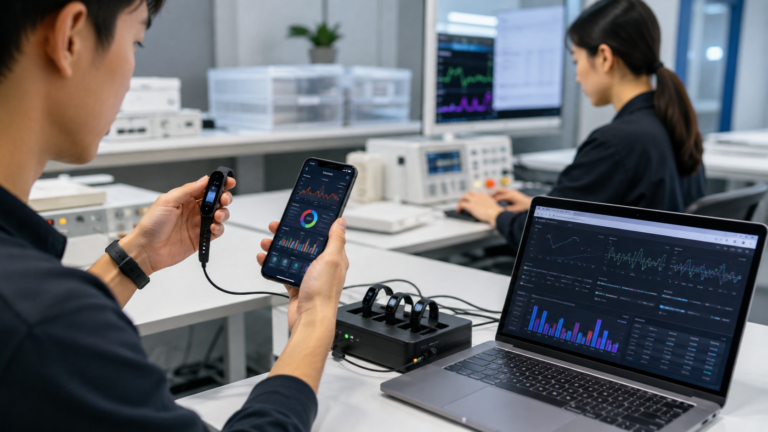
Never commit to mass production without validating pre-production samples. Request samples that are as close to final as possible, including packaging and app. Test thoroughly:
- Fit and comfort: Wear for several days to assess ergonomics.
- App connectivity: Test Bluetooth range, pairing stability, and data sync.
- Battery life: Verify claims under real-world usage.
- Sensor accuracy: Compare heart rate and SpO2 with a medical-grade device (note: consumer wearables are not medical devices).
- Water resistance: Confirm IP rating with a water immersion test.
Also, review the design for manufacturability (DFM). A design that looks great on paper may be hard to assemble or prone to defects. Ask the manufacturer for a DFM report. If they cannot provide one, consider it a warning sign.
Step 5: Evaluate Quality Control & Reliability
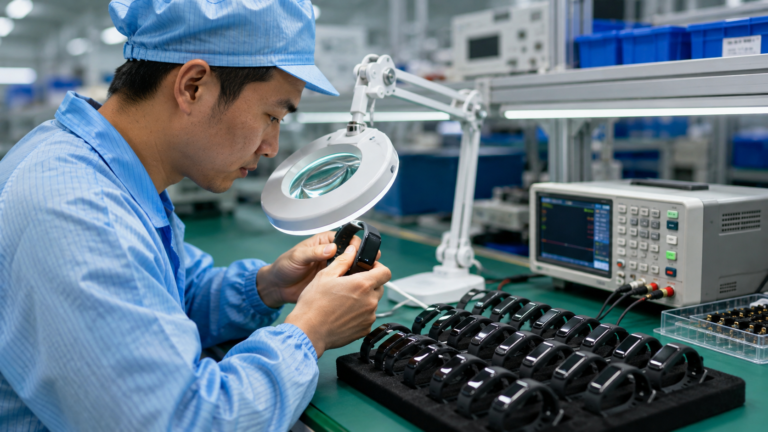
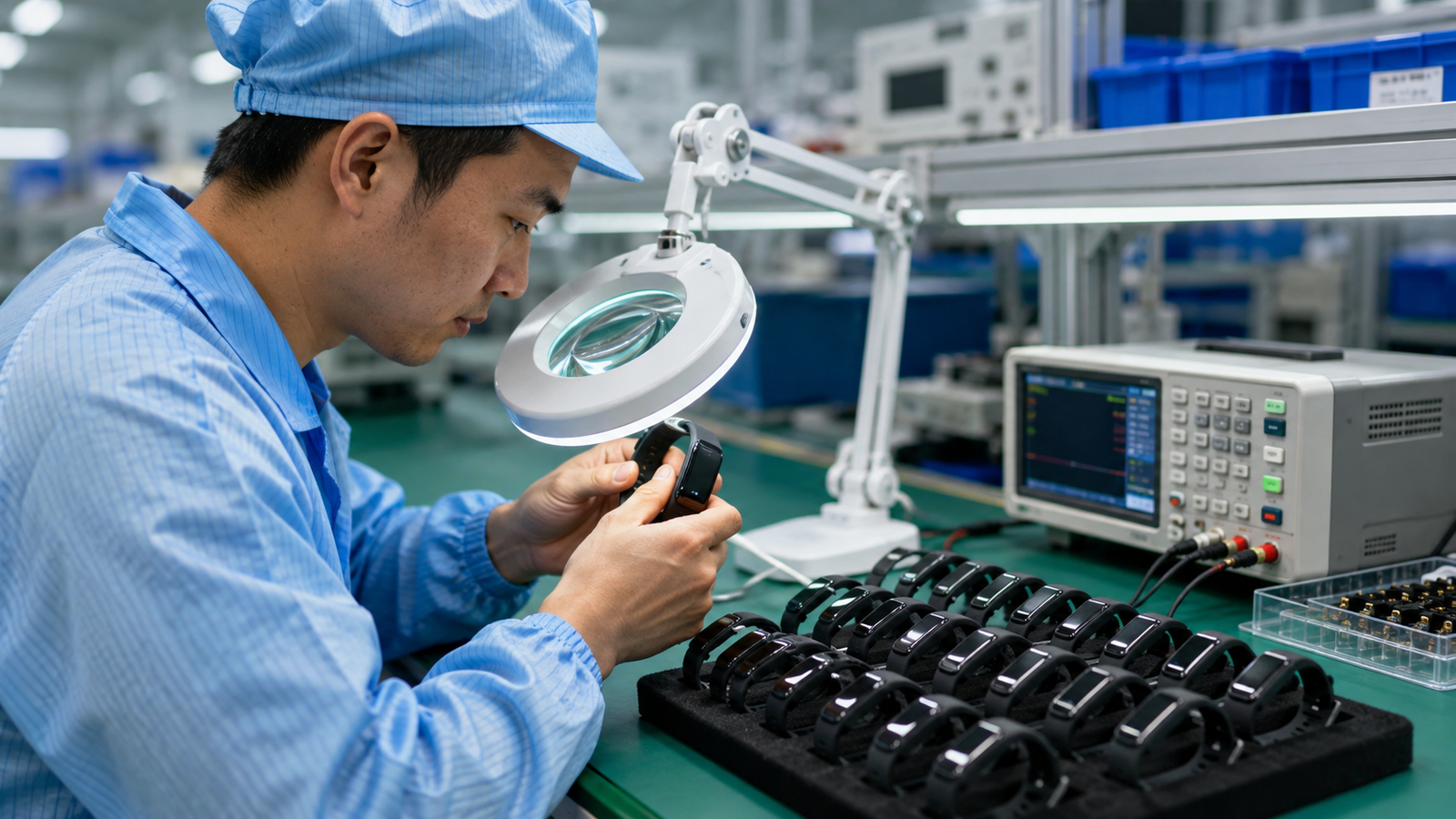
Quality control (QC) separates reliable manufacturers from risky ones. Ask about their QC process at each stage: incoming materials, in-process assembly, and final testing. A robust QC plan includes:
- Supplier qualification for critical components (sensors, batteries).
- Statistical process control (SPC) on assembly lines.
- Functional testing of every unit (pairing, charging, sensors).
- Reliability testing: drop, waterproof, aging, temperature cycling.
- Pre-shipment inspection (PSI) with AQL sampling.
Request their QC documentation and, if possible, conduct a factory audit. For startups, a third-party inspection (e.g., SGS, Bureau Veritas) before shipment is a worthwhile investment. It catches defects early and protects your brand reputation. STAR KING implements rigorous QC protocols; details can be shared during supplier discussions [STAR KING TO CONFIRM specific QC metrics].
Step 6: Verify Certifications & Target-Market Compliance
Smart rings contain a lithium battery and a radio transmitter, so they must comply with regulations in each market. Common certifications include:
- CE for European Union (Radio Equipment Directive, EMC, safety).
- FCC for United States (radio frequency).
- RoHS for hazardous substances (EU, UK, and others).
- UN38.3 for lithium battery transport.
- MSDS for battery shipping documentation.
Not all products are certified by default. Certification depends on the specific configuration and target market. Buyers should verify that the manufacturer can provide test reports and certificates for the exact model they intend to import. Some manufacturers include certification in the unit price; others charge separately. Clarify this early. For official information, refer to the FCC and EU Single Market resources. Additionally, compliance with Bluetooth SIG standards may be required; check the Bluetooth SIG for details.
Note: This is general guidance, not legal advice. Regulations change; always consult a compliance specialist.
Step 7: Confirm Supply Chain Transparency & Communication
Even the best product can fail if the supply chain is opaque or communication is poor. During supplier selection, assess:
- Responsiveness: How quickly do they reply? Do they answer technical questions?
- Supply chain visibility: Can they identify component sources and lead times?
- Contingency plans: What happens if a key component is delayed?
- IP protection: Do they have a clear policy on design ownership and confidentiality?
- After-sales support: Warranty terms, spare parts availability, and return process.
Startup brands should also consider the manufacturer’s ability to scale with them. A partner who can grow from 500 to 10,000 units per month without quality issues is valuable. Ask for their capacity and expansion plans. STAR KING supports startups with scalable manufacturing and dedicated account management; contact our sales team to discuss your project.
Common Mistakes Startup Brands Make
- Choosing on price alone: The cheapest smart ring manufacturer often cuts corners on QC, certification, or materials, leading to higher costs later.
- Ignoring MOQ flexibility: Locking into a high MOQ ties up capital and inventory. Seek pilot-friendly terms.
- Skipping sample validation: Assuming the final product will match the brochure is risky. Always test samples.
- Overlooking certification costs: These can add thousands of dollars; include them in your budget.
- Not clarifying IP ownership: If you co-develop, ensure you own the design or have exclusive rights.
- Underestimating lead times: Hardware development takes months; plan accordingly.
- Failing to audit the factory: A virtual relationship is not enough; visit or hire a third party.
Buyer Red Flags
- Vague answers about testing or certification.
- Pressure to pay large deposits upfront without a contract.
- No clear IP policy or refusal to sign NDA.
- Unrealistically low prices or lead times.
- Poor communication or evasiveness.
Practical Buyer Checklist
| Area | Questions to Ask |
|---|---|
| Capability | Do you have experience with smart rings? Can you share case studies? |
| OEM/ODM | What is your model? What customization is possible? |
| MOQ & Pricing | What is the MOQ per model? Can we start with a pilot run? Provide a detailed quote. |
| Samples | What is the sample lead time and cost? Can we test the app and sensors? |
| QC | What is your QC process? Can we conduct a pre-shipment inspection? |
| Certifications | Which certifications are included? For which markets? Who pays? |
| Supply Chain | Who are your key component suppliers? What are the contingency plans? |
| IP | Who owns the design and tooling? Will you sign an NDA? |
Frequently Asked Questions
1. What is the typical MOQ for a custom smart ring?
MOQs vary by manufacturer and design. For custom OEM smart rings, expect 1,000–2,000 units. For ODM with private label, MOQs can be as low as 500 units. Some manufacturers offer pilot runs of 100–300 units at higher unit cost. Always confirm the exact MOQ for your chosen model.
2. How long does it take to manufacture a smart ring from scratch?
From design freeze to mass production, a custom smart ring typically takes 4–6 months. This includes tooling (4–8 weeks), sample production (2–4 weeks), and mass production (6–10 weeks). ODM projects can be faster, around 2–4 months. Timelines depend on complexity and factory capacity.
3. What certifications do I need to sell smart rings in the US and EU?
For the US, you typically need FCC certification for the radio and UN38.3 for the battery. For the EU, CE marking (including RED, EMC, and safety) and RoHS compliance are required. Other markets have their own rules. Confirm with your manufacturer which certifications are included and which you must obtain separately.
4. Can I customize the app and packaging for my brand?
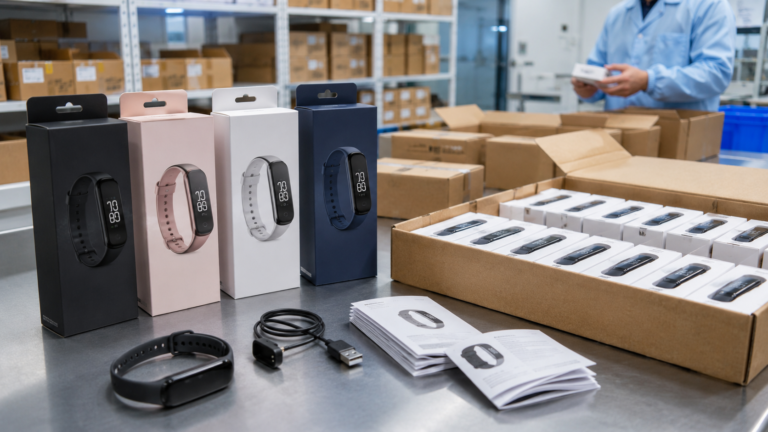
Yes, many manufacturers offer app customization (white-label, custom UI) and packaging customization (logo, box design, manuals). This is part of private label services. Discuss your requirements early, as app development can affect cost and timeline.
5. How do I verify a smart ring manufacturer’s quality?
Request pre-production samples, review their QC process, and if possible, conduct a factory audit or third-party inspection. Ask for references from other brands. A manufacturer that welcomes scrutiny is more likely to be reliable.
6. What should I do if the manufacturer refuses to sign an NDA or assign IP?
This is a major red flag. If you are investing in custom design, you need IP protection. Look for another manufacturer who respects your intellectual property. Never proceed without a clear contract.
Conclusion
Choosing the right smart ring manufacturer is a strategic decision that impacts your brand’s quality, compliance, and speed to market. By following these seven steps—assessing capability, clarifying OEM/ODM, understanding MOQs, validating samples, evaluating QC, verifying certifications, and ensuring supply chain transparency—startup brands can mitigate risks and build a strong foundation. Remember that the cheapest option is rarely the best; prioritize partners who align with your quality standards and growth plans. With careful evaluation, you can find a manufacturer that becomes a long-term asset.
Next Step: Request a Quote or Discuss Your Project
Ready to evaluate smart ring manufacturing partners? STAR KING supports startup brands with flexible OEM/ODM solutions, transparent MOQs, and comprehensive support. Contact our sales team to discuss your project, request samples, or get a detailed quotation. We’ll help you navigate the path from concept to market.
Image Suggestions:


Discuss Your Smart Wearable OEM/ODM Project
Planning a smart ring, smart watch, smart band, AI glasses, AI translator, or AI voice mouse project? Contact STAR KING to discuss product positioning, sample testing, customization scope, certification requirements, lead time, and quotation details.

Team Star King

Scan WhatsApp QR code