Smart Rings for Retail Chains: 7 Critical Checks Before You Commit in 2026
Smart Rings for Retail Chains: 7 Critical Checks Before You Commit in 2026
Short answer: Smart rings for retail chains succeed or fail on sizing logistics, app reliability, battery claims and certification paperwork — not on sensor marketing. Before committing to a program, retail buyers should verify a supplier’s size-kit system, MOQ and size-ratio flexibility, app stability across phone models, measured battery life, and per-SKU compliance documents. This guide gives you seven checks, a buyer checklist and the red flags that separate a profitable ring assortment from a clearance problem.
Table of Contents
Table of Contents
smart rings for retail chains: Introduction
Smart rings have moved from early-adopter novelty into mainstream wearable retail. For a retail chain, the category raises different questions than it does for a consumer: can you stock it across 40 or 400 stores without drowning in size returns? Does the companion app work on the phones your customers actually carry? Can you prove battery-life claims in a way that survives a product-review video? And does each SKU ship with the certification paperwork your import and legal teams need?
This article is written for category managers, buyers and sourcing leads at retail chains evaluating smart rings for retail chains programs for 2026. It is not a product story. It is a procurement decision framework: seven checks covering assortment, sizing, app ownership, battery math, compliance, packaging and landed cost — each with a verification method you can run before signing a purchase order.
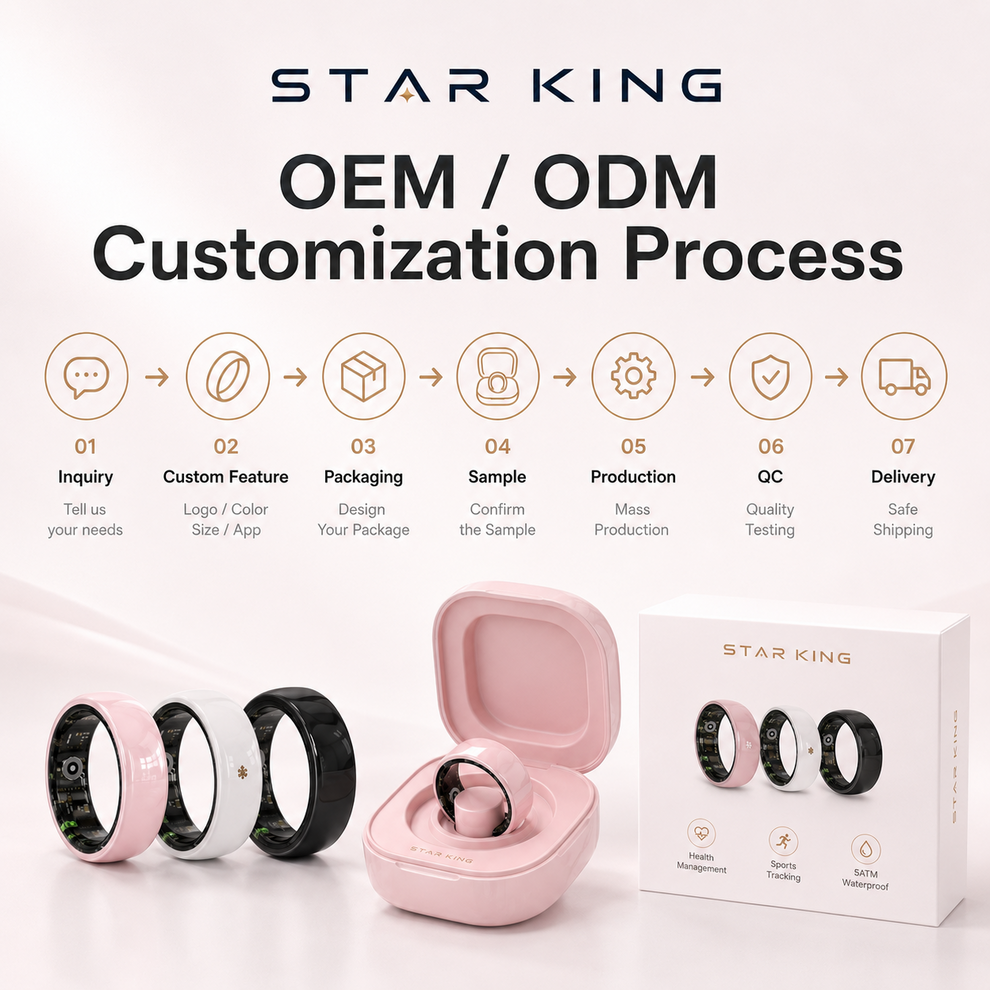
Table of Contents
- What Is a Retail-Grade Smart Ring?
- Key Takeaways
- Key Facts for Buyers
- Check 1: Assortment Fit and Use-Case Clarity
- Check 2: Sizing System and Return-Rate Control
- Check 3: MOQ, Size Ratios and Reorder Economics
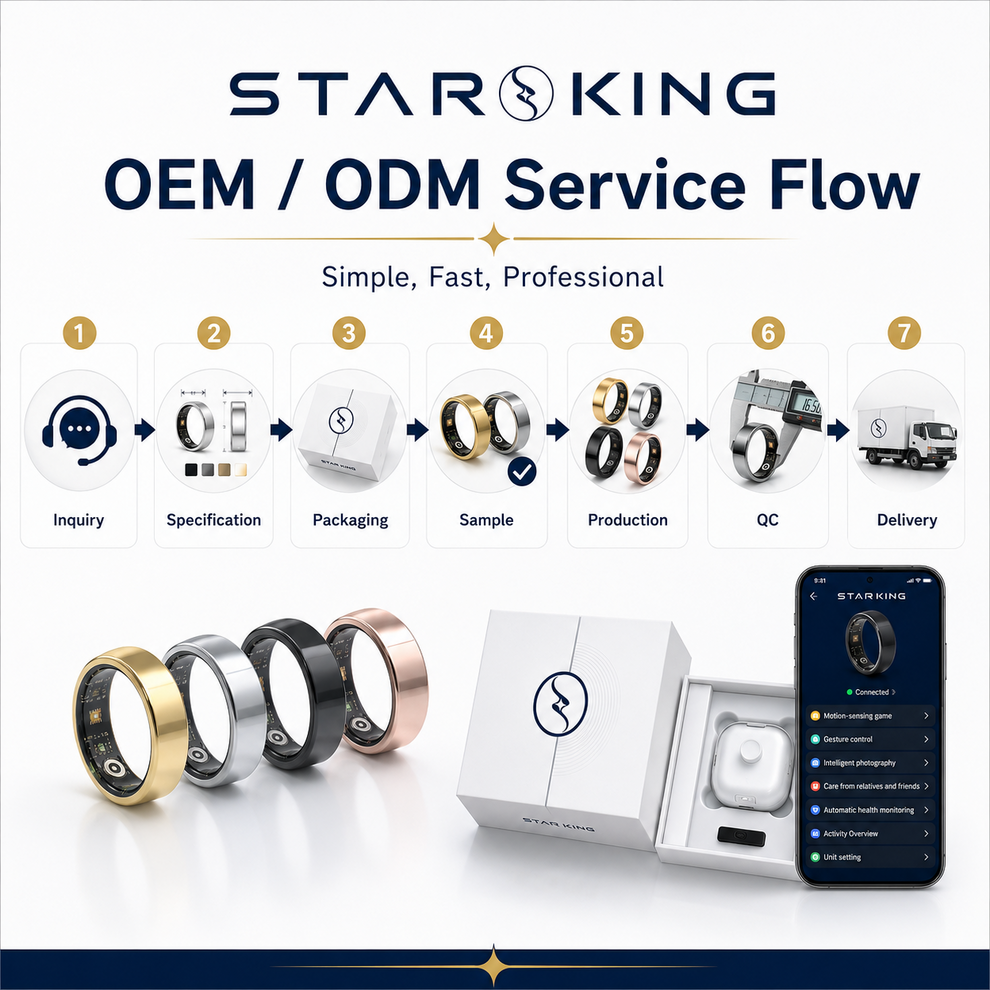
- Check 4: App, Firmware and Data Ownership
- Check 5: Battery Claims You Can Defend
- Check 6: Compliance and Customs Documentation
- Check 7: Packaging, Planogram and Landed Cost
- Comparison Table: Retail Readiness by Check
- Common Mistakes and Buyer Red Flags
- Practical Buyer Checklist
- FAQ
- Conclusion
What Is a Retail-Grade Smart Ring?
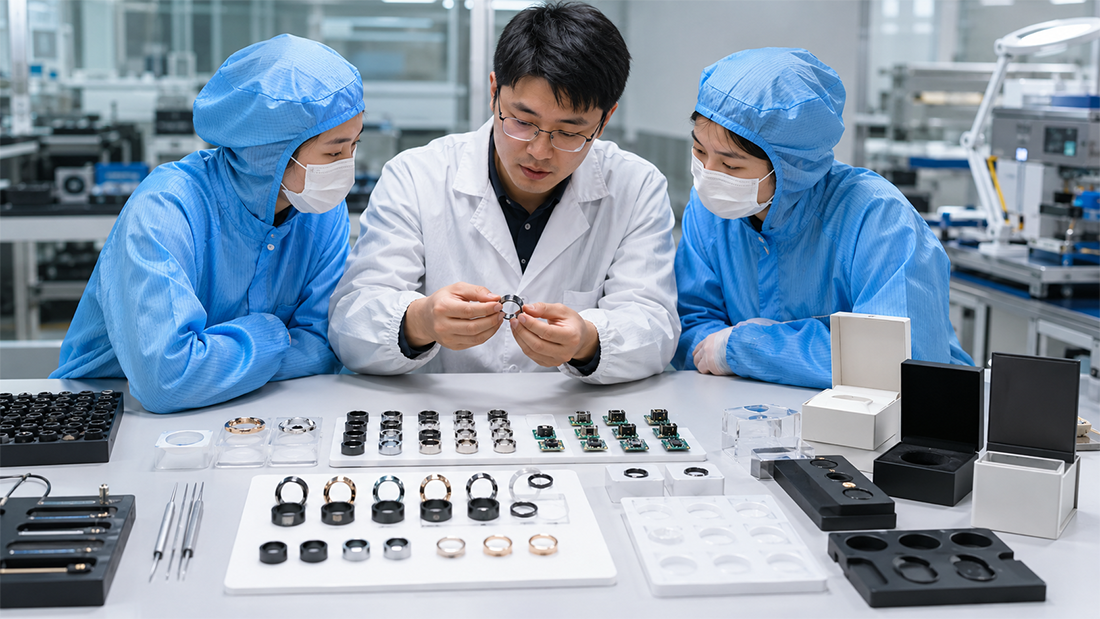
A retail-grade smart ring is a wearable device that has been designed, packaged and documented for multi-store distribution — not just for direct-to-consumer sale. That distinction matters because retail adds requirements that a factory-direct seller can ignore: consistent size distribution across batches, retail-ready packaging that survives a planogram, an app that installs cleanly on a wide range of Android and iOS devices, per-SKU compliance files, and a return profile that supports category margin.
Functionally, most smart rings in the market combine a ring form factor with optical sensors (typically photoplethysmography, or PPG) to estimate heart rate, heart rate variability, blood oxygen trends and sleep stages. These are generally positioned as wellness and lifestyle measurements, not medical diagnostics. If a supplier describes consumer ring data as “medical-grade diagnosis,” treat that as a compliance risk rather than a feature — consumer wellness claims and medical claims follow different regulatory paths, and the latter typically requires clinical evidence and device registration.
For a retail chain, the practical definition is simpler: a ring is retail-grade when you can reorder the same SKU next quarter, in the same sizes, with the same app behavior and the same paperwork — at a cost that leaves room for category margin after returns.
Key Takeaways
- Sizing is the single largest controllable driver of smart-ring return rates; a supplier’s size-kit system matters more than its sensor spec sheet.
- MOQ is not one number — negotiate it as three: minimum order quantity, minimum size-ratio flexibility, and minimum reorder quantity.
- App stability across mid-range Android phones is a better predictor of review scores than any sensor benchmark.
- Battery claims should be verified against realistic use conditions (screen-on time, app sync frequency, Bluetooth pairing behavior), not lab best-case figures.
- Certification scope varies by SKU, configuration and destination market. Buyers should request documentation per SKU and verify applicability rather than assuming a blanket certificate covers the line.
- Landed cost should include size-kit overhead, retail packaging, documentation handling and expected return processing — not just unit FOB price.
Key Facts for Buyers
| Factor | Typical Market Range | Why It Matters to Retail | How to Verify |
|---|---|---|---|
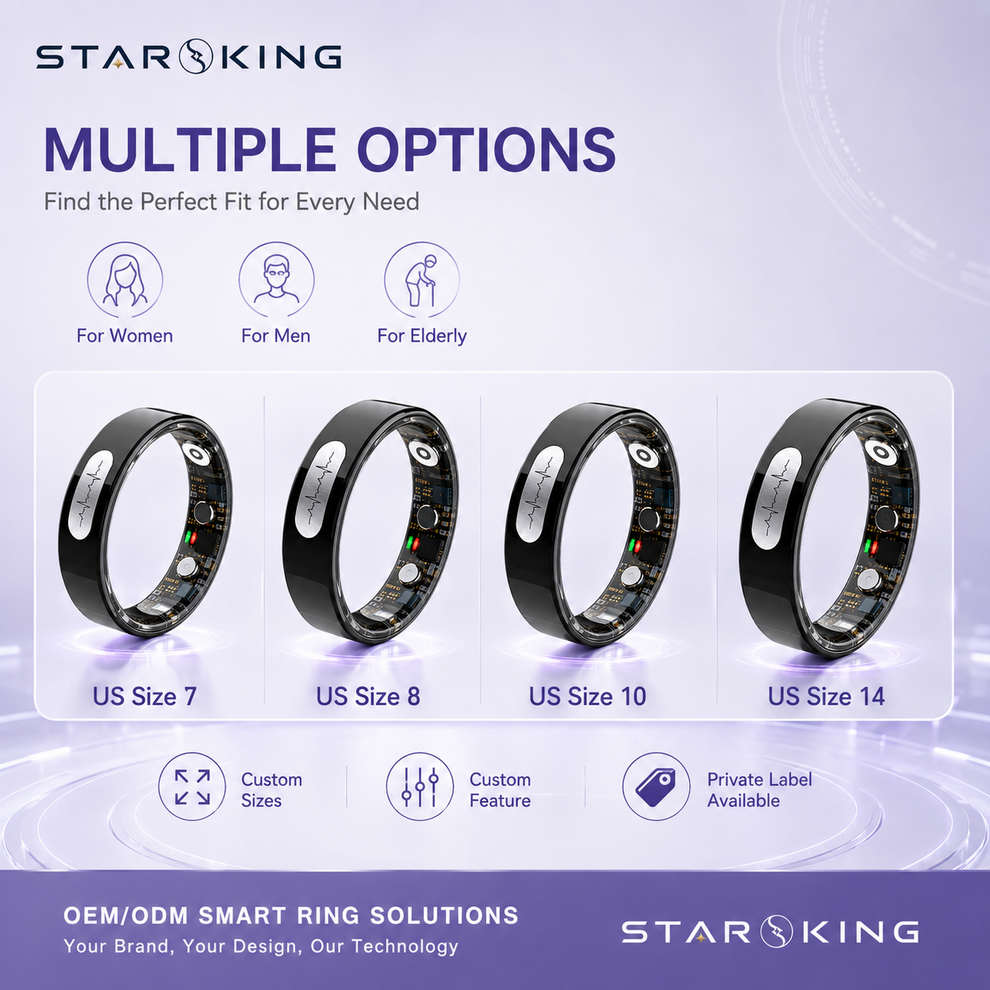
| Ring sizes offered | US 6–13 common; wider sets vary | Determines addressable customer base per store | Request size chart and in-store fit method |
| Size kit model | Loaner kit, sellable kit, or store-only sizing set | Reduces wrong-size returns | Pilot in 5 stores, measure return delta |
| MOQ (private label) | Varies widely by configuration | Drives cash commitment and markdown risk | Request written quote with size-ratio terms [STAR KING TO CONFIRM] |
| Battery life claims | Often quoted 4–7 days; real-world varies | Misstated claims drive returns and reviews | Run a 14-day internal wear test per configuration |
| App platforms | iOS and Android; Android fragmentation is the risk | Support cost and review sentiment | Test on 5+ Android models sold in your market |
| Compliance | Depends on SKU, radio module, battery, market | Customs clearance and legal exposure | Request per-SKU declarations; verify with your compliance team |
| Lead time | Varies by tooling, firmware and packaging stage | Seasonal shelf commitments | Ask for a dated production schedule in the quote [STAR KING TO CONFIRM] |
Retail chains evaluating wearable categories often look at rings alongside adjacent formats. A practical first step is to compare physical format trade-offs across the smart rings catalog before deciding how a ring slot fits next to watches and bands. If your chain also sells broader smart retail solutions, align the ring assortment with your existing wearable shelf logic rather than treating it as a standalone experiment.
Check 1: Assortment Fit and Use-Case Clarity
The first retail question is not “which ring” but “which customer job does this ring do on my shelf?” Rings compete for a narrow slice of consumer attention, and retail buyers who skip this step end up with overlapping SKUs that confuse shoppers and slow sell-through.
Map rings to one primary promise per SKU
Strong retail assortments separate rings by a single dominant promise: sleep and recovery, everyday activity and heart-rate trends, or a style-led entry model. When a SKU tries to be everything, the shelf talker, the packaging and the app onboarding all get muddier.
Decide the price architecture before the product
Rings typically sit at a higher price point than bands and can undercut entry watches on features. Define your good/better/best price ladder first, then ask suppliers to quote against those tiers. This prevents the common pattern where a chain buys three similar rings and cannibalizes its own category.
Check 2: Sizing System and Return-Rate Control
Sizing is where smart-ring retail economics are won or lost. A ring that fits is a retained sale; a ring that does not fit is a return, a support ticket and a damaged review — often all three.
Ask suppliers to explain their sizing system explicitly, and treat vagueness as a warning sign. A workable system usually includes at least one of the following:
- Loaner or loan-to-buy size kits placed in-store or shipped to online customers before final purchase.
- Printed sizer tools included in packaging, with a clear instruction sequence.
- Store-only sizing sets that staff use to confirm fit before the customer commits.
For retail chains, the operational question is cost-bearing: who pays for the size kit, who owns it after the pilot, and how it is replenished. These are commercial terms, not technical details, and they should be written into the supply agreement rather than agreed verbally. Size-kit availability and commercial terms should be confirmed with your supplier [STAR KING TO CONFIRM].
Run a sizing pilot before a full rollout
Pilot in a small number of stores with different customer demographics. Measure two numbers: wrong-size return rate, and conversion rate for customers who used a sizing method versus those who did not. Those two numbers justify (or kill) the national rollout.
Check 3: MOQ, Size Ratios and Reorder Economics
Retail buyers frequently negotiate MOQ as a single figure and then discover, in production, that the supplier ships a fixed size distribution that does not match local demand. Negotiate MOQ as three separate terms:
- Minimum order quantity — total units per production run.
- Minimum size-ratio flexibility — how much you can skew sizes toward your market’s actual fit profile.
- Minimum reorder quantity — the unit count for a restock, which is often the number that determines whether a reorder is commercially viable at all.
These terms interact with tooling and packaging setup. Custom molds, custom colors and custom retail packaging usually raise the effective minimum because setup cost must be amortized. Ask for the cost curve: unit price at your initial MOQ, at 2×, and at 4×. A flat curve suggests little true scale benefit; a steep curve tells you where the real breakpoints are. Typical MOQ figures vary by configuration and should be confirmed in a written quotation for your specific SKU and packaging [STAR KING TO CONFIRM].
Check 4: App, Firmware and Data Ownership
The app is the product experience for a ring. A perfect device with an unstable app generates the same returns as a defective device, and it does so at scale across every store.
Buyers should get written answers to four questions before committing:
- App availability: Is the app published on both the Apple App Store and Google Play, and is it maintained by the manufacturer or a third party?
- Branding: Can the app carry your retail brand, and if so, who controls the store listing and the privacy policy?
- Data handling: Where is health and activity data stored, who can access it, and what happens to it if the relationship ends?
- Update path: How are firmware and app updates delivered, and what is the support commitment after launch?
Data ownership is a legal and brand-risk question, not just a technical one. If the app is white-labeled, confirm which entity appears as the data controller in the privacy policy, because that determines who answers to regulators and to customers.
Retailers building a broader wearable ecosystem — for example, customers tracking sleep and recovery as part of a sleep and recovery application — should confirm that the ring’s data does what the marketing claims before the shelf talker is printed.
Check 5: Battery Claims You Can Defend
Battery life is the most commonly overstated number in wearable marketing, and retail chains absorb that overstatement as returns and one-star reviews. Lab figures typically assume low sync frequency and minimal interaction. Real customers charge inconsistently, sync often and use features that draw more power.
Before you publish a battery claim on packaging or a product page, run a controlled internal test:
- Charge to full, then use the ring as a normal customer would for 14 days.
- Log battery percentage daily and note sync frequency and feature use.
- Repeat the test across at least two production batches to check consistency.
Then write the packaging claim to the lower end of what you measured, not the upper end. A conservative claim that customers beat is a marketing asset; an optimistic claim they miss is a return driver.
Check 6: Compliance and Customs Documentation
Compliance is the check where retail chains carry the most exposure and often do the least verification. Certification requirements depend on the product’s specific configuration, radio modules, battery chemistry and the destination market. A certificate issued for one configuration does not automatically cover a different SKU.
Request documentation per SKU, and verify applicability with your own compliance team. Documents commonly relevant to smart rings include:
- Radio and EMC: for example FCC equipment authorization in the United States and CE marking requirements in the EU, depending on the product’s radio configuration.
- RoHS and, where applicable, REACH documentation for material restrictions in the EU.
- Battery transport documentation, including UN 38.3 test summaries for lithium cells, plus safety data sheets (MSDS/SDS) where required for shipping.
The U.S. Federal Communications Commission publishes equipment authorization guidance at fcc.gov/oet/ea, and the EU’s harmonized product rules are summarized through the European Commission’s single market pages at single-market-economy.ec.europa.eu. For battery transport specifics, IATA’s dangerous goods guidance is the operational reference most carriers follow.
Build a per-SKU documentation file
Create a folder per SKU containing: certificate or declaration, issuing lab, issue and expiry dates, the exact model numbers covered, and the destination markets the document supports. When customs asks, the answer should be one file away — not a two-week email thread.
Check 7: Packaging, Planogram and Landed Cost
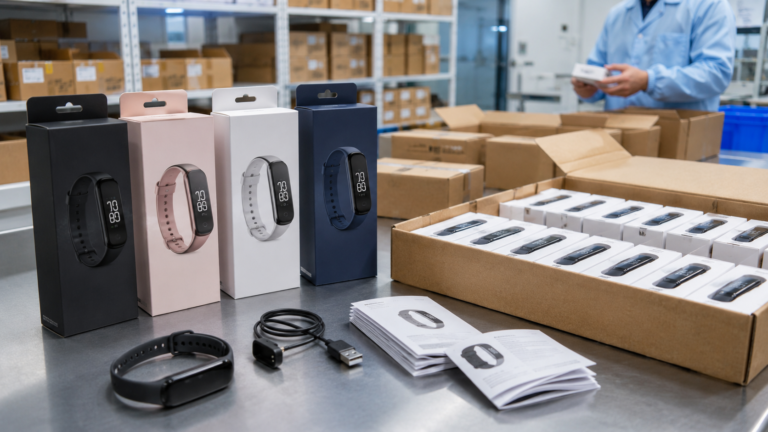
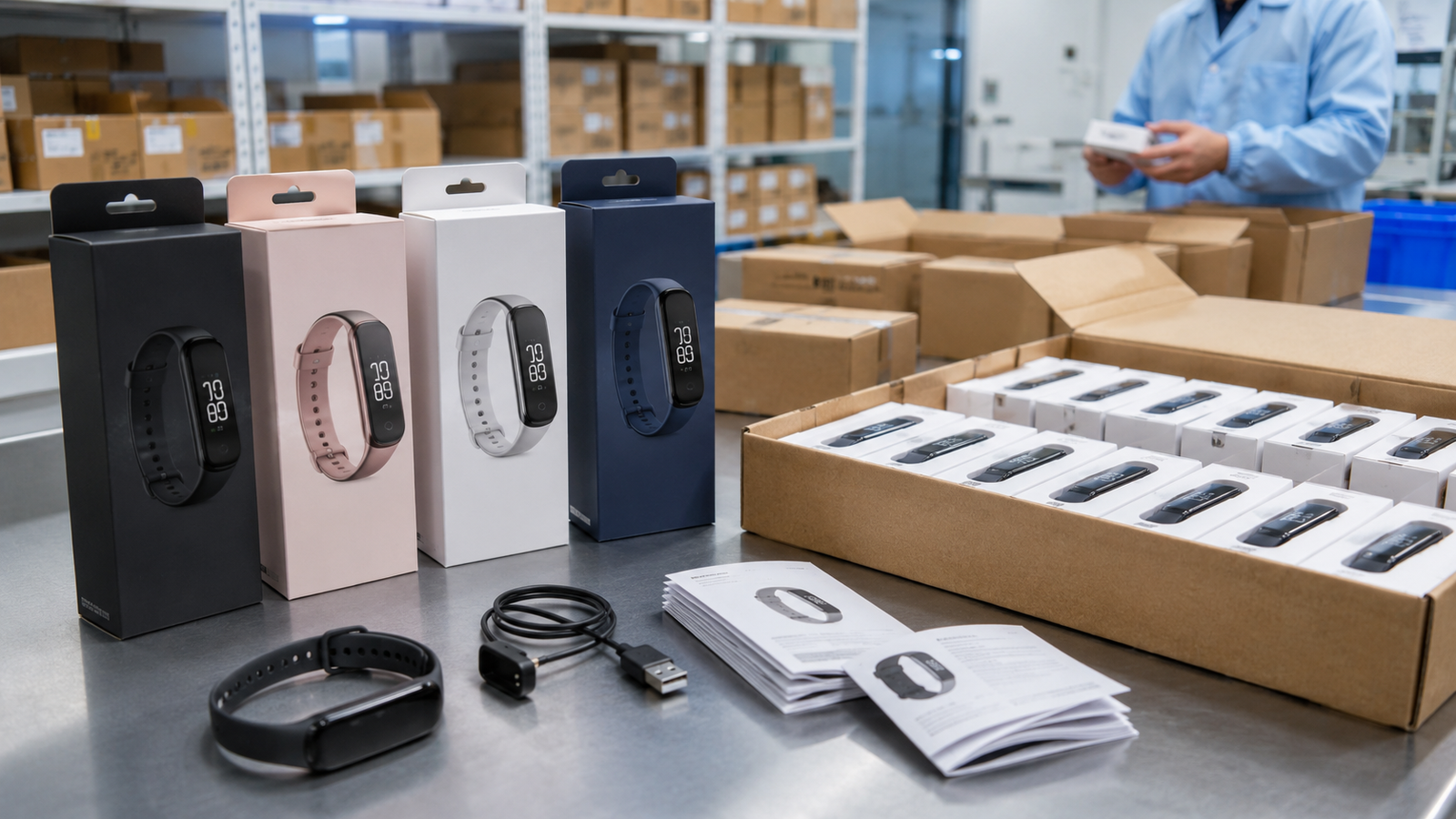
Retail packaging is a cost line, a brand asset and a returns-management tool at the same time. A ring that ships in a jewelry-style box protects the device; a box that also holds a printed sizer, a quick-start card and a warranty URL reduces support contacts.
For a chain, packaging must also survive the planogram: consistent dimensions so it hangs or stacks cleanly, a shelf-ready form factor, and a barcode and label placement that your logistics team can scan without exceptions.
Calculate landed cost honestly
Unit FOB price is the beginning of the calculation, not the end. A defensible landed cost for a ring program typically includes:
- Unit cost and packaging cost
- Freight, duties and customs handling
- Size-kit cost and replenishment
- Compliance documentation handling
- Expected return processing and refurbishment cost
- Markdown reserve for end-of-season stock
A ring with a marginally higher unit price but a materially lower return rate is usually the cheaper program. For suppliers offering white-label or customized programs across a wearable range, review the available private label OEM/ODM solutions to understand which cost drivers are negotiable and which are fixed.
Insert image suggestion
Insert image here: a retail shelf comparison of smart rings for retail chains packaging formats, showing size-kit box, retail box and shelf-ready planogram layout. Alt text: smart rings for retail chains packaging and size kit comparison.
Comparison Table: Retail Readiness by Check
| Check Area | Low Readiness Signal | High Readiness Signal | Retail Impact |
|---|---|---|---|
| Assortment | Three SKUs with identical promises | Clear good/better/best ladder | Sell-through and category clarity |
| Sizing | “Sizes 6–13, no kit” | Documented kit with replenishment plan | Return rate |
| MOQ | Single fixed number, fixed size ratio | Separate MOQ, ratio and reorder terms | Cash commitment and reorder viability |
| App | Manufacturer-branded only, unclear data owner | Brandable, documented data controller | Support cost and brand risk |
| Battery | Best-case lab figure on packaging | Conservative claim backed by internal test | Reviews and returns |
| Compliance | One generic certificate | Per-SKU file with scope and markets | Customs clearance and legal exposure |
| Landed cost | Unit price only | Full model including size kits and returns | Real category margin |
If your category team is weighing rings against other wearable formats for the same shelf, comparing core specifications across the smart watches range can clarify where the ring’s price and promise sit relative to adjacent products.
Common Mistakes and Buyer Red Flags
Common mistakes
- Buying the sensor spec instead of the size system. A better sensor does not save a program with a 25% wrong-size return rate.
- Treating MOQ as one number. Ignoring size-ratio flexibility leads to dead stock in unpopular sizes.
- Publishing lab battery claims. Customers measure battery life in real use, not on a bench.
- Assuming one certificate covers the line. Certification scope follows configuration and market.
- Skipping the data-ownership question. If the app is white-labeled, someone must be the named data controller — decide who before launch, not after a complaint.
- Testing the app on one phone. Android fragmentation means one model proves nothing about the install base.
Buyer red flags
- The supplier cannot describe the sizing system in operational detail.
- Battery life is quoted only as a single maximum figure with no test methodology.
- Certification documents are described generically (“we are CE”) rather than per SKU and per market.
- Health features are described with medical or diagnostic language without regulatory support.
- The quotation does not break out packaging, size kits, tooling or reorder terms.
- Lead time is given verbally with no dated production schedule in the quotation.
Practical Buyer Checklist
Use this list before issuing a purchase order for any smart-ring program.
- ☐ Each SKU assigned one primary customer promise and one price tier.
- ☐ Sizing method documented, with kit cost, ownership and replenishment terms.
- ☐ MOQ, size-ratio flexibility and reorder quantity quoted in writing.
- ☐ Unit price quoted at initial MOQ, 2× and 4× volumes.
- ☐ App tested on at least five Android models and three iOS versions sold in your market.
- ☐ App branding, store listing ownership and data-controller identity confirmed in writing.
- ☐ Battery claim validated by a 14-day internal test across two production batches.
- ☐ Per-SKU compliance file assembled with scope, issuing lab and covered markets.
- ☐ Battery transport documentation and safety data sheets confirmed for your shipping route.
- ☐ Packaging dimensions, barcode placement and planogram compatibility confirmed.
- ☐ Landed cost model includes size kits, documentation and expected return processing.
- ☐ Written warranty term and spare-parts or replacement policy for in-warranty units. [STAR KING TO CONFIRM]
- ☐ Dated production and shipping schedule attached to the quotation. [STAR KING TO CONFIRM]
For teams that need a structured way to source and verify wearable partners, the broader STAR KING resources blog covers supplier evaluation and procurement topics that apply across the wearable category, not only to rings.
FAQ
What is a realistic MOQ for private-label smart rings?
Private-label MOQ depends on tooling, color, firmware configuration and retail packaging. There is no single industry figure, because a standard-color ring in stock firmware has a very different setup burden than a custom-shell, custom-box program. Ask for a written quotation that separates unit MOQ from packaging and tooling setup, and request the reorder quantity at the same time. Confirm current terms for your configuration with the supplier. [STAR KING TO CONFIRM]
How should a retail chain reduce smart-ring size returns?
Use a documented sizing method — loaner kit, in-pack sizer or in-store sizing set — and pilot it in a small group of stores before rollout. Measure the wrong-size return rate for customers who used the sizing method against those who did not. The delta is your business case for or against a national rollout.
Can a smart ring carry our retail brand on the app?
App white-labeling is technically possible in many OEM arrangements, but the commercial and legal details matter more than the branding itself. Confirm who owns the app store listing, who is named as the data controller in the privacy policy, and what the post-launch support commitment is. Get all three in writing before launch.
Do smart rings need FCC, CE and RoHS certification?
It typically depends on the product’s radio configuration, battery, materials and the markets you sell into. FCC equipment authorization and CE marking are commonly relevant, and RoHS applies to electrical products placed on the EU market. Requirements vary by SKU and configuration, so request documentation per SKU and verify applicability with your own compliance team rather than relying on a single blanket certificate.
How do we handle lithium battery shipping requirements for rings?
Small lithium cells still fall within dangerous goods rules for air and sea transport. Expect to need UN 38.3 test summaries and, where required, safety data sheets. Carrier requirements and documentation can differ by route and mode, so confirm the exact paperwork with your freight forwarder and supplier before the first shipment. [STAR KING TO CONFIRM]
What battery life should we print on retail packaging?
Print the lower end of what your own testing measured, not the supplier’s best-case figure. Run a 14-day test under normal use across at least two production batches, then publish a conservative claim. Under-promising on battery life reduces returns and protects the review profile of the entire category.
What should a landed cost model for smart rings include?
Include unit cost, packaging, freight, duties, customs handling, size-kit cost and replenishment, compliance documentation handling, expected return processing, and a markdown reserve. Unit FOB price alone will understate the program cost and can make a high-return SKU look cheaper than it is.
Mid-way through your evaluation, it often helps to pressure-test your shortlist against a real configuration rather than a datasheet. If you already have a size range, packaging format or app-branding requirement in mind, STAR KING can walk through how those choices affect MOQ, lead time and per-SKU compliance scope — a useful step before your sourcing committee meets.
Conclusion
Smart rings can be a durable, high-margin wearable category for retail chains — but only when the program is built around retail realities. The seven checks in this guide are deliberately unglamorous: assortment clarity, sizing logistics, MOQ structure, app ownership, defensible battery claims, per-SKU compliance paperwork and an honest landed cost model. None of them are solved by a better sensor.
The teams that succeed treat the ring as a supply-chain and operations product first, and a consumer gadget second. They pilot sizing before rollout, negotiate MOQ as three separate terms, test the app on the phones their customers actually own, and keep a compliance folder per SKU. Do those things and the category margins hold; skip them and the returns and customs exceptions arrive with the first reorder.
Verify every claim before you print it, and treat any figure in this article — including MOQ, lead time and certification scope — as something to confirm in writing for your specific configuration, market and packaging.
Ready to Evaluate a Smart Ring Program for Your Chain?
If you are building a 2026 wearable assortment and want to compare configurations, sizing options and private-label packaging against your price architecture, the next step is a focused evaluation rather than a catalog browse. Request product samples with sizing tools and discuss your target size distribution, app branding requirements and destination markets so you can confirm MOQ, compliance scope and lead time before committing shelf space.
Request smart ring samples and a private-label quotation →
Discuss Your Smart Wearable OEM/ODM Project
Planning a smart ring, smart watch, smart band, AI glasses, AI translator, or AI voice mouse project? Contact STAR KING to discuss product positioning, sample testing, customization scope, certification requirements, lead time, and quotation details.

Team Star King

Scan WhatsApp QR code