
smart band suppliers: Smart Bands European Union Amazon Sellers: 7 Critical Verification Steps for 2026 Procurement Success
smart band suppliers buyers need a supplier evaluation process that checks product fit, OEM/ODM capability, compliance documents, quality control, pricing, lead time, and after-sales support before placing a bulk order.
Table of Contents
Table of Contents
Smart Bands European Union Amazon Sellers: 7 Critical Verification Steps for 2026 Procurement Success
For smart bands European Union Amazon sellers, the 7 critical verification steps are: confirm CE marking and EU Declaration of Conformity, validate GPSR responsible person and traceability, verify Lithium battery compliance with UN38.3 and MSDS, audit health data software for GDPR, secure correct HS codes and VAT/EORI documentation, negotiate OEM/ODM terms with clear MOQ and lead times, and plan packaging for FBA prep with compliant labeling. Each step reduces customs delays, listing suspensions, and product recalls risk.
smart band suppliers: Table of Contents
- Step 1: Confirm CE Marking and EU Declaration of Conformity
- Step 2: Validate GPSR Responsible Person and Traceability
- Step 3: Verify Lithium Battery Compliance (UN38.3, MSDS, IEC 62133)
- Step 4: Audit Health Data Software for GDPR and App Integration
- Step 5: Secure Correct HS Codes, VAT, and EORI Documentation
- Step 6: Negotiate OEM/ODM Terms: MOQ, Lead Time, and Customization
- Step 7: Plan Packaging and FBA Prep for EU Compliance
- Key Facts for Buyers
- Comparison Table: Entry-Level vs. Mid-Range vs. Premium Smart Bands
- Common Mistakes by Amazon Sellers
- Practical Buyer Checklist
- FAQ
- Conclusion

Direct Answer
To successfully sell smart bands in the European Union as an Amazon seller, you must verify seven critical areas: CE marking and Declaration of Conformity, GPSR compliance including an EU responsible person, lithium battery safety with UN38.3 and MSDS documentation, GDPR-compliant health data software, correct HS codes and VAT documentation, OEM/ODM terms with transparent MOQ and lead times, and FBA-ready packaging with compliant labeling. These steps prevent customs holds, listing suspensions, and product recalls risk under EU law.

Key Takeaways
- CE marking alone is insufficient; you need a valid EU Declaration of Conformity and technical file for each smart band model.
- GPSR requires a responsible person in the EU and traceability information on the product or packaging since December 2024.
- Lithium batteries must comply with UN38.3, have an MSDS, and often require IEC 62133 test reports for EU market access.
- Health data apps must comply with GDPR; server location and data processing agreements are buyer responsibilities.
- HS code classification affects duty rates; smart bands typically fall under 8517.62 or 9102.12 depending on features.
- OEM/ODM MOQs for smart bands vary widely; sample evaluation before mass production is critical.
- FBA packaging must meet Amazon’s prep requirements and include required EU labeling like WEEE and packaging recycling symbols.
Step 1: Confirm CE Marking and EU Declaration of Conformity
CE marking is mandatory for most smart bands sold in the EU, as they fall under the Radio Equipment Directive (RED) 2014/53/EU, and often the Electromagnetic Compatibility (EMC) Directive and Low Voltage Directive. However, a CE logo on the product is not enough. You need a signed EU Declaration of Conformity (DoC) that lists the applicable directives and standards, plus a technical file with test reports from an accredited lab.
When evaluating a supplier, ask for the DoC for the exact model you intend to import. Check that the manufacturer’s name and address are on the DoC, and that it references current standards such as EN 301 489-1 for EMC or EN 62479 for RF exposure. Verify the test reports match the model number. For more details, see the European Commission’s CE marking page.
If you are private-labeling, you become the manufacturer of record in many cases, and you must ensure the DoC is issued under your brand name. This often requires a new DoC from the OEM, or you may assume responsibility if the OEM permits. Always clarify this in your OEM agreement.

Step 2: Validate GPSR Responsible Person and Traceability
The General Product Safety Regulation (GPSR) (EU) 2023/988 applies to all consumer products, including smart bands, and has been fully applicable since 13 December 2024. It requires that a responsible person be established in the EU (or Northern Ireland) for products sold online, including via Amazon. That responsible person must be identified on the product, packaging, or accompanying documents, along with contact details.
Additionally, GPSR mandates traceability: you need to be able to identify the manufacturer, importer, and distributor. For Amazon sellers, this often means having an EU-based responsible person service or using Amazon’s own solution if available. The responsible person must hold the technical documentation and cooperate with market surveillance authorities.
Verify that your supplier can provide a responsible person agreement or that you have your own. Without this, Amazon may deactivate your listing. The full GPSR text is available on EUR-Lex.
Step 3: Verify Lithium Battery Compliance (UN38.3, MSDS, IEC 62133)
Smart bands contain lithium-ion or lithium-polymer batteries, which are regulated for transport and product safety. For air shipping, you need a UN38.3 test report and a Material Safety Data Sheet (MSDS). These documents are typically required by freight forwarders and customs.
For the EU market, the Battery Directive 2006/66/EC (and upcoming Battery Regulation (EU) 2023/1542) sets requirements for battery labeling, recycling, and restricted substances. Many smart bands also undergo IEC 62133 testing for secondary cells and batteries, which is recognized as a safety standard. While not always legally mandatory, it is often requested by buyers and insurers.
Ask your supplier for the UN38.3 report, MSDS, and IEC 62133 certificate if available. Check dates and model numbers. Ensure the battery capacity is declared correctly for shipping.
Step 4: Audit Health Data Software for GDPR and App Integration
Smart bands collect heart rate, sleep, blood oxygen, and activity data. Under the GDPR, this is personal data, and if used for health purposes, may be special category data. As the seller, you are likely a data controller or joint controller with the app provider. You must ensure a lawful basis for processing, provide a privacy policy, and have data processing agreements with any third parties.
Evaluate where the app stores data: EU servers, US servers, or elsewhere. Cross-border data transfers require safeguards like Standard Contractual Clauses. Check if the app requires users to create an account, and what data is collected. If the app claims medical benefits, it may fall under Medical Device Regulation (MDR), requiring CE marking as a medical device. Most consumer smart bands are not medical devices and should not claim to diagnose or treat conditions.
Request the app’s privacy policy and data flow diagram from the OEM. For private label, you may need to customize the privacy policy to reflect your brand and data practices.
Step 5: Secure Correct HS Codes, VAT, and EORI Documentation
Importing smart bands into the EU requires correct HS code classification. Smart bands are typically classified under HS 8517.62 (machines for the reception, conversion and transmission or regeneration of voice, images or other data) or 9102.12 (wrist-watches, electrically operated). The code affects duty rates and customs procedures. Misclassification can lead to penalties and delays.
You need an EORI number (Economic Operators Registration and Identification) for customs. If selling via Amazon FBA in multiple EU countries, you may need VAT registration in each country where you hold inventory, or use the One-Stop-Shop (OSS) for distance sales. Since July 2021, the EU removed the VAT exemption for low-value imports, so all imports are subject to VAT.
Work with a customs broker to confirm the HS code and duty rate. Keep commercial invoices, packing lists, and proofs of origin if applicable. Ensure your supplier provides accurate documentation.
Step 6: Negotiate OEM/ODM Terms: MOQ, Lead Time, and Customization
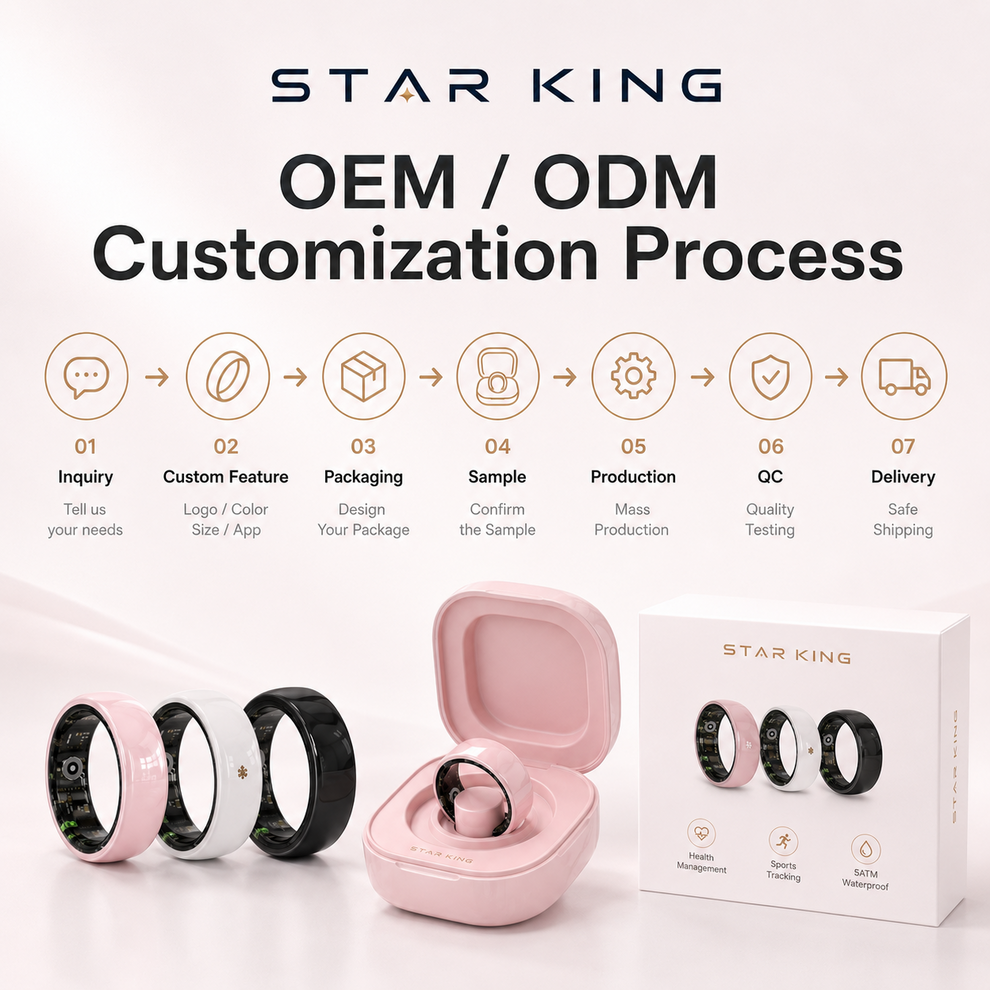
For Amazon sellers, private label or OEM smart bands offer differentiation. MOQs vary: for standard models with logo customization, MOQ might be 500–1,000 units; for full ODM with custom tooling, MOQ could be 3,000+ units. Lead times typically range from 30–60 days for mass production after sample approval, but can be longer for customized firmware or app development.
Clarify what is customizable: logo, packaging, app name, firmware features, sensor selection. Ask for a sample development timeline and cost. Ensure the OEM provides a detailed quotation with unit price, tooling cost (if any), sample fee, and payment terms. Negotiate MOQ based on your sales forecast and cash flow.
Consider STAR KING’s private label OEM/ODM solutions for smart bands with flexible MOQ options. Also review our guide on smart bands product page for baseline specifications.
Step 7: Plan Packaging and FBA Prep for EU Compliance
Amazon FBA requires specific packaging and labeling. Each unit must have a scannable FNSKU label. Poly bags must have a suffocation warning. Boxes must meet weight and size limits. Beyond Amazon’s rules, EU regulations require WEEE symbol (for electronic waste), packaging recycling symbols (Green Dot or national schemes), and the GPSR responsible person’s contact information on the product or packaging.
Packaging should include the CE mark, model number, manufacturer name, and importer details if applicable. For private label, you can design custom packaging that meets these requirements. Work with your supplier to ensure all labels are correct before shipping.
Key Facts for Buyers
| Requirement | Details | Buyer Action |
|---|---|---|
| CE Marking | Mandatory for smart bands under RED, EMC, LVD | Obtain DoC and test reports for each model |
| GPSR | Responsible person in EU, traceability | Appoint responsible person, verify labeling |
| Battery Compliance | UN38.3, MSDS, IEC 62133, Battery Directive | Request test reports, ensure shipping documents |
| GDPR | Health data protection, privacy policy | Review app data flow, sign DPAs |
| HS Code | Typically 8517.62 or 9102.12 | Confirm with customs broker |
| VAT & EORI | Required for import and sales | Register for VAT in inventory countries, get EORI |
| MOQ & Lead Time | Varies by customization level | Negotiate based on forecast, plan 30-60 days production |
Comparison Table: Entry-Level vs. Mid-Range vs. Premium Smart Bands
| Feature | Entry-Level | Mid-Range | Premium |
|---|---|---|---|
| Display | OLED, 0.96″ | AMOLED, 1.1″ | AMOLED, 1.4″ |
| Sensors | Heart rate, step counter | + SpO2, sleep tracking | + ECG, stress monitoring |
| Battery Life | 7 days | 10-14 days | 14-21 days |
| Water Resistance | IP67 | 5 ATM | 5 ATM+ |
| App Customization | Limited | Moderate | Full ODM |
| MOQ (OEM) | 500-1,000 | 1,000-3,000 | 3,000+ |
| Target Price (FOB) | $8-15 | $15-30 | $30-60 |
When evaluating which tier fits your Amazon EU strategy, consider that higher-tier models often require more complex certification and app development, increasing lead time. For EU buyers, mid-range often balances features and compliance complexity. If you need guidance on fitness tracking features, see our Fitness Tracking application page.
If you are comparing smart band suppliers for the EU market, it may help to request sample units and compliance documentation to evaluate fit for your Amazon listings. STAR KING provides OEM/ODM smart bands with support for CE, GPSR, and battery documentation.
Common Mistakes by Amazon Sellers
- Accepting a CE certificate without a DoC or test reports.
- Ignoring GPSR responsible person requirement, leading to listing removal.
- Shipping lithium batteries without UN38.3 or MSDS, causing customs seizures.
- Using an app that stores data outside the EU without GDPR safeguards.
- Misclassifying HS code, resulting in overpayment or penalties.
- Underestimating MOQ and lead time for customized models.
- Forgetting WEEE and packaging symbols on product and packaging.
Practical Buyer Checklist
- ☐ Obtain CE DoC and test reports for each smart band model.
- ☐ Confirm GPSR responsible person in EU and labeling.
- ☐ Request UN38.3, MSDS, and IEC 62133 for battery.
- ☐ Review app privacy policy and data processing agreement.
- ☐ Verify HS code with customs broker.
- ☐ Register for VAT and EORI as needed.
- ☐ Negotiate OEM/ODM terms: MOQ, lead time, customization.
- ☐ Ensure packaging meets Amazon FBA and EU labeling requirements.
- ☐ Order samples and test before mass production.
- ☐ Plan for after-sales support and warranty in the EU.
FAQ
Q1: Do I need a CE certificate for smart bands sold on Amazon EU?
Yes, smart bands typically require CE marking under the Radio Equipment Directive. You need a Declaration of Conformity and technical file. The certificate alone is not sufficient; the DoC is the legal document.
Q2: What is GPSR and how does it affect my Amazon listings?
The General Product Safety Regulation requires an EU-based responsible person for certain products, including smart bands. Amazon may ask for this information. Non-compliance can lead to listing deactivation.
Q3: What battery documents are required for shipping smart bands to the EU?
You need a UN38.3 test report and MSDS for air transport. Additionally, IEC 62133 is often requested. The EU Battery Directive also requires labeling and recycling information.
Q4: Can I use the OEM’s app for my private label smart bands?
Often yes, but you may need to customize the app name, icon, and privacy policy. Ensure the app complies with GDPR, especially regarding data storage location and user consent.
Q5: What is the typical MOQ for custom smart bands from China?
MOQs vary: logo customization may start at 500 units, while full ODM with custom tooling may require 3,000 units or more. Always confirm with your supplier.
Q6: How long does production take for smart bands?
After sample approval, mass production typically takes 30-60 days. Custom firmware or app development can add 2-4 weeks. Plan for shipping time to EU.
Q7: Are smart bands considered medical devices in the EU?
Most consumer smart bands are not medical devices. If they claim to diagnose or treat medical conditions, they may fall under MDR and require CE marking as a medical device. Avoid medical claims unless certified.
Conclusion
Selling smart bands on Amazon in the European Union requires diligent verification across compliance, logistics, and product development. By following these seven steps, you can reduce risk of customs delays, listing suspensions, and legal penalties. Start with CE and GPSR, then address battery, data, and customs requirements. Finally, negotiate OEM/ODM terms that align with your market entry strategy and order samples to validate quality.
Next Step: Request Smart Band Samples for EU Market Evaluation
To evaluate smart bands for your Amazon EU business, request samples from STAR KING. We provide OEM/ODM smart bands with support for CE, GPSR, and battery documentation. Discuss your customization needs, MOQ, and lead time with our team.
Request smart band samples or contact us to discuss your EU procurement plan.
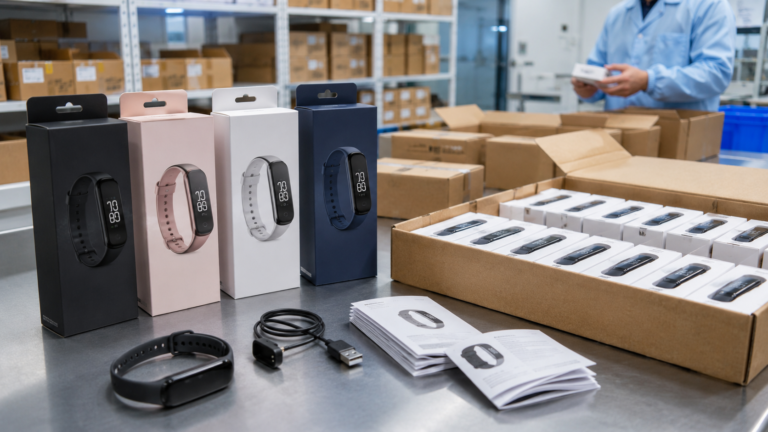
Image suggestion 1:  — Placement: after Step 1 introduction, showing a smart band with CE mark and packaging.
Image suggestion 2:  — Placement: after Step 3, illustrating battery testing documents.
Image suggestion 3:  — Placement: after Step 4, showing app privacy settings.
Discuss Your Smart Wearable OEM/ODM Project
Planning a smart ring, smart watch, smart band, AI glasses, AI translator, or AI voice mouse project? Contact STAR KING to discuss product positioning, sample testing, customization scope, certification requirements, lead time, and quotation details.

Team Star King

Scan WhatsApp QR code