
Smart Rings for Retail Chains: 7 Critical Checks Before You Commit to a Private Label Program
November 23, 2026 · Team Star King
Smart Rings for Retail Chains: 7 Critical Checks Before You Commit to a Private Label Program
If you are evaluating smart rings for retail chains, the core question is not whether the category is trending, but whether a supplier can deliver consistent quality, certified products, and reliable app support at retail scale. This guide answers that question by outlining seven due-diligence checks that retail buyers should complete before signing a private label agreement. Smart rings are compact, software-dependent wearable devices with specific battery, connectivity, and compliance requirements, so a disciplined supplier evaluation process is essential to protect margins, brand reputation, and shelf turnover.
Table of Contents
Table of Contents
smart rings for retail chains: Table of Contents
- Short Answer
- Key Takeaways
- Key Facts for Buyers
- 1. Define the Retail Use Case and Feature Set
- 2. Verify the Supplier’s Manufacturing and OEM Capability
- 3. Confirm App, Firmware, and Data Privacy Readiness
- 4. Assess Certification and Market Compliance
- 5. Review Quality Control and Testing Protocols
- 6. Understand MOQ, Pricing, and Lead Time Structure
- 7. Plan Packaging, Branding, and After-Sales Support
- Comparison: Ready-to-Brand vs. Full Custom Programs
- Common Mistakes and Buyer Red Flags
- Practical Buyer Checklist
- FAQ
- Conclusion

Short Answer
To evaluate smart rings for retail chains, focus on seven areas: a clearly defined retail use case, verified OEM/ODM capability, app and firmware integration readiness, target-market certification, documented quality control, transparent MOQ and lead-time terms, and a credible packaging and after-sales plan. Retail buyers should request samples, audit supplier documentation, and confirm software support commitments before committing to volume orders. A structured evaluation reduces returns, compliance risk, and unsold inventory.

Key Takeaways
- Retail viability depends on software stability as much as hardware quality. Smart rings are app-dependent devices; buyers should test the companion app and firmware update process before ordering.
- Certification requirements vary by market and product configuration. Retailers should confirm which certifications apply to their target countries and request current test reports.
- MOQ and lead time should be matched to store-level sales velocity. Over-ordering slow-moving SKUs ties up capital; under-ordering risks stockouts.
- Private label packaging and app branding are often the main differentiators for retail chains competing on shelf presence.
- Quality control should be documented, not assumed. Request pre-shipment inspection reports and aging/drop test summaries.

Key Facts for Buyers
| Evaluation Area | What Retail Buyers Should Confirm | Typical Documentation |
|---|---|---|
| Supplier capability | OEM/ODM experience, production capacity, references | Company profile, factory audit report [STAR KING TO CONFIRM] |
| App & firmware | Compatibility (iOS/Android), update history, data privacy policy | App documentation, privacy policy, version log |
| Certification | CE, FCC, RoHS, UN38.3, MSDS as applicable | Test reports, certificates, declarations of conformity |
| Quality control | Incoming, in-process, and pre-shipment checks | QC plan, inspection records, aging/drop test data |
| MOQ & lead time | Per-SKU MOQ, sample lead time, production lead time | Quotation sheet, production schedule |
| Packaging & branding | Logo, packaging design, app UI customization options | Packaging mockups, branding guidelines |
| After-sales | Warranty terms, spare parts, RMA process | Warranty policy, RMA procedure |
1. Define the Retail Use Case and Feature Set
Smart rings are not a single product category. They range from basic activity trackers to advanced health-monitoring devices with heart rate, blood oxygen, and sleep tracking. For retail chains, the first step is to define which customer segment the ring will serve and which features are non-negotiable. A fitness-focused SKU may prioritize step accuracy and battery life, while a wellness-oriented SKU may emphasize sleep and recovery metrics.
Buyers should also consider the sales channel. A smart ring sold in a physical retail environment benefits from simple setup, clear packaging, and a companion app that guides first-time users through pairing. For e-commerce or Amazon listings, the priority shifts toward detailed product photography, A+ content, and app store ratings.
Feature trade-offs directly affect cost. Advanced sensors, larger batteries, and premium materials increase unit price. Retail buyers should map features to price bands and target margins before approaching suppliers. STAR KING offers a range of smart rings that can be configured for different retail tiers, and buyers can discuss feature priorities during the evaluation stage.
2. Verify the Supplier’s Manufacturing and OEM Capability
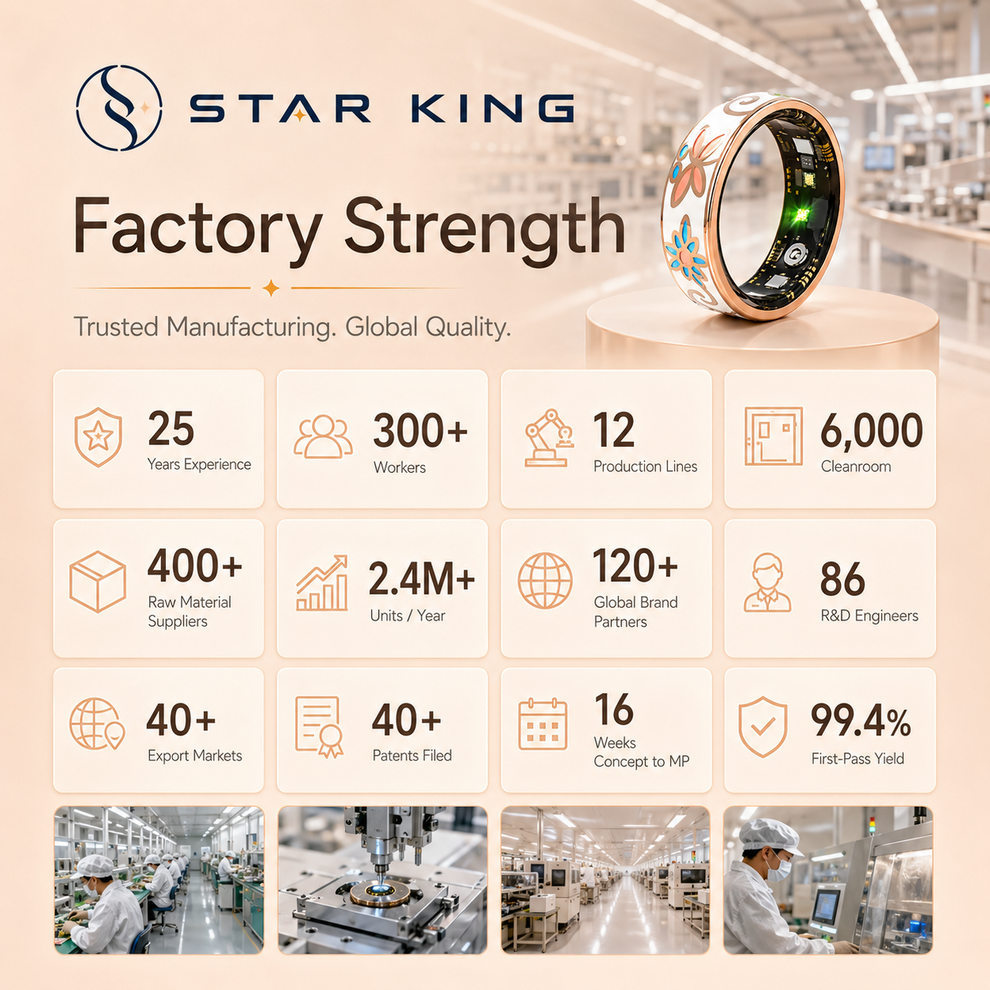
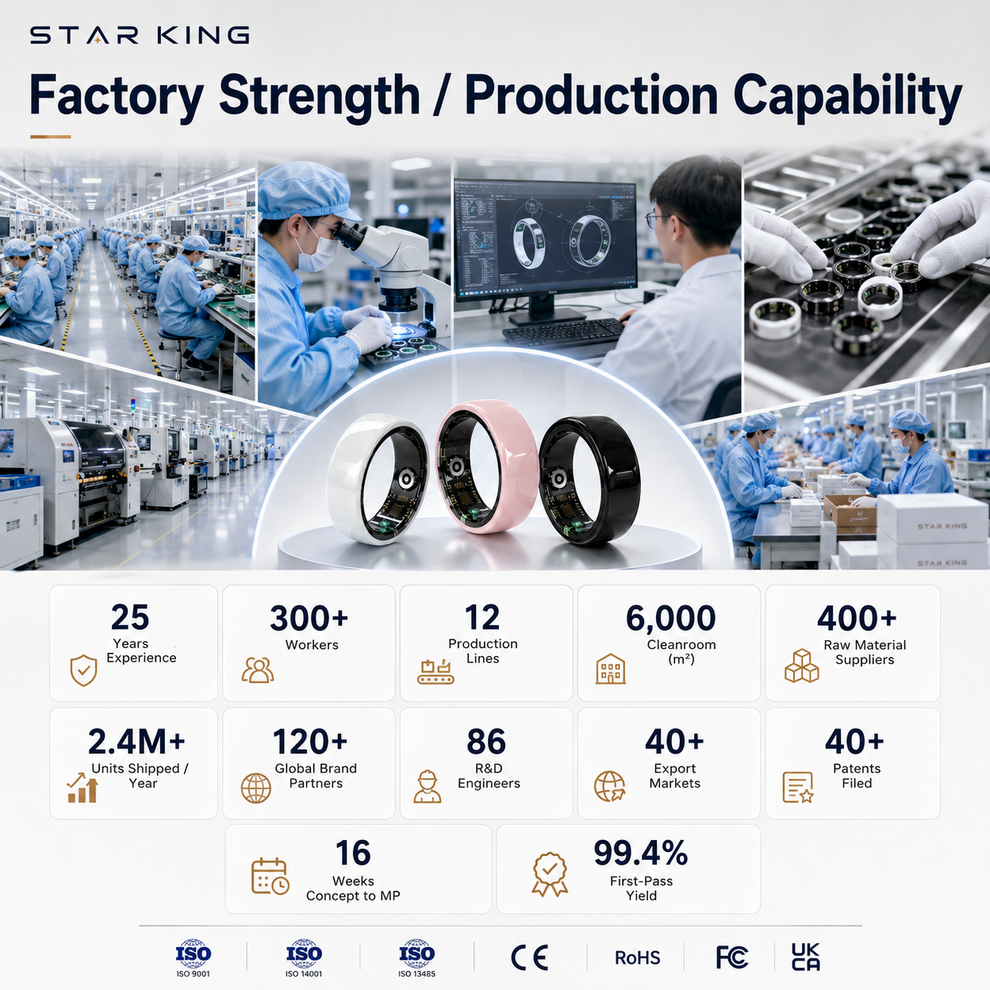
The smart ring supply chain includes sensor modules, batteries, housings, and firmware. Suppliers may be full manufacturers, assemblers, or trading companies. For retail chains planning a private label program, it is important to understand where design, tooling, and final assembly take place. A supplier with in-house hardware and firmware development can typically support customization more effectively than a trading intermediary.
Buyers should request a factory profile, recent audit reports, and examples of past OEM projects. If the supplier claims to offer private label OEM/ODM services, ask for the scope: logo printing, packaging design, app branding, or full industrial design. Clarify ownership of tooling and molds, especially if the retail chain funds custom development.
Verification steps include video calls, third-party inspections, and reference checks. For buyers new to sourcing from China, a structured sourcing guide can help frame the evaluation. STAR KING’s manufacturing capabilities and OEM/ODM process can be reviewed directly with the supplier team [STAR KING TO CONFIRM].
3. Confirm App, Firmware, and Data Privacy Readiness
Smart rings rely on a companion app to display data, manage settings, and deliver firmware updates. For retail chains, app quality is a critical but often overlooked evaluation area. A poorly rated app leads to returns and negative reviews, which can damage brand equity across an entire product line.
Buyers should test the app on both iOS and Android devices, review app store ratings and recent user feedback, and confirm the supplier’s firmware update cadence. Ask whether the app supports multiple languages, as retail chains with international stores may need localized interfaces.
Data privacy is another consideration. Health data collected by wearables may be subject to regulations such as GDPR in the EU. Suppliers should provide a privacy policy and explain where user data is stored. Buyers should verify that the app’s data handling aligns with their own compliance obligations. For retail chains operating in regulated markets, this step is not optional.
Customization of the app—such as logo placement, color scheme, or feature toggles—is often available for private label programs. STAR KING can discuss health and fitness wearable app integration options during the evaluation phase.
4. Assess Certification and Market Compliance
Certification requirements for smart rings depend on the target market, product configuration, and whether the device includes wireless connectivity or a lithium battery. Common requirements include CE marking for the EU, FCC for the US, RoHS for hazardous substances, UN38.3 for lithium battery transport, and MSDS for battery safety documentation.
Retail chains should not assume that a supplier’s products are certified for all markets. Buyers should request current test reports and certificates for the specific SKU and target country. For example, a ring sold in Germany may require CE and possibly additional national requirements, while a ring sold in the US may require FCC authorization. The FCC certification process and EU CE marking rules are useful references for buyers.
If the supplier does not hold the required certifications, they may be able to arrange testing at an accredited lab. Buyers should confirm who bears the cost and timeline for certification, and whether the certificate will be issued in the retail chain’s name or the supplier’s. This affects the retail chain’s ability to defend compliance claims.
For lithium battery shipping, buyers should confirm UN38.3 test summaries and MSDS documentation. These are typically required by freight forwarders and may be requested by customs authorities.
5. Review Quality Control and Testing Protocols
Quality control for smart rings includes incoming component inspection, in-process assembly checks, and pre-shipment inspection. Because rings are small and worn on the body, they are subject to sweat, water exposure, and mechanical stress. Suppliers should have documented tests for water resistance, drop resistance, and aging.
Buyers should ask for the supplier’s QC plan and recent inspection records. Key questions include:
- What is the sampling plan for pre-shipment inspection (e.g., AQL levels)?
- Are aging tests performed on finished units?
- How is water resistance verified?
- What is the process for handling out-of-spec units?
Third-party inspection can be arranged for larger orders. Retail chains with strict quality standards may also request a factory audit. For more information on battery and wearable testing, buyers can refer to IEC standards for electronic devices.
Quality control is not a one-time event. Retail chains should establish a process for ongoing batch testing and feedback to the supplier. STAR KING’s quality control procedures can be discussed during the supplier evaluation [STAR KING TO CONFIRM].
6. Understand MOQ, Pricing, and Lead Time Structure
MOQ, pricing, and lead time are interconnected. A lower MOQ may come with a higher unit price, and a shorter lead time may require a premium or may not be available for customized products. Retail chains should understand the cost drivers before negotiating.
Typical factors affecting smart ring pricing include:
- Sensor and component quality
- Battery capacity and life
- Housing material (e.g., plastic vs. metal)
- Packaging complexity
- App customization level
- Order volume and MOQ
Lead time has two phases: sample lead time and production lead time. Sample lead time for customized rings may be longer than for standard models. Production lead time depends on order volume and component availability. Buyers should request a production schedule and confirm penalties for delays.
For retail chains, MOQ should be balanced against sales velocity. High MOQ can reduce unit cost but increases inventory risk. A pilot order at a higher unit cost may be preferable to a large commitment before sell-through data is available. STAR KING can provide MOQ and lead time estimates based on specific requirements [STAR KING TO CONFIRM].
7. Plan Packaging, Branding, and After-Sales Support
In retail, packaging is part of the product. Smart rings for retail chains should be packaged to protect the device during shipping and to present key features clearly on the shelf. Private label buyers can typically customize the box, insert cards, and user manual. Some suppliers also offer custom molds for charging cases or display stands.
Branding extends to the app. A retail chain may want its logo and color scheme in the companion app to reinforce brand identity. This should be discussed early, as app customization may affect development timeline and cost.
After-sales support is critical for retail. Buyers should confirm warranty terms, spare parts availability, and the RMA (return merchandise authorization) process. A supplier that provides clear troubleshooting guides and replacement parts can reduce return rates and customer service costs.
For retail chains operating in multiple countries, after-sales logistics can be complex. Buyers should clarify whether the supplier supports direct-to-consumer returns or requires consolidated returns to the factory.
Comparison: Ready-to-Brand vs. Full Custom Programs
Retail chains can choose between ready-to-brand smart rings (standard hardware with logo and packaging customization) and full custom programs (custom industrial design, app, and firmware). The table below outlines key differences.
| Factor | Ready-to-Brand | Full Custom |
|---|---|---|
| MOQ | Typically lower | Typically higher |
| Lead time | Shorter | Longer (design, tooling, testing) |
| Unit cost | Moderate | Higher upfront, potentially lower at scale |
| Differentiation | Limited to branding | High (unique design, features) |
| Tooling ownership | Supplier-owned | Negotiable |
| Certification | May be pre-existing | May require new testing |
| Best for | Pilot programs, quick market entry | Established brands with volume |
Retail chains new to smart rings may start with a ready-to-brand program to test demand, then transition to full custom once volumes justify the investment.
Common Mistakes and Buyer Red Flags
Retail buyers evaluating smart rings should watch for these common mistakes:
- Assuming all suppliers are certified for all markets. Always request certificates for the specific SKU and destination.
- Ignoring app quality. A poorly functioning app can generate returns regardless of hardware quality.
- Overcommitting on MOQ. Pilot orders reduce inventory risk.
- Not clarifying tooling ownership. If the retail chain funds custom molds, ownership should be documented.
- Underestimating after-sales complexity. Returns and warranty claims require a clear process.
Red flags include suppliers who cannot provide test reports, who pressure buyers with false urgency, or who are vague about manufacturing locations.
Practical Buyer Checklist
- Defined target customer segment and feature priorities
- Requested and reviewed supplier factory profile and audit reports
- Tested companion app on iOS and Android
- Confirmed app data privacy policy and localization options
- Obtained current certificates for target markets (CE, FCC, RoHS, UN38.3, MSDS as applicable)
- Reviewed quality control plan and pre-shipment inspection process
- Clarified MOQ, sample lead time, and production lead time
- Discussed packaging and branding customization
- Confirmed warranty, spare parts, and RMA process
- Requested samples for hands-on evaluation
FAQ
What is a typical MOQ for private label smart rings?
MOQ varies by supplier and customization level. Standard models with logo and packaging customization may have lower MOQs than full custom designs. Buyers should request a quotation with specific requirements to get an accurate MOQ.
Do smart rings require FCC certification for US retail?
Smart rings with wireless connectivity (e.g., Bluetooth) typically require FCC certification or authorization for sale in the US. Buyers should confirm that the supplier holds the appropriate FCC documentation for the specific model.
Can the companion app be customized for our retail brand?
Many OEM/ODM suppliers offer app customization, such as logo placement and color scheme. The scope and cost depend on the supplier and the extent of customization. Buyers should discuss app branding early in the evaluation.
How long does it take to receive samples?
Sample lead time depends on whether the sample is a standard model or requires customization. Standard samples may be available quickly, while customized samples may take longer. Buyers should confirm sample lead time in the quotation.
What quality tests should smart rings undergo?
Typical tests include water resistance, drop testing, and aging tests for battery and electronics. Buyers should request test reports and confirm that testing is performed on production units, not just prototypes.
Who owns the tooling if we fund custom molds?
Tooling ownership should be documented in the supply agreement. If the retail chain funds the molds, ownership typically remains with the retail chain, but this must be negotiated.
What is the warranty period for smart rings?
Warranty terms vary by supplier. Retail buyers should confirm the warranty period, what it covers, and the process for handling warranty claims before placing orders.
Conclusion
Evaluating smart rings for retail chains requires a structured approach that goes beyond unit price. By completing the seven checks outlined in this guide—use case definition, supplier verification, app readiness, certification, quality control, MOQ and lead time planning, and packaging and after-sales support—retail buyers can reduce risk and build a viable wearable program. The smart ring category continues to evolve, and retail chains that establish a rigorous evaluation process will be better positioned to capitalize on demand while protecting their brand and margins.
Next Step
Ready to move from evaluation to samples? STAR KING supports retail chains with smart ring customization and private label programs. Request product samples to test hardware and app performance, or contact us to discuss your OEM/ODM requirements and certification needs.
Discuss Your Smart Wearable OEM/ODM Project
Planning a smart ring, smart watch, smart band, AI glasses, AI translator, or AI voice mouse project? Contact STAR KING to discuss product positioning, sample testing, customization scope, certification requirements, lead time, and quotation details.

Team Star King

Scan WhatsApp QR code
Leave a Reply