
smart band suppliers: Smart Bands for EU Retail Chains: 9 Checks Before You Commit to a Private Label Program
November 20, 2026 · Team Star King
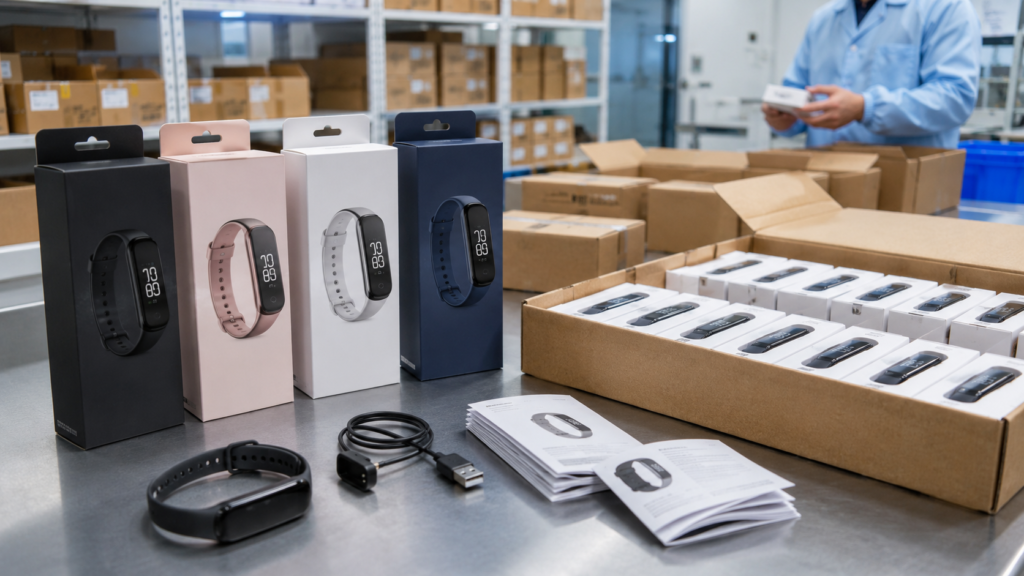
smart band suppliers buyers need a supplier evaluation process that checks product fit, OEM/ODM capability, compliance documents, quality control, pricing, lead time, and after-sales support before placing a bulk order.
Table of Contents
Table of Contents
Smart Bands for EU Retail Chains: 9 Checks Before You Commit to a Private Label Program
Smart bands for EU retail chains should only be ordered after nine verifications: compliance documentation for the exact SKU, an EU-compliant battery pack, a confirmed MOQ and price ladder, a working sample, a defined QC plan, an app and firmware roadmap, packaging and label approval, a realistic lead time, and a written after-sales and spare-parts policy. Retail buyers who skip any of these steps usually discover the gap after container arrival, when returns, delisting risk and markdown costs are already committed.
smart band suppliers: Short Answer: What Should an EU Retail Chain Verify First?
Before signing a smart band purchase order, confirm that the supplier can provide CE conformity documentation referencing the Radio Equipment Directive and RoHS for your specific model, plus UN38.3 and MSDS documents for the battery. Then lock the commercial terms — MOQ, price breaks, Incoterms, lead time and warranty — in writing, and validate a production-equivalent sample under your own QC criteria.

Table of Contents
- Why EU retail chains source smart bands differently
- The 9 sourcing checks in detail
- Comparison table: entry, mid and premium tiers
- Common mistakes and buyer red flags
- Practical buyer checklist
- FAQ for retail buyers
- Conclusion and next step

Key Takeaways
- Compliance must be tied to the exact SKU and battery pack, not to a supplier’s general capability list.
- MOQ, tooling, packaging and certification costs usually dominate first-order economics more than unit price.
- Retail chains should require a production-equivalent sample and an agreed test protocol before mass production.
- App quality, firmware update policy and data handling affect returns and brand risk in the EU market.
- Lead time planning must include battery documentation review and, for private label, packaging artwork approval cycles.

Key Facts for Buyers
| Item | What EU retail buyers should confirm | Why it matters |
|---|---|---|
| Product category | Smart band model, sensor set, display type, app platform | Defines the compliance scope and test plan |
| Regulatory scope | CE marking route, RED and RoHS documentation, REACH declarations | Required for lawful sale in the EU; scope depends on configuration |
| Battery | UN38.3 test summary, MSDS, EU Battery Regulation obligations | Affects shipping, storage and producer responsibility |
| Commercials | MOQ tiers, FOB/CIF/DDP terms, price validity period | Determines landed cost and cash exposure |
| Quality | AQL level, test protocol, pre-shipment inspection | Reduces defect-driven returns and markdowns |
| After-sales | Warranty terms, spare parts, RMA process | Protects margin and customer satisfaction |

Why Smart Bands for EU Retail Chains Require a Different Sourcing Process
A retail chain buying smart bands for shelves is not buying a gadget; it is buying a sellable, compliant, returnable consumer product with a two-year-plus consumer expectation attached. In the EU, the retailer carries reputational and legal exposure alongside the importer of record. That shifts the sourcing question from “what is the unit price” to “what documentation, app support and warranty structure will still be defensible twelve months after launch?”
Category economics reinforce this. Smart bands sit in a narrow band between low-cost fitness trackers and entry smartwatches. Buyers at retail chains typically need a clear price architecture across three tiers, a stable app experience across iOS and Android, and packaging that works in both shelf and e-commerce contexts. A supplier that cannot support all three will create friction at every subsequent stage.
It also helps to understand how compliance responsibilities are distributed. If you are sourcing as an EU-established retailer or importer, obligations such as CE marking, technical documentation retention and producer responsibility registration generally fall on your side of the transaction, with the manufacturer supporting you. Review the official guidance from the European Commission on CE marking and confirm with your legal team how each obligation applies to your entity.
If your range also includes adjacent categories, the same supplier can often support a broader program — for example smart watches for retail assortment planning — which can simplify supplier management but should not replace SKU-level due diligence.
The 9 Sourcing Checks for Smart Bands in the EU
1. Product Definition and Tier Architecture
Start by writing the SKU definition: display size and type, sensor set (heart rate, SpO2, accelerometer), battery capacity target, water resistance rating, strap material, charging method and app dependencies. Retail chains usually need at least an entry and a mid tier, with clear feature separation so shelf comparison is intuitive.
Be explicit about feature trade-offs. Larger displays and richer sensors consume battery; higher water resistance ratings require different sealing and testing; always-on displays raise power draw. Ask the supplier to state which features are hardware-defined and which can be adjusted through firmware customization within a private label program.
2. Compliance Documentation for the Exact Model
Ask for the conformity documentation linked to your model number and radio configuration. Radio equipment sold in the EU typically requires CE marking under the Radio Equipment Directive, and restricted substances are governed by RoHS. The manufacturer should be able to point to the applicable test reports and the declaration of conformity scope.
Two cautions apply. First, a supplier may hold compliant products without every configuration being covered; scope must match your build. Second, compliance responsibility typically depends on who places the product on the EU market. Confirm details with your compliance advisor and the official Radio Equipment Directive text. Where Bluetooth functionality is central, review the Bluetooth SIG qualification process to understand declaration requirements.

3. Battery Documentation, Shipping and EU Battery Rules
Smart bands ship with lithium-based cells, which triggers transport and safety documentation requirements. At minimum, buyers should request a UN38.3 test summary and an MSDS for the battery pack used in the exact model. Air freight typically requires these documents to be available and consistent with the pack specification.
In addition, EU battery rules are evolving. Obligations around producer registration, reporting and, over time, design and removability requirements may apply depending on the product and timeline. Buyers should verify current obligations with their compliance team rather than relying on supplier summaries. See the European Commission batteries framework for primary guidance.
4. MOQ, Tooling and Price Ladder
MOQ in smart bands is rarely a single number. It usually breaks down into MOQ per model, per colorway, per packaging version and per custom logo or enclosure change. A private label enclosure or a new strap tooling may carry its own minimum. Ask for a written price ladder showing unit cost at several volume tiers and the MOQ attached to each customization.
Model the landed cost rather than the FOB price. Freight, duties, insurance, compliance testing contributions, packaging artwork costs and in-market distribution add materially to the shelf price calculation. A simple landed cost model with three cost scenarios is usually enough to decide whether the SKU set is viable.
5. Sample Validation and Production Equivalence
Request a sample that reflects the intended production configuration, not a showcase unit. Test battery endurance under realistic use, screen readability in daylight, strap durability, pairing stability across iOS and Android, and app onboarding time. Record the results against agreed criteria.
Ask whether the sample is production-equivalent and, if not, which components will change. A supplier that cannot describe the differences between sample and mass production is a warning sign for later quality disputes.
6. Quality Control and Pre-Shipment Inspection
Agree a QC plan in writing: incoming component checks, in-line functional testing, aging or burn-in checks, waterproof testing where the rating is claimed, drop testing per packaging design, and a pre-shipment inspection using an agreed AQL level. Define the defect classification so both sides use the same vocabulary.
For retail programs, cosmetic criteria matter as much as function. Scratches, display uniformity and strap finish drive returns and shelf rejection, so include appearance limits in the inspection standard.

7. App, Firmware and Data Handling
The app is part of the product. Confirm which app will be used — a supplier-branded app, a white-label app, or a custom app — and who maintains it. Ask about firmware update cadence, bug-fix turnaround and compatibility with current iOS and Android versions. For EU retail, data protection expectations are high; clarify where health and activity data is stored and how consent is handled.
If your program includes health-oriented features, keep language accurate. Consumer smart bands provide wellness estimates and should not be presented as diagnostic devices. For the broader category context, see the health and fitness wearable solution overview.
8. Packaging, Labeling and Retail Readiness
EU retail packaging typically needs the importer or manufacturer identification, model information, language variants for the target countries, and recycling or disposal symbols where applicable. E-commerce packaging needs different structural protection than shelf packaging, so decide early whether you need one design or two.
Build artwork approval into the timeline. Each revision cycle consumes days, and late artwork changes are a common cause of missed launch dates. Request a printed dummy or a digital proof with material samples before mass printing.
9. Lead Time, Warranty and Spare Parts
Ask for a lead time breakdown: material procurement, production, testing, packaging and inspection. For private label programs, add artwork approval and any tooling time. Plan your initial order so that launch stock is covered before the second production run arrives.
Agree warranty terms, RMA handling and spare-parts availability in writing, including the expected period of post-launch support. Retail chains should also clarify who covers return shipping and how defect rates are measured.
Comparison Table: Sourcing Posture by Retail Tier
| Consideration | Entry tier | Mid tier | Premium tier |
|---|---|---|---|
| Feature focus | Core activity tracking, compact display | Larger display, richer sensors, better battery | Advanced sensors, metal or premium materials |
| Typical MOQ pressure | Lower per-SKU MOQ, more colorways | Balanced SKU count | Higher tooling and packaging investment |
| Compliance scope | Standard CE/RoHS documentation | Same, with more model variants | Same, plus additional market-specific labeling |
| App expectation | White-label app acceptable | Branded app experience preferred | Custom app or deeper integration likely |
| Warranty exposure | Volume-driven returns management | Balanced service expectation | Higher service expectation per unit |
Use this table to decide where the supplier relationship needs the most rigor. Entry-tier programs live or die on returns rate; premium-tier programs live or die on app experience and material quality.
Common Mistakes and Buyer Red Flags
- Accepting generic certification claims. A capability list is not a model-level conformity file. Ask for scope tied to your SKU.
- Comparing FOB prices without landed cost. Freight, duties and compliance contributions can reverse the ranking of suppliers.
- Treating the sample as representative. Confirm production equivalence in writing.
- Ignoring the app roadmap. An unsupported app produces returns long after the shipment clears customs.
- Late packaging artwork. Artwork cycles routinely delay launches when planned at the end of the project.
- No written warranty or spare-parts policy. Service commitments agreed verbally tend not to survive a change of account manager.
Red flags include refusal to share test documentation scope, unclear ownership of app maintenance, MOQ figures that shift between quotations, and pressure to place orders before a sample is validated. If your program expands into adjacent categories such as smart rings for retail range extension, apply the same discipline rather than assuming a favorable experience transfers automatically.
A mid-project reminder: it is reasonable to ask a potential supplier to walk you through one real compliance file and one real inspection report under NDA. If your team is comparing suppliers, the sourcing resource library covers supplier evaluation and sample validation in more depth.
Practical Buyer Checklist Before You Commit
- SKU definition document signed off internally, including sensor set and strap materials.
- Compliance documentation scope confirmed for the exact model and radio configuration.
- UN38.3 test summary and MSDS on file for the battery pack used.
- EU importer-of-record responsibilities clarified with your compliance advisor.
- MOQ and price ladder received in writing, including customization-specific minimums.
- Landed cost model built with at least three cost scenarios.
- Production-equivalent sample tested against agreed criteria and documented.
- QC plan, AQL level and defect classification agreed.
- App, firmware update and data handling terms confirmed.
- Packaging artwork proof approved and printed dummy reviewed.
- Lead time breakdown received, including inspection and artwork time.
- Warranty, RMA and spare-parts policy documented.

Buyers can also review STAR KING Smart Bands OEM/ODM options to compare product positioning, customization scope, and sample planning.
FAQ: Smart Bands for EU Retail Chains
What MOQ should a retail chain expect for private label smart bands?
MOQ typically depends on model, colorway, packaging and any enclosure or logo customization. Ask for a per-variable breakdown rather than one headline number, and confirm whether MOQ changes across the price tiers.
Are CE and RoHS documents sufficient to sell smart bands in every EU country?
Not automatically. Compliance depends on the product configuration, the country-specific requirements and who places the product on the market. Buyers should verify scope with their compliance advisor and maintain technical documentation as required.
How long should first-order lead time be planned?
Plan for material procurement, production, testing, packaging, inspection and — for private label — artwork approval. Build a buffer before launch stock runs low so the second production run arrives without a shelf gap.
Can we use our own app with a supplier’s smart band hardware?
It depends on the firmware and SDK arrangement offered. App integration requires technical cooperation and a defined update policy. Confirm support commitments and maintenance ownership in writing before committing to volume.
What battery documents do we need for EU shipping?
Buyers should request a UN38.3 test summary and MSDS for the pack in the model being shipped. Air freight and warehouse handling may require additional documentation depending on the logistics provider and route.
How should we handle warranty and returns for a retail program?
Set warranty duration, defect classification, RMA process and spare-parts availability in the purchase agreement. Define how defect rates are measured and who pays return shipping, so both sides have a shared reference point.
Conclusion
Smart bands for EU retail chains reward disciplined procurement. The suppliers that perform best are usually not the ones with the lowest quoted unit price, but the ones that can show compliance scope for your exact SKU, provide production-equivalent samples, agree a written QC plan, and commit to app and spare-parts support. Work through the nine checks in order, document each result, and let the evidence rather than the quotation drive the decision.
Next Step
If you are evaluating smart bands for an EU retail program, request a quotation that includes MOQ by tier, customization costs, lead time and the compliance documentation available for your target configuration. Our team can walk through sample options, packaging requirements and certification scope for your market — request a quote for your smart band program.
Discuss Your Smart Wearable OEM/ODM Project
Planning a smart ring, smart watch, smart band, AI glasses, AI translator, or AI voice mouse project? Contact STAR KING to discuss product positioning, sample testing, customization scope, certification requirements, lead time, and quotation details.

Team Star King

Scan WhatsApp QR code
Leave a Reply