
AI Translators for Amazon sellers: 7 Critical Checks for Sourcing AI Translators for Amazon Southeast Asia in 2026
November 14, 2026 · Team Star King
7 Critical Checks for Sourcing AI Translators for Amazon Southeast Asia in 2026
AI Translators for Amazon sellers in Southeast Asia should be evaluated on seven checks before you commit to inventory: language coverage and accuracy for SEA languages, offline versus cloud translation, battery and portability, Bluetooth and app integration, certification for each marketplace, MOQ and landed cost, and after-sales support. This guide explains each check so first-time Amazon sellers can shortlist suppliers and request samples with confidence.
Table of Contents
Table of Contents
AI Translators for Amazon sellers: Short Answer
For Southeast Asian Amazon marketplaces, prioritize AI translator suppliers that can demonstrate accurate Thai, Vietnamese, Indonesian, Malay and Filipino language pairs, provide a working offline mode for travel use, document battery capacity and air-shipping compliance, and confirm certification relevant to the destination country. Treat MOQ, lead time and warranty coverage as negotiable points in the first supplier conversation, and always test a production-intent sample before placing a bulk order.

Table of Contents
- Key Takeaways
- Key Facts for Buyers
- Check 1: Language Coverage and Accuracy for SEA Languages
- Check 2: Offline Versus Cloud Translation
- Check 3: Battery, Size and Daily Carry
- Check 4: Bluetooth, App and Firmware Integration
- Check 5: Certification and Marketplace Compliance
- Check 6: MOQ, Landed Cost and Payment Terms
- Check 7: Packaging, After-Sales and Spare Parts
- Comparison Table: Cloud vs Offline Translator Models
- Common Mistakes and Buyer Red Flags
- Practical Buyer Checklist
- FAQ
- Conclusion

Key Takeaways
- SEA is not one language market: Thai, Vietnamese, Indonesian, Malay, Filipino and English pairings each need validation on a real device, not just a spec sheet.
- Offline translation is a selling point for travel buyers, but offline language packs vary by SKU and require source-code or firmware access discussions during OEM talks.
- Air shipping of AI translators triggers lithium-battery rules, so UN38.3, MSDS and often a test summary are required by forwarders.
- Amazon marketplace compliance in Southeast Asia generally depends on country, product classification and configuration; buyers should verify with a local agent.
- MOQ is usually negotiable per SKU and per packaging version; first orders are best structured as a small pilot before full production.
- A production-intent sample, not a demo unit, is the only reliable way to test translation accuracy, battery claims and app stability.

Key Facts for Buyers
| Decision Area | What to Verify | Why It Matters for SEA Amazon |
|---|---|---|
| Languages | Supported language list per SKU, including Thai, Vietnamese, Indonesian, Malay, Filipino | Listing accuracy claims affect reviews and returns |
| Offline mode | Number of offline pairs and storage method | Travel buyers expect use without SIM or Wi-Fi |
| Battery | Capacity, rated runtime, charging standard | Returns rise when runtime claims are not met |
| Connectivity | Bluetooth version, companion app availability | App support and firmware updates affect longevity |
| Certification | CE, FCC, RoHS where applicable; UN38.3 and MSDS for battery | Required by forwarders and some marketplaces |
| MOQ | Per-SKU MOQ, customized packaging MOQ | Determines cash tied up in first inventory |
| Lead time | Sample lead time, production lead time, peak-season capacity | Avoids Q4 stockouts and Amazon penalties |
| Warranty | Coverage window, replacement policy, spare parts availability | Reduces return cost and negative seller feedback |
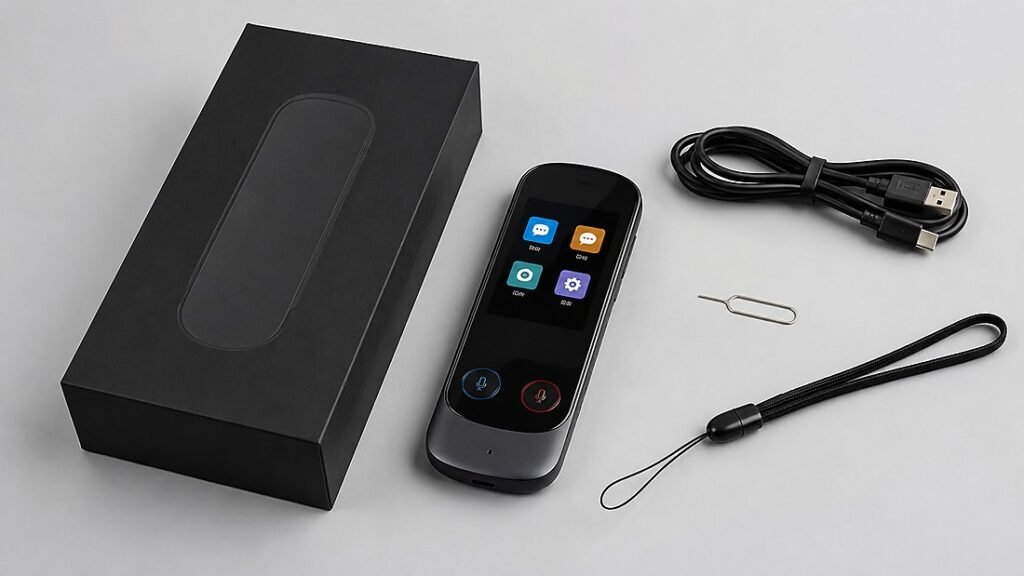
[IMAGE PLACEMENT: hero product image of AI translator device — see image_seo_suggestions]

Introduction to the SEA Buyer Context
Southeast Asia is one of the fastest-growing e-commerce regions for travel and language hardware. Amazon sellers entering this space often start with a single listing and a modest first order, which makes supplier selection the single biggest risk in the project. A device that translates English well but struggles with Thai or Vietnamese will generate returns regardless of price. This guide is written for Amazon sellers who are still at the awareness stage: you know the product category has potential, and you want a structured way to evaluate AI translator suppliers before you request quotes.
Check 1: Language Coverage and Accuracy for SEA Languages
Language coverage is where AI translator sourcing usually fails. A supplier spec sheet may list sixty or eighty languages, but listing a language is not the same as translating it well in daily conversation. For Southeast Asia, buyers should request demonstration of at least these pairs: English to Thai, English to Vietnamese, English to Indonesian, English to Malay, and English to Filipino. Local-to-local pairs, such as Thai to Vietnamese or Indonesian to Malay, matter for regional travelers and are often weaker on entry-level devices.
How to evaluate accuracy during sampling
Do not rely on scripted demo phrases. Prepare a short test set of ten to fifteen sentences drawn from travel, retail, hospitality and medical-tourism scenarios. Include at least three sentences with numbers, addresses or product names. Run the test on a production-intent sample, in both online and offline mode, and record the results. This gives you a repeatable benchmark when comparing two suppliers.
Ask the supplier whether translation engines are proprietary, licensed from a third party, or rely on a public API. That answer affects cost per unit over time, offline capability, and how updates are delivered. If the device uses a cloud API, ask how the subscription cost is handled and whether it is passed to the buyer or the end user.
Check 2: Offline Versus Cloud Translation
Offline translation is one of the strongest marketing points for a travel translator, and one of the most common source of returns when buyers over-promise in the listing. Offline language packs are usually limited in number and consume device storage. Confirm exactly which language pairs work offline, how the user downloads or switches packs, and how much storage remains for other functions.
Cloud translation typically offers broader coverage and better accuracy but requires Wi-Fi, a SIM, or a hotspot. Many successful listings position the device as a hybrid: online for rare languages, offline for the top travel languages. That framing reduces disappointed buyers and is easier to support at the listing level.
Check 3: Battery, Size and Daily Carry
Battery claims deserve scrutiny. Ask for rated runtime under a stated test condition, such as continuous translation or mixed standby, and ask for the charging standard (USB-C is now expected). A device that lasts a full travel day on standby but only two hours in continuous use can still be marketed responsibly if the listing states the conditions.
Size and weight matter for travel buyers. Confirm the actual product dimensions and weight, not the packaged weight. If your Amazon listing will include a comparison image, request accurate dimensions early so the rendering is correct.
Check 4: Bluetooth, App and Firmware Integration
Many AI translators pair with a phone app for language updates, history and firmware upgrades. Before you commit, ask how firmware updates are delivered, whether the app is maintained by the supplier or by you as the brand, and how long the supplier supports the app version you launch with. App abandonment is a real risk in this category: a device that loses app support becomes difficult to update and support.
If you plan a private-label version, discuss white-labeling the companion app and whether the supplier allows logo and UI changes. See private label OEM/ODM options for the broader customization picture on STAR KING hardware.
Check 5: Certification and Marketplace Compliance
Certification requirements for AI translators depend on the product configuration, wireless modules and destination country. Buyers should confirm with the supplier which certificates apply to the specific SKU they will import, and should verify current marketplace requirements with a local compliance agent. Typical documents discussed in this category include CE and RoHS for relevant markets, FCC for the United States, and UN38.3 plus MSDS for lithium-battery air shipments. Reference the official sources: the U.S. Federal Communications Commission for FCC rules, and the International Electrotechnical Commission for standards context.
Do not assume every SKU in a catalog carries every certificate. Ask for certificate numbers, issuing labs and the exact model covered, and check that the model on the certificate matches the model you will ship. If a supplier cannot provide the document for your exact SKU, treat that as a gap to close before ordering.
Check 6: MOQ, Landed Cost and Payment Terms
MOQ and price are the two numbers that shape your first Amazon order. AI translator MOQ is usually quoted per SKU and per packaging version, and customized packaging often carries a higher threshold than neutral packaging. Ask for a clear table: standard MOQ, private-label MOQ, customized box MOQ, and the price break at each threshold. STAR KING MOQ and lead time for AI translator models: [STAR KING TO CONFIRM].
Cost factors to include in landed cost
- Unit price at your order quantity, in your chosen Incoterm
- Freight (air vs sea), including battery-handling surcharges
- Import duties and taxes in the destination country
- Marketplace referral fee and fulfillment cost
- Packaging and any private-label tooling or plate costs
- Reserve for returns and warranty replacement
A useful mid-article pause: many Amazon sellers fund the first AI translator inventory from working capital, so a small pilot order with a clear price break at the next tier is often a better first move than chasing the lowest unit price at a large MOQ. If you want to compare configurations against your target retail price, you can review AI translator model options and request a specification sheet from the supplier before finalizing quantity.
Check 7: Packaging, After-Sales and Spare Parts
Packaging affects both logistics cost and marketplace presentation. Ask for box dimensions and weight at the packed level, whether the retail box is designed for Amazon’s prep requirements, and whether the supplier can apply your logo, manual and warranty card. Confirm the minimum for private-label printing and the proofing process before mass production.
After-sales terms are often overlooked at the awareness stage. Ask for the warranty window, the process for replacement devices, the availability of spare parts such as chargers and cables, and whether the supplier provides troubleshooting documentation your customer service team can use. Amazon sellers carry the customer-facing burden, so clear documentation reduces negative reviews.
[IMAGE PLACEMENT: QC and testing image — see image_seo_suggestions]
Comparison Table: Cloud vs Offline Translator Models
| Criterion | Cloud-Based Translator | Offline-Capable Translator |
|---|---|---|
| Language breadth | Broader; depends on API | Limited to downloaded packs |
| Accuracy in noisy travel settings | Usually stronger with live connectivity | Varies by pack quality |
| Trip reliability | Requires SIM, Wi-Fi or hotspot | Works without network for supported pairs |
| Recurring cost | Possible API or subscription cost | Lower ongoing cost |
| Firmware and updates | Easier to update online | Updates need app sync or memory card |
| Listing positioning | “Best with connection” messaging | “Travel-ready offline” messaging |
Common Mistakes and Buyer Red Flags
- Relying on a demo video. Demo videos show the best-case scenario. Ask for a live video call test or a physical sample.
- Assuming one certificate covers all SKUs. Certificates are model-specific; confirm the exact model.
- Ignoring battery shipping documents. Missing UN38.3 or MSDS can block air freight or delay a shipment.
- Underestimating app support. Ask who maintains the app and for how long.
- Ordering at a large MOQ before sample approval. A pilot order protects working capital.
- Red flag: no clear answer on certification. If a supplier cannot state which certificates apply and for which model, slow down.
- Red flag: unrealistic accuracy claims. No consumer device achieves perfect translation in every language pair.
Practical Buyer Checklist
- Language pair list confirmed in writing, including SEA languages
- Sample tested on a short, repeatable sentence set in online and offline mode
- Battery runtime verified under stated conditions
- Bluetooth version and companion app support period confirmed
- Certificate numbers and covered models requested and checked
- UN38.3 and MSDS available for air shipments
- MOQ table requested: standard, private label and custom packaging
- Sample lead time and production lead time written into the quote
- Warranty terms and spare parts availability confirmed
- Payment terms and Incoterm agreed before tooling or packaging spend
[IMAGE PLACEMENT: packaging and private-label options — see image_seo_suggestions]
FAQ
What languages should an AI translator support for Southeast Asian Amazon marketplaces?
At minimum, English paired with Thai, Vietnamese, Indonesian, Malay and Filipino. Local-to-local pairs are a bonus that supports regional travelers. Confirm pairs in writing and test them on a sample.
Do AI translators need special shipping documents?
Yes, because they contain lithium batteries. Air shipments typically require UN38.3 test documentation and an MSDS, and some forwarders may request additional documents. Requirements vary by carrier and route.
What MOQ should a first-time Amazon seller expect?
MOQ varies by supplier, model and packaging version. Customized packaging usually raises the threshold. Request a MOQ table and consider a pilot order before scaling. STAR KING AI translator MOQ: [STAR KING TO CONFIRM].
Is a demo unit enough for testing translation accuracy?
No. Request a production-intent sample and test a fixed sentence set in both online and offline mode. This produces a repeatable benchmark you can compare across suppliers.
Can I private-label an AI translator with my logo and packaging?
Many AI translator suppliers offer logo and packaging customization, and some offer app-level customization. Ask which elements can be customized and at what MOQ. STAR KING customization scope: [STAR KING TO CONFIRM].
Are AI translators certified for all Southeast Asian markets?
Certification depends on the product configuration, wireless modules and destination country. Buyers should verify current requirements with a local compliance agent and confirm which certificates cover their exact SKU.
Conclusion
Sourcing AI translators for Amazon Southeast Asia rewards buyers who test early and document everything. Validate SEA language pairs on a real sample, confirm offline capability, battery and app support, verify certificates for your exact SKU, and treat MOQ and lead time as negotiable in the first conversation. This structured approach reduces returns and protects your first inventory investment. For wider product context, you can browse our B2B sourcing resources and compare adjacent hardware such as AI voice mouse devices if your catalog is expanding into AI office hardware.
Next Step: Request AI Translator Samples
If you are evaluating AI translators for an Amazon Southeast Asia launch, start with a production-intent sample and a specification sheet for the exact SKU you are considering. STAR KING can discuss language configuration, packaging options, certification documentation and MOQ for your target market. Request product samples and a formal quotation to compare your shortlisted options.
Discuss Your Smart Wearable OEM/ODM Project
Planning a smart ring, smart watch, smart band, AI glasses, AI translator, or AI voice mouse project? Contact STAR KING to discuss product positioning, sample testing, customization scope, certification requirements, lead time, and quotation details.

Team Star King

Scan WhatsApp QR code
Leave a Reply