
Smart Rings for Retail Chains: 7 Critical Checks Before Your First Bulk Order
November 13, 2026 · Team Star King
Smart Rings for Retail Chains: 7 Critical Checks Before Your First Bulk Order
Smart rings for retail chains are a fast-moving wearable category, but they carry procurement risks that differ sharply from watches or bands. Before committing to a bulk order, retail buyers should verify seven areas: product specification and sensor accuracy, private-label and packaging options, MOQ and landed cost, app and firmware integration, certification for each target market, sample validation, and lead-time planning. This guide gives retail chains a practical, buyer-side checklist to evaluate suppliers and avoid costly reorders.
Table of Contents
Table of Contents
smart rings for retail chains: Table of Contents
- Short Answer
- Key Takeaways
- Key Facts for Buyers
- Why Smart Rings Matter for Retail Chains
- Check 1: Product Specification and Sensor Performance
- Check 2: Private Label, Branding, and Packaging
- Check 3: MOQ, Pricing, and Landed Cost
- Check 4: App, Firmware, and Data Integration
- Check 5: Certification and Market Compliance
- Check 6: Sample Validation and Quality Control
- Check 7: Lead Time, Logistics, and After-Sales
- Smart Ring Sourcing Comparison Table
- Common Mistakes and Buyer Red Flags
- Practical Buyer Checklist
- FAQ
- Conclusion
Short Answer
Retail chains should treat smart rings as a regulated, software-connected wearable rather than a simple accessory. The safest path is to shortlist two or three suppliers, request samples from the exact SKU you plan to sell, confirm certifications for each destination market, and agree on MOQ, packaging, app support, and lead times in writing before placing a bulk order.
Key Takeaways
- Smart rings combine hardware, firmware, and a companion app — all three must be validated before bulk ordering.
- Private-label and packaging options are usually negotiable, but MOQ and tooling costs typically depend on customization depth.
- Certification needs vary by market and product configuration; buyers should verify CE, FCC, RoHS, UN38.3, and battery documentation per SKU.
- Sensor accuracy claims should be tested with your own sample units, not accepted from a spec sheet alone.
- Lead times for smart rings are typically longer than for accessories because of battery, firmware, and app QA steps [STAR KING TO CONFIRM].
- A written quality-control and pre-shipment inspection plan reduces retail return risk.

Key Facts for Buyers
| Procurement Area | What Retail Chains Should Verify | Typical Decision Point |
|---|---|---|
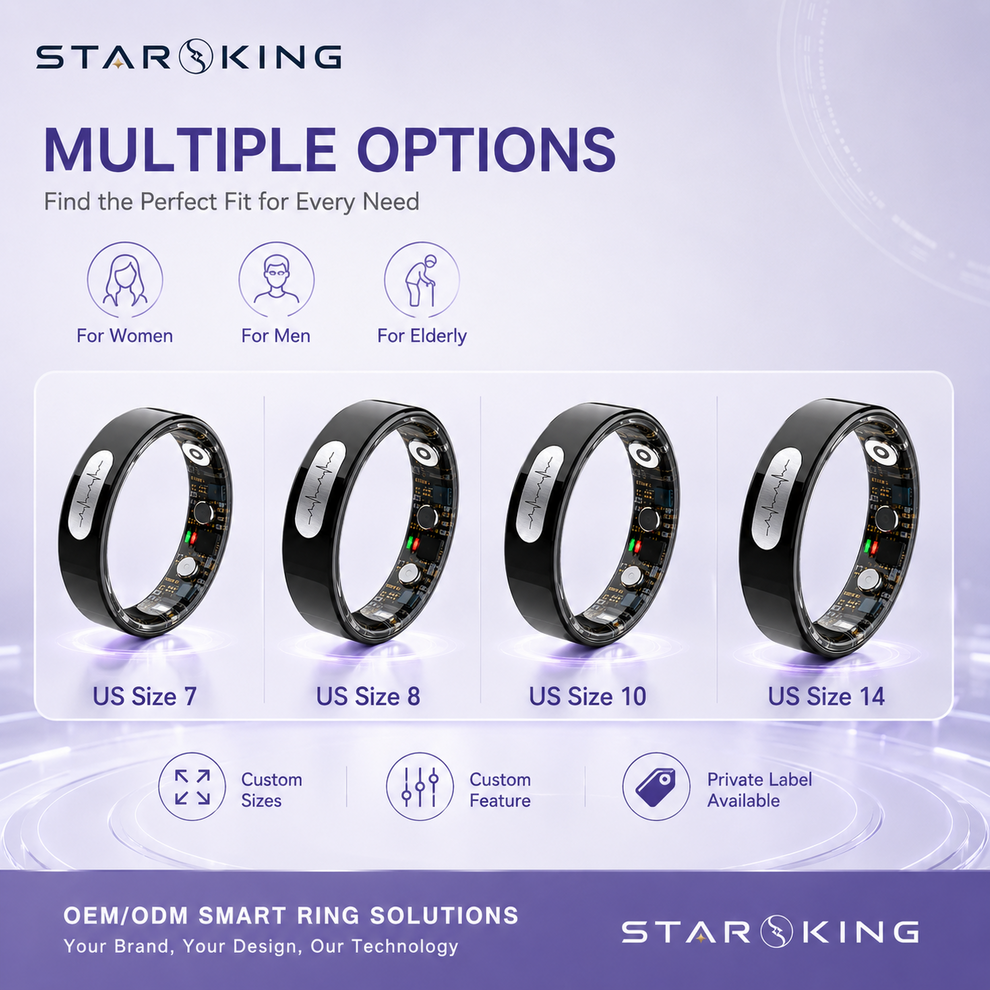
| Product specification | Sensor types, battery life, ring sizes, water resistance | Before shortlisting suppliers |
| Private label | Logo, packaging, app branding options | During quotation |
| MOQ | Per-SKU and per-size minimums | At sample request stage |
| Certification | CE, FCC, RoHS, UN38.3, MSDS per target market | Before purchase order |
| App integration | iOS/Android support, data export, account model | During sample evaluation |
| Quality control | Pre-shipment inspection, aging and waterproof testing | Before mass production |
| Lead time | Sample, production, and shipping windows | At contract stage |

Why Smart Rings Matter for Retail Chains
Smart rings have moved from niche novelty to a recognizable wearable category. For retail chains, they offer a compact, giftable, and higher-margin item that complements watches and bands. But unlike a watch strap or a phone case, a smart ring is a connected device: it depends on sensors, firmware, a mobile app, and a rechargeable battery. That combination raises the bar for supplier evaluation.
Retail buyers evaluating smart rings should think in terms of category management, not single-unit sourcing. You are choosing a supplier who can support a product line across sizes, colors, packaging variants, and possibly private-label branding — often across multiple markets. The seven checks below are designed for that reality.
Check 1: Product Specification and Sensor Performance
Start with a written specification that matches what you intend to sell. At minimum, confirm sensor types, battery capacity and realistic battery life, ring sizing range, water resistance rating, charging method, and supported app features. Consumer wearable health features such as heart rate or blood oxygen monitoring are typically wellness-oriented and should not be presented as medical diagnostic functions. Buyers should verify claims carefully and align marketing language with the actual product capability.
What to ask for
- A current datasheet per SKU, not a generic brochure.
- Battery life figures under defined usage conditions.
- Ring size range and sizing kit availability for retail try-on.
- Sensor feature list and any limitations disclosed in writing.
Check 2: Private Label, Branding, and Packaging
Retail chains usually need more than a logo on the box. Ask how the supplier handles logo customization, retail packaging, user manuals, and app branding. A private-label smart ring program may include custom colors, branded charging cases, multilingual manuals, and retail-ready packaging. Confirm which elements affect MOQ and tooling costs, and which can be handled within standard production.
If you are exploring a broader program, review the supplier’s private label OEM/ODM capabilities alongside product specifications. Clarify ownership of packaging artwork and any custom tooling, and put it in the contract.
Check 3: MOQ, Pricing, and Landed Cost
MOQ for smart rings is typically influenced by ring sizes, color variants, packaging, and branding depth. A supplier may quote a base MOQ per SKU, with higher minimums for custom colors or custom packaging [STAR KING TO CONFIRM]. Always request a cost breakdown that separates unit price, tooling or setup fees, packaging, testing, and shipping.
Landed cost checklist
- Unit price at your target volume.
- Setup, tooling, or artwork fees.
- Packaging and manual localization costs.
- Battery shipping surcharges and freight mode.
- Duties, taxes, and import compliance costs for each market.
Landed cost matters more than unit price for retail chains, because a slightly higher unit price with reliable certification and packaging can reduce returns and markdowns.
Check 4: App, Firmware, and Data Integration
A smart ring is only as good as its app. Confirm iOS and Android support, account and pairing model, data export options, and how firmware updates are delivered. Ask whether the app can be white-labeled for your brand, and what happens to user data. For retail chains with loyalty programs or omnichannel strategies, clarify whether any API or data integration is possible.
Test the app with your sample units on the devices your customers actually use. App quality issues are among the most common reasons for negative reviews in the wearable category, so this check protects your brand reputation. More detail on app and data considerations is available in the fitness tracking application overview.
Check 5: Certification and Market Compliance
Certification requirements depend on the product configuration and the destination market. Buyers should verify, per SKU, which documents the supplier can provide — for example CE marking for the EU, FCC for the United States, RoHS for restricted substances, and UN38.3 plus MSDS for lithium batteries. Do not assume all certifications apply to all products; request certificates and test reports and check that they match the model you are buying.
For battery-powered wearables, UN38.3 testing is commonly required for air transport, and carriers may also request MSDS documentation. Buyers should confirm shipping documentation with their freight forwarder and verify requirements with official sources such as the FCC and the European Commission. Bluetooth-enabled devices may also require Bluetooth SIG declaration; buyers should verify the applicable process.
Check 6: Sample Validation and Quality Control
Order samples from the exact production SKU and test them against your retail requirements. Evaluate fit across ring sizes, charging reliability, app pairing, sensor consistency, and packaging condition after shipping. Ask the supplier to describe their quality-control process, including incoming component checks, aging testing, waterproof testing, and pre-shipment inspection.
A written QC plan should specify sampling levels, defect classification, and who bears the cost of rework. If you are comparing suppliers, ask for their standard QC documentation rather than a verbal promise.
Check 7: Lead Time, Logistics, and After-Sales
Lead time for smart rings typically includes sample approval, component procurement, production, testing, and shipping [STAR KING TO CONFIRM]. Retail chains should plan around launch windows and replenishment cycles, and should ask for a production schedule in writing. Confirm the shipping mode for lithium-battery products, the Incoterms, and the warranty and spare-parts policy.
After-sales support is often overlooked at the awareness stage. Ask how defective units are handled, what the return window is, and whether replacement parts such as chargers or sizing kits are available. A clear after-sales process protects margin and customer satisfaction.
Smart Ring Sourcing Comparison Table
| Evaluation Area | Low-Risk Supplier Signal | Warning Signal |
|---|---|---|
| Specification | Datasheet per SKU with defined test conditions | Generic marketing claims only |
| Private label | Documented options for logo, packaging, and app | Vague promises without MOQ impact |
| Certification | Certificates matched to model and market | “All certifications available” without documents |
| App support | Testable app with update policy | App not available for sample testing |
| Quality control | Written QC and inspection plan | No inspection documentation |
| Lead time | Written schedule with milestones | Verbal estimates only |
Common Mistakes and Buyer Red Flags
Common mistakes
- Approving a bulk order based on a single sample without testing all ring sizes.
- Assuming one certification covers all target markets.
- Ignoring app quality and firmware update policy.
- Underestimating battery shipping documentation and freight surcharges.
- Failing to define packaging and manual localization early.
Buyer red flags
- Supplier cannot provide certificates that match the exact model.
- No clear MOQ structure or cost breakdown.
- App is unavailable for evaluation before purchase.
- No written QC or pre-shipment inspection process.
- Pressure to commit to large volumes before sample validation.
Practical Buyer Checklist
- Request datasheets and samples for every SKU and ring size.
- Confirm private-label and packaging options with MOQ impact.
- Obtain a written cost breakdown including landed cost.
- Test the companion app on iOS and Android devices.
- Verify certification documents per model and target market.
- Review the QC and pre-shipment inspection plan.
- Confirm lead times, shipping mode, warranty, and spare parts.
FAQ
What MOQ should a retail chain expect for smart rings?
MOQ varies by supplier and customization level. Standard SKUs may have lower minimums, while custom colors or packaging typically raise the MOQ [STAR KING TO CONFIRM]. Always request MOQ per size and per variant.
Are smart rings medical devices?
Most consumer smart rings are wellness devices, not medical devices. Health metrics should be presented as wellness information, and any medical claims require separate regulatory review.
Which certifications are needed for smart rings?
It depends on the product configuration and destination market. Common documents include CE, FCC, RoHS, UN38.3, and MSDS. Buyers should verify certificates match the exact model.
Can smart rings be private-labeled with our brand?
Many suppliers offer logo, packaging, and app branding options. Confirm which elements are included in standard production and which affect MOQ or tooling costs.
How long does a bulk smart ring order take?
Lead time typically includes sample approval, production, testing, and shipping. Timelines vary by customization and volume, so request a written schedule [STAR KING TO CONFIRM].
How should retail chains handle lithium battery shipping?
Confirm UN38.3 and MSDS documentation and coordinate with your freight forwarder on carrier requirements for battery-powered devices.
Conclusion
Smart rings can be a strong addition to a retail chain’s wearable assortment, but they require disciplined sourcing. By checking specification, private-label options, MOQ and landed cost, app integration, certification, quality control, and lead-time planning, retail buyers can reduce risk and protect margin. Use the checklist above as a starting framework, and validate every claim with samples and documents before committing to a bulk order.
Next step: Request product samples for the exact smart ring SKUs you plan to stock, and confirm certification and customization requirements for your target markets. Request product samples to begin evaluation.
Discuss Your Smart Wearable OEM/ODM Project
Planning a smart ring, smart watch, smart band, AI glasses, AI translator, or AI voice mouse project? Contact STAR KING to discuss product positioning, sample testing, customization scope, certification requirements, lead time, and quotation details.

Team Star King

Scan WhatsApp QR code
Leave a Reply