
Smart Bands for Corporate Wellness in the EU: 7 Procurement Checks Before You Buy
November 3, 2026 · Team Star King
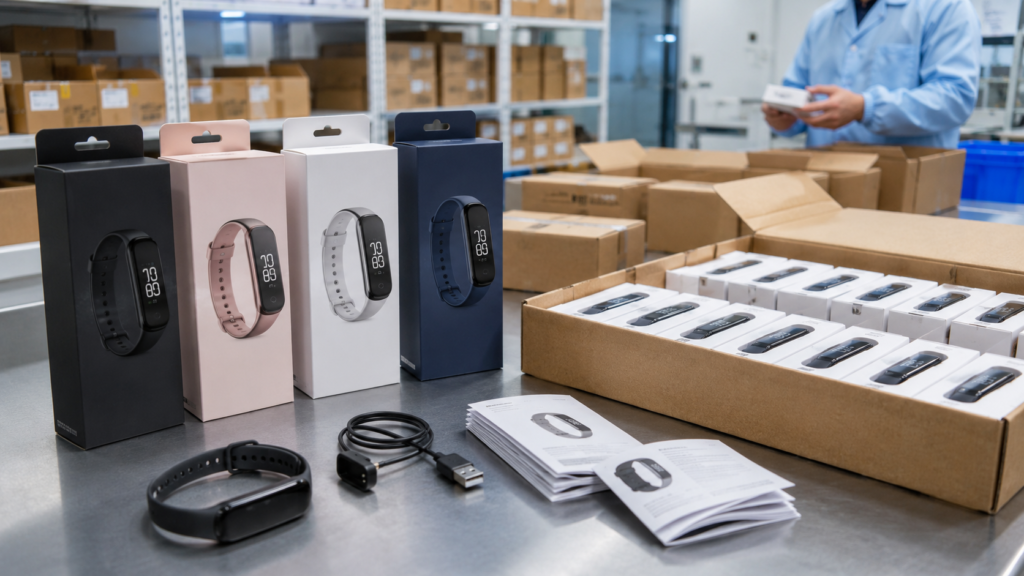
Smart Bands for Corporate Wellness in the EU: 7 Procurement Checks Before You Buy
Smart bands for corporate wellness are wearable devices that employers deploy to employees, insurers, or occupational health programs to support activity, sleep, and recovery tracking. For EU corporate buyers, the right vendor is not simply the one with the lowest unit price: it is the one that can document EU compliance, data protection, stable quality, and predictable lead times for a multi-year wellness program. This guide gives procurement teams seven checks to run during the evaluation phase, covering certifications, GDPR, testing, MOQ, and OEM/ODM fit, before a purchase decision is made.
Table of Contents
Table of Contents
smart bands for corporate wellness: Table of Contents
- Direct Answer: What Should EU Buyers Prioritize?
- Key Takeaways
- Key Facts for Buyers
- Check 1: Define Your Corporate Wellness Use Case
- Check 2: Map EU Compliance and Documentation
- Check 3: Evaluate Data Protection and GDPR Readiness
- Check 4: Verify Quality Control and Product Testing
- Check 5: Understand MOQ, Pricing Drivers, and Lead Times
- Check 6: Assess OEM/ODM and Private Label Flexibility
- Check 7: Plan App, Firmware, and After-Sales Support
- Smart Band Program Comparison Table
- Common Mistakes and Buyer Red Flags
- Practical Buyer Checklist
- Frequently Asked Questions
- Conclusion

Direct Answer: What Should EU Corporate Buyers Prioritize?
EU corporate buyers evaluating smart bands for corporate wellness should prioritize four things: documented compliance for the exact SKU (CE, RoHS, RED, battery transport documentation), a clear GDPR data-flow model, a repeatable quality control process with test evidence, and a supplier that can support multi-year supply and customization. Price and MOQ matter, but they should be assessed after these compliance and quality checks are satisfied.

Key Takeaways
- Corporate wellness programs in the EU usually trigger obligations under the Radio Equipment Directive, GDPR, and battery transport rules; the exact requirements typically depend on product configuration and destination market.
- Ask for certification documents by SKU, not by factory; certificates may not automatically cover customized firmware or new accessories.
- Data protection is a procurement issue: clarify who is the controller, where health data is stored, and whether an app or cloud service is involved.
- MOQ and lead time should be quoted with assumptions: logo, packaging, firmware, and app changes all affect timeline.
- Run a small sample validation round before committing to a full rollout, ideally with employees from different departments.

Key Facts for Buyers
| Topic | What EU Buyers Should Confirm | Why It Matters |
|---|---|---|
| Compliance | CE marking basis, RED test report, RoHS declaration, battery UN38.3 and MSDS documentation for the specific SKU | Customs and market surveillance may request documentation; missing files can delay clearance |
| Data protection | App data flow, cloud hosting region, controller/processor roles, consent and delete mechanisms | Employee health data is sensitive; GDPR obligations apply to employers as controllers |
| Quality | IQC, in-line QC, aging, drop, waterproof test reports, pre-shipment inspection option | Early failure rates affect program credibility and replacement costs |
| MOQ | MOQ by color, logo method, and packaging type | Mixed-color and custom-box orders often raise the minimum |
| Lead time | Sample lead time, production lead time, and buffer for EU-bound freight | Corporate launch dates are usually fixed; late delivery creates internal reputation risk |
| Customization | Logo, strap color, packaging, firmware strings, app name | Private-label fit influences employee adoption |
For teams comparing product families, STAR KING’s smart bands product page lists current hardware options, and the corporate wellness application page describes typical program scenarios.

Check 1: Define Your Corporate Wellness Use Case
Before comparing suppliers, write a one-page use-case brief. Corporate buyers who skip this step often receive quotes that look comparable but cover different hardware, software, and support scopes. A clear brief typically includes headcount, program duration, whether devices are gifted, loaned, or co-funded, which metrics employees will see, and whether the program is voluntary.
Questions to resolve internally
- Is the objective activity motivation, sleep and recovery awareness, or occupational health support?
- Will the employer access individual data, or only aggregated, anonymized reports?
- Does the program need integration with an existing HR, insurer, or occupational health platform?
- Is a smart band sufficient, or do some groups need smart watches? The smart watches range can cover higher-touch user groups.
For broader background on how employers structure these programs, the STAR KING resources blog publishes procurement and application guides.
Check 2: Map EU Compliance and Documentation
In the EU, smart bands are radio equipment and typically fall under the Radio Equipment Directive (RED), which also covers EMC and safety aspects. RoHS restrictions apply to hazardous substances, and lithium battery products usually require UN38.3 test summaries and MSDS for transport. None of these obligations disappear because the buyer is an employer rather than a retailer; the importer or entity placing the product on the EU market generally carries responsibility.
Documentation to request by SKU
- EU Declaration of Conformity and the standards used.
- RED test report from an accredited lab, with the model number matching the quote.
- RoHS test report or declaration covering the finished product.
- UN38.3 test summary and MSDS for the battery pack.
- Instructions and safety information in the languages required by the destination market.
Official references are maintained by the European Commission on CE marking and by national market surveillance authorities. Buyers should verify that certificates name the exact model and that any firmware or battery change does not invalidate the tested configuration. Certification status usually depends on product configuration and target market, so ask the supplier to confirm per SKU in writing.
Check 3: Evaluate Data Protection and GDPR Readiness
Wellness data from employees can reveal health information, which is a special category under the GDPR. Procurement teams should involve legal and data protection officers early, because the choice of device, app, and cloud service determines the data flow. A supplier that cannot explain where data is stored and who can access it creates compliance risk that outweighs any unit-price saving.
Data questions to put in the RFQ
- Which entity is the data controller and which is the processor?
- Where is user data hosted, and is an EU hosting option available? [STAR KING TO CONFIRM]
- Does the app support account deletion and data export?
- Are health insights computed on-device or in the cloud?
- Can the employer receive only aggregated reports?
The European Data Protection Board publishes guidance relevant to workplace data processing. Document the answers in the contract, not only in sales emails.
Check 4: Verify Quality Control and Product Testing
Wellness bands are worn daily, charged often, and exposed to sweat and showers. Quality issues are visible quickly and can undermine employee trust in the program. During evaluation, ask for the QC flow and recent test reports, and consider a pre-shipment inspection for the first production order.
Test evidence to review
- Aging and charging-cycle tests.
- Drop testing from typical hand height.
- Water resistance testing consistent with the stated IP rating.
- Strap durability and buckle fatigue testing.
- Sensor accuracy validation method for heart rate and SpO2 features.
Consumer wellness metrics are not medical diagnoses. Suppliers should describe them as wellness indicators, and buyers should avoid internal communications that imply clinical accuracy. For device-level detail, see STAR KING’s health and fitness wearables solution.
Check 5: Understand MOQ, Pricing Drivers, and Lead Times
Quotes that look identical often hide different assumptions. A clean comparison lists MOQ per color, logo method, packaging type, and whether firmware or app changes are included. Unit price is driven by hardware specification, display type, sensor set, battery capacity, strap material, and packaging.
| Cost or Timeline Driver | Typical Effect on Quote | What to Ask |
|---|---|---|
| Logo method (print, laser, emboss) | May raise MOQ per color | MOQ by logo method |
| Custom retail box | Adds tooling and material cost | Packaging MOQ and sample lead time |
| Firmware strings / app name | Adds engineering time | Who owns the customization and how updates are delivered |
| Battery capacity and sensor set | Changes unit cost and power profile | Trade-off between battery life and feature set |
| EU-bound freight | Adds transit time and battery handling rules | Shipping terms and documentation package |
STAR KING MOQ and lead-time ranges by model are [STAR KING TO CONFIRM]; ask for a written quote with assumptions so internal stakeholders can compare options fairly. If you need packaging and logo options explained, review the private label OEM/ODM solution.
Check 6: Assess OEM/ODM and Private Label Flexibility
Corporate wellness programs benefit from branding, but not every program needs a new product. Buyers should distinguish between light customization (logo, color, packaging) and deeper ODM work (firmware features, app branding, integration). Light customization is faster and lower risk; deeper ODM usually requires sample development, validation, and a longer schedule.
What to clarify with the supplier
- Which parts are configurable without new tooling?
- Who owns the tooling and custom firmware created for the project?
- Can the supplier provide a sample in the final configuration before mass production?
- What is the policy for spare parts and replacement units during the program?
IP and tooling ownership terms should be agreed in writing before development begins. For a broader overview of wearable sourcing, see smart retail and e-commerce solutions if your program includes retail distribution alongside employee use.
Check 7: Plan App, Firmware, and After-Sales Support
The app experience often decides whether employees keep wearing the band after the novelty period. Procurement teams should test the app during the evaluation phase, not after the rollout. Confirm supported languages, onboarding flow, permission prompts, and the process for firmware updates.
Support items to write into the agreement
- Warranty period and RMA process.
- Replacement unit ratio and spare-part availability.
- Firmware update policy and end-of-support notice.
- Technical contact for IT and HR teams during rollout.
If the supplier offers an API or cloud dashboard, confirm whether it is included in the quote and how integration testing is handled.
Smart Band Program Comparison Table
| Procurement Model | Best For | Typical Trade-off |
|---|---|---|
| Off-the-shelf band with logo | Pilot programs and smaller headcounts | Limited branding; fastest timeline |
| Private label with custom packaging | Mid-size corporate rollouts | Higher MOQ per color; stronger brand fit |
| ODM with firmware and app branding | Multi-year programs with platform integration | Longer development and validation cycle |
| Full custom development | Large employers with unique requirements | Highest investment; tooling and IP terms required |
Common Mistakes and Buyer Red Flags
- Accepting a generic certificate: a RED report for a similar model may not cover the SKU you are buying.
- Skipping the data-flow discussion: employee health data requires early legal review; retrofitting consent flows is costly.
- Comparing unit prices without assumptions: different packaging, logo, and firmware scopes produce misleading comparisons.
- Ignoring battery transport rules: lithium battery products need correct documentation for EU-bound freight.
- No sample validation: a small pilot with real employees surfaces fit, app, and charging issues before mass rollout.
- No spare-parts plan: replacement units are essential for program continuity.
Practical Buyer Checklist
- Written use-case brief approved by HR, IT, legal, and procurement.
- Certification documents matched to the exact model and configuration.
- GDPR roles, hosting location, and data deletion process documented.
- QC flow and recent test reports reviewed.
- Quote with MOQ, lead time, packaging, and firmware assumptions in writing.
- Sample order in final configuration tested by a pilot group.
- Warranty, RMA, and spare-parts terms agreed.
- Freight and battery documentation plan confirmed with the forwarder.
Frequently Asked Questions
Do smart bands for corporate wellness require CE marking in the EU?
Yes, radio-enabled smart bands generally require CE marking under the Radio Equipment Directive. The supplier should provide an EU Declaration of Conformity and test reports that match the exact model and configuration.
Can employers access individual employee health data?
Access should be limited and justified. Many programs provide only aggregated reports to the employer and keep individual data with the employee or a healthcare provider. The legal basis and data flow should be reviewed by a data protection officer.
What MOQ should a corporate buyer expect?
MOQ varies by model, color, logo method, and packaging. Ask for MOQ per configuration and confirm whether mixed-color orders are accepted. STAR KING model-specific MOQ is [STAR KING TO CONFIRM].
How long does a private-label smart band order take?
Timeline typically depends on sample approval, packaging, and production scheduling. A practical plan includes sample lead time, production lead time, and buffer for EU-bound freight. Confirm dates in writing before internal launch communications.
Are wellness metrics on smart bands medical measurements?
No. Consumer smart band metrics such as heart rate and SpO2 are wellness indicators, not clinical diagnoses. Buyers should avoid communications that suggest medical accuracy unless the device is separately certified for that purpose.
Who owns the custom tooling and firmware?
Ownership should be agreed in the contract. Buyers should clarify tooling ownership, firmware source ownership, and spare-parts obligations before development starts.
What battery documents are needed for EU shipping?
Lithium battery products typically require UN38.3 test summaries and MSDS for transport. Requirements may vary by carrier and destination, so confirm with your freight forwarder.
Conclusion
Smart bands can support corporate wellness programs effectively, but only when procurement teams validate compliance, data protection, quality, and supply terms before committing. The seven checks in this guide give EU buyers a structured way to compare suppliers and reduce rollout risk. A device that fails a compliance or data review creates far more cost than a modest unit-price difference.
Next Step: Request Samples for Your Wellness Program
If you are evaluating smart bands for a corporate wellness program in the EU, the next practical step is to request product samples in your target configuration and confirm certification requirements for your destination market. Request product samples or discuss an OEM/ODM project with the STAR KING team to compare specifications, MOQ, and lead-time assumptions for your program.
Discuss Your Smart Wearable OEM/ODM Project
Planning a smart ring, smart watch, smart band, AI glasses, AI translator, or AI voice mouse project? Contact STAR KING to discuss product positioning, sample testing, customization scope, certification requirements, lead time, and quotation details.

Team Star King

Scan WhatsApp QR code
Leave a Reply