
Smart Bands for EU Distributors: 7 Critical Steps to Evaluate Suppliers in 2026
October 13, 2026 · Team Star King

Smart Bands for EU Distributors: 7 Critical Steps to Evaluate Suppliers in 2026
If you are a distributor planning to add smart bands to your 2026 EU catalog, the supplier you choose will determine your margins, compliance risk, and after-sales burden. This guide gives you a 7-step framework to evaluate smart band manufacturers — covering MOQ, CE marking, battery safety, and quality control — so you can sign with confidence.
Table of Contents
Table of Contents
smart bands for EU distributors: Short Answer
To source smart bands for EU distributors, prioritize suppliers that provide a signed EU Declaration of Conformity, UN38.3 test reports, and transparent MOQ tiers. Evaluate at least three factories, request sample units from production runs, and confirm that firmware and app localization support your target countries. Certification depends on the exact model and market; verify every claim with documentation before placing a bulk order.

Key Takeaways
- EU market access for smart bands requires CE marking under applicable directives (RED, EMC, RoHS) — never assume a supplier’s claim without paperwork.
- Lithium battery safety (UN38.3, MSDS) is non-negotiable for air freight and customs clearance.
- MOQ and lead time vary by customization level; plan for 500–1,000 units for logo-only orders and higher volumes for full ODM.
- Quality control should include pre-shipment inspection, aging tests, and waterproof verification.
- Distributors should verify software update commitments and local app language support.
- Red flags include reluctance to share test reports, vague certification statements, and no traceable production samples.

Table of Contents
- Step 1: Define Your EU Market Entry Requirements
- Step 2: Verify Manufacturer Credentials and Factory Capability
- Step 3: Understand Certification and Compliance
- Step 4: Evaluate MOQ, Pricing, and Lead Time
- Step 5: Test Samples and Validate Quality Control
- Step 6: Check Software, App, and Firmware Support
- Step 7: Plan Logistics, Battery Shipping, and After-Sales
- Common Mistakes and Buyer Red Flags
- Practical Buyer Checklist
- FAQ
- Conclusion

Key Facts for Buyers
| Item | Typical EU Requirement | Buyer Action |
|---|---|---|
| CE Marking | Required for RED, EMC, RoHS depending on features | Request EU Declaration of Conformity and test reports |
| Battery Safety | UN38.3 test summary, MSDS for lithium cells | Verify documents match the exact battery model |
| MOQ | Varies by customization; often 500–1,000 units for logo, higher for ODM | Ask for written MOQ tiers for each customization level |
| Lead Time | Sample: 7–15 days; Mass production: 30–45 days after deposit | Confirm schedule in writing and plan buffer for shipping |
| Quality Control | Pre-shipment inspection, aging test, waterproof test | Request third-party inspection or factory test reports |
| App & Firmware | Local language support, regular updates | Test app connectivity and update policy before launch |
Note: STAR KING can provide CE, RoHS, and UN38.3 documentation for qualified projects. Exact scope depends on configuration and destination; buyers should verify all documents before purchase.
Step 1: Define Your EU Market Entry Requirements
Before contacting any supplier, map out the legal and commercial requirements for each EU country you plan to sell into. Smart bands are consumer electronic devices, so they must comply with the Radio Equipment Directive (RED 2014/53/EU), the Electromagnetic Compatibility Directive (EMC), and the Restriction of Hazardous Substances (RoHS). Some models with health sensors may also fall under additional guidance from national authorities.
On the commercial side, decide whether you want a private-label product (your brand on an existing model) or a full ODM solution (custom design). This decision directly affects MOQ, tooling costs, and lead time.
Buyers should verify the current scope of directives on the official EU portal. The EU’s Your Europe portal on technical standards provides up-to-date guidance.
Step 2: Verify Manufacturer Credentials and Factory Capability
Not every trading company that claims to be a manufacturer actually owns production lines. As a distributor, you need a partner that can control quality, deliver on time, and support you after the sale.
Ask for:
- Business license and export records for the EU.
- Photos or live video of the production line (SMT, assembly, testing).
- List of key equipment: aging test racks, waterproof testers, RF testers.
- References from other EU distributors or brand owners.
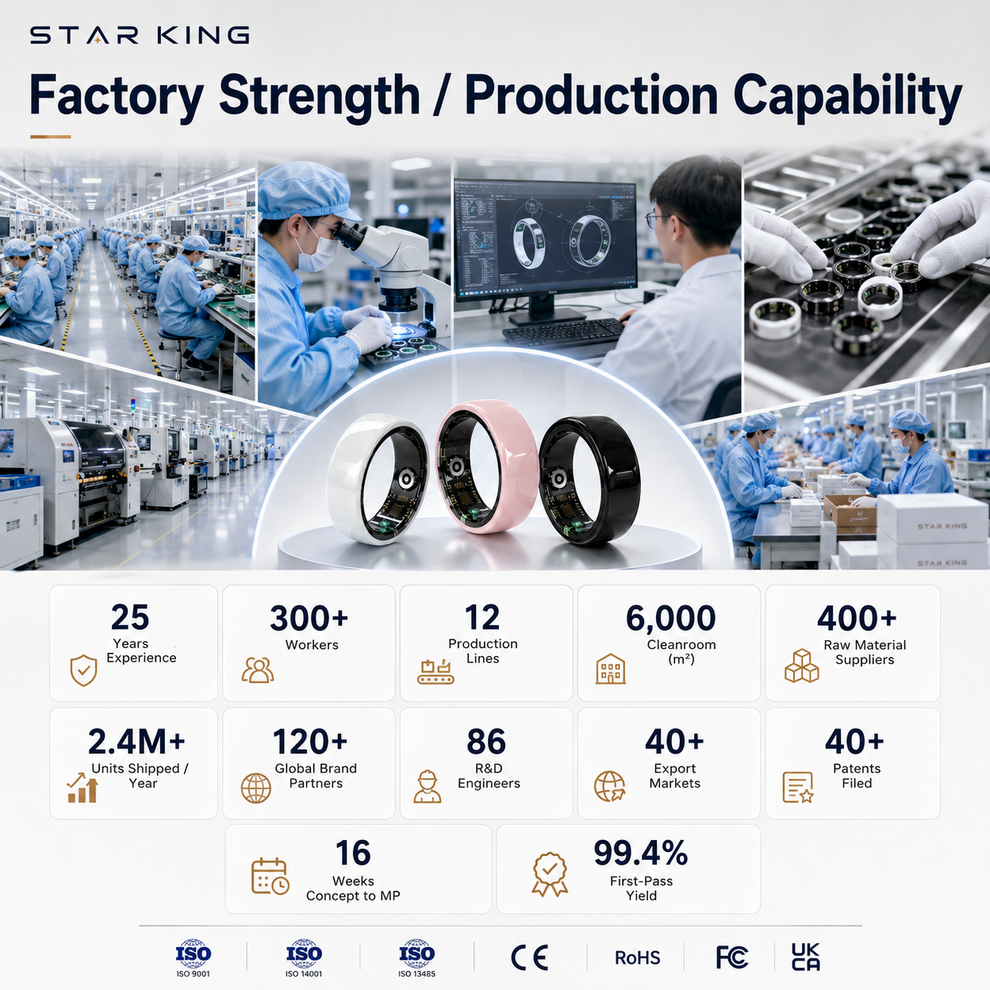
STAR KING operates as an OEM/ODM manufacturer with in-house capabilities for smart bands. Specific factory certifications and capacity details are [STAR KING TO CONFIRM]. When evaluating any supplier, request a virtual factory tour or a third-party audit report.
Read more on our smart bands product page to see typical specifications and customization options.
Step 3: Understand Certification and Compliance
Compliance is the number one reason shipments get held at EU customs. A responsible manufacturer will give you a complete package:
- CE Declaration of Conformity – signed document listing applicable directives.
- Test reports – from accredited labs for RED, EMC, RoHS, and safety.
- UN38.3 test summary – for lithium battery transport.
- MSDS – material safety data sheet for the battery.
- REACH and WEEE compliance – if your market requires it.
Be cautious: certification is model-specific. A supplier may have CE for one smart band model but not for another you are considering. Always match the certificate to the exact product and configuration you are buying.
For battery safety standards, refer to the IATA lithium battery guidance which is widely used for air transport of UN38.3 tested cells.
Ask your supplier to confirm which directives apply to your specific model. STAR KING can support compliance documentation for relevant products; the final requirements depend on the product configuration and target country.
Step 4: Evaluate MOQ, Pricing, and Lead Time
MOQ is often the deal-breaker for distributors testing a new category. Most factories set minimums based on customization level. Here is a typical structure:
| Customization Level | Typical MOQ | Lead Time (after deposit) |
|---|---|---|
| Logo on existing model | 500–1,000 units | 25–35 days |
| Custom packaging | 1,000–2,000 units | 30–40 days |
| App / firmware customization | 2,000+ units | 40–60 days |
| Full ODM new design | 5,000+ units | 60–90 days + tooling |
These figures are indicative. STAR KING’s exact MOQ and lead times are [STAR KING TO CONFIRM] and will depend on your project scope. Always get a written quotation with a breakdown of unit price, tooling, packaging, and certification costs.
Consider total landed cost, not just FOB price. Import duties, VAT, and freight can add 20–30% to your cost. For guidance on customs procedures, see the European Commission Taxation and Customs Union.
For distribution models and private-label strategies, visit our Private Label OEM/ODM solution page.
Step 5: Test Samples and Validate Quality Control
Never place a bulk order based on a catalog photo. Request samples from the actual production line, not hand-made golden samples. Test them for at least one week.
What to test:
- Battery life under normal use (heart rate on, notifications on).
- Charging cycles and connector durability.
- Water resistance (IP rating) – verify with a splash or immersion test if applicable.
- App pairing stability on both iOS and Android.
- Sensor accuracy compared to a known reference (for heart rate and SpO2, treat as wellness estimates, not medical data).
Ask for the factory’s QC process: do they run aging tests? Do they perform 100% functional checks? What is the AQL level? STAR KING can provide pre-shipment inspection reports and supports third-party inspection for bulk orders.
If you are also considering smart watches for your portfolio, apply the same sample validation approach.
Step 6: Check Software, App, and Firmware Support
A smart band is only as good as its app. For EU distributors, language support is critical. Confirm that the companion app is available in the main languages of your target countries (English, German, French, Spanish, Italian, etc.).
Ask about:
- Update frequency and how users receive firmware updates.
- Data privacy compliance – GDPR applies if you collect user data in the EU.
- Possibility of white-labeling the app (custom name, icon, and splash screen).
- API availability if you plan to integrate with a corporate wellness platform.
GDPR compliance is the distributor’s responsibility in many cases. Ensure your supplier provides a clear data processing agreement. For official GDPR information, see the European Commission data protection page.
STAR KING offers firmware and app customization options for OEM projects. Specific capabilities are discussed per project.
Step 7: Plan Logistics, Battery Shipping, and After-Sales
Smart bands contain lithium batteries, which are classified as dangerous goods for transport. You need:
- UN38.3 test summary for the exact battery model.
- MSDS.
- Proper packaging with lithium battery marks.
- Freight forwarder experienced in DG cargo.
Air freight is faster but more expensive; sea freight is cheaper but takes 30–45 days. For EU distributors, having a local warehouse or 3PL can reduce delivery times and improve after-sales service.
Discuss warranty terms: what is covered, for how long, and how replacements are handled. A clear after-sales policy protects your brand reputation.
For more on supply chain planning, see our blog on smart wearable sourcing and OEM insights.
Common Mistakes and Buyer Red Flags
- Accepting a CE certificate that doesn’t match your model. Certificates are product-specific.
- Skipping UN38.3 verification. Without it, your shipment may be rejected by the airline or customs.
- Paying a deposit without a written QC plan. Insist on AQL and inspection terms.
- Assuming MOQ is negotiable after tooling starts. Get all terms locked before production.
- Ignoring app maintenance. If the supplier stops updating the app, your product becomes obsolete.
- No IP or mold ownership agreement. Clarify who owns the tooling and design files.
Practical Buyer Checklist
- ✅ EU Declaration of Conformity and test reports for your exact model.
- ✅ UN38.3 test summary and MSDS for the battery.
- ✅ Written MOQ and lead time for each customization level.
- ✅ Sample units from production run tested for at least 7 days.
- ✅ App language support and update policy confirmed.
- ✅ GDPR data processing agreement if applicable.
- ✅ Pre-shipment inspection terms (AQL, third-party option).
- ✅ Warranty and spare parts policy in writing.
- ✅ Tooling ownership and IP clauses in the contract.
FAQ
Q1: What certifications do smart bands need to be sold in the EU?
A: Typically CE marking under RED, EMC, and RoHS. Some models may also require WEEE registration and REACH compliance. The exact scope depends on the product’s features and your sales channels. Always verify with the manufacturer’s documentation.
Q2: What is a realistic MOQ for private-label smart bands?
A: For logo-only customization, MOQ often starts at 500–1,000 units. Custom packaging or app changes usually require 1,000–2,000 units. Full ODM projects may require 5,000+ units. These are indicative; confirm with your supplier.
Q3: How long does it take to get samples?
A: Standard samples usually ship in 7–15 days. Customized samples may take 15–25 days depending on complexity. Always request a sample from the actual production line.
Q4: Can I ship smart bands by air?
A: Yes, but lithium batteries are regulated. You need UN38.3 test reports and MSDS, and the shipment must comply with IATA dangerous goods regulations. Many suppliers handle this; confirm before ordering.
Q5: What should I check in the app before committing?
A: Test pairing stability, language support, data sync accuracy, and update frequency. Ask about white-label options if you want your own app branding.
Q6: How do I verify a supplier’s quality control?
A: Request their QC process documentation, ask about AQL levels, and consider a third-party pre-shipment inspection. Factory audit reports or virtual tours also help.
Q7: What are the biggest risks when sourcing from overseas?
A: Compliance gaps, battery shipping issues, quality inconsistency, and lack of after-sales support. Mitigate by validating certifications, testing samples, and signing clear contracts.
Conclusion
Sourcing smart bands for EU distributors in 2026 requires a disciplined approach. Start with compliance, verify the manufacturer, test samples, and lock down MOQ, lead time, and after-sales terms. By following these seven steps, you reduce risk and build a product line that meets EU requirements and satisfies your customers.
STAR KING supports distributors with OEM and private-label smart bands, including customization of logo, packaging, and app. Request product samples to evaluate quality and discuss your project requirements.
Note: This article is for informational purposes and does not constitute legal or compliance advice. Buyers should verify all requirements with qualified professionals and official sources.
Discuss Your Smart Wearable OEM/ODM Project
Planning a smart ring, smart watch, smart band, AI glasses, AI translator, or AI voice mouse project? Contact STAR KING to discuss product positioning, sample testing, customization scope, certification requirements, lead time, and quotation details.

Team Star King

Scan WhatsApp QR code
Leave a Reply