
private-label smart watches suppliers: 7 Supplier Checks for Private-Label Smart Watches in the US (2026 Sourcing Guide)
October 11, 2026 · Team Star King
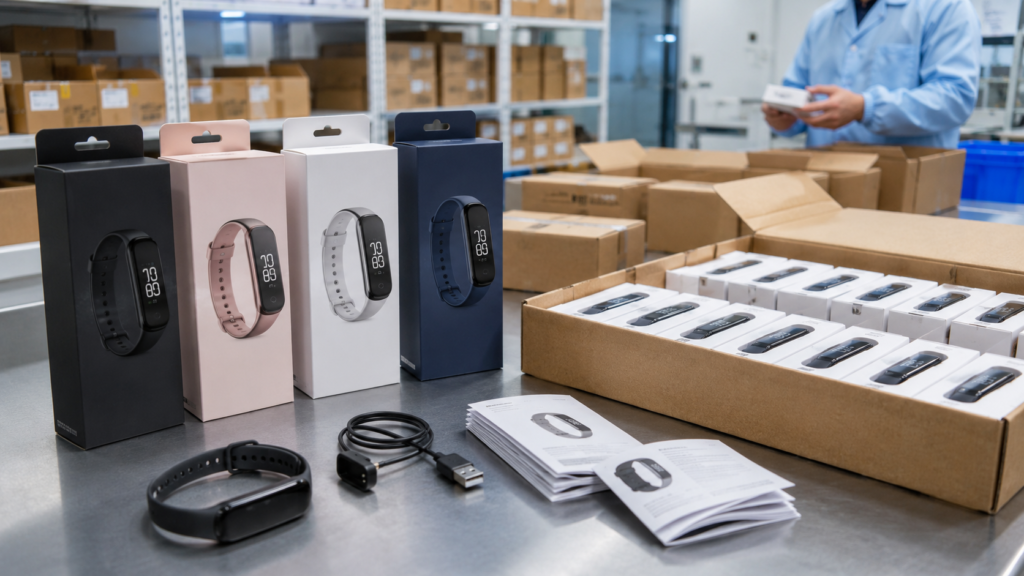
7 Supplier Checks for Private-Label Smart Watches in the US: A 2026 Sourcing Guide
Choosing private-label smart watches suppliers for the US market comes down to seven verifiable checks: manufacturing scope, hardware and firmware capability, App integration, MOQ and landed cost, quality systems, certification for your SKU, and after-sales support. Buyers who validate these points before paying a deposit reduce rework, customs holds and warranty claims far more than buyers who compare price lists alone. This guide shows private-label brands how to run each check, what evidence to request, and where suppliers commonly fall short.
Table of Contents
Table of Contents
private-label smart watches suppliers: Table of Contents
- Direct Answer
- Key Takeaways
- Key Facts for Buyers
- What Makes a Qualified Private-Label Smart Watch Supplier?
- Check 1 – Manufacturing Scope and Ownership
- Check 2 – Hardware and Firmware Roadmap
- Check 3 – Companion App and Data Control
- Check 4 – MOQ, Tooling and Landed Cost
- Check 5 – Quality Control and Pre-Shipment Inspection
- Check 6 – Certification and US Compliance
- Check 7 – Lead Time, Warranty and Spare Parts
- Supplier Evaluation Scorecard
- Common Mistakes and Buyer Red Flags
- Practical Buyer Checklist
- FAQ
- Conclusion
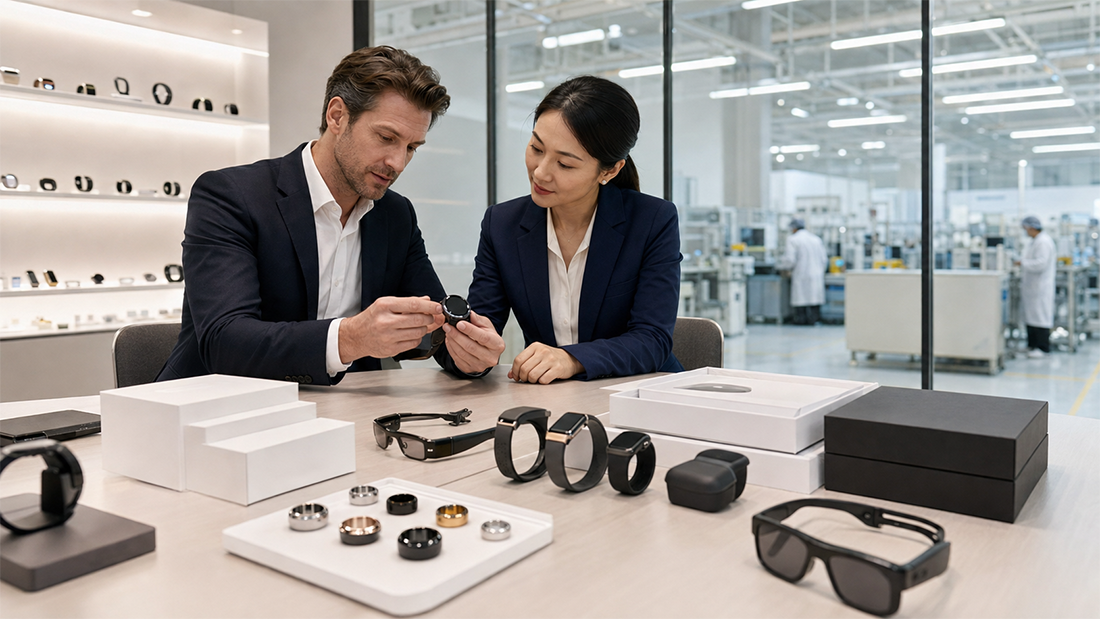
Direct Answer
The most reliable private-label smart watches suppliers can show, in writing, what they build in-house, which firmware and companion App features are customizable, their MOQ tiers and tooling costs, their quality and inspection process, which test reports apply to your exact SKU, and how warranty and spare parts are handled after delivery. Verify documents and samples rather than relying on catalogs or verbal claims.
Key Takeaways
- Confirm the supplier’s real scope: design, tooling, SMT, assembly, testing and packaging are rarely all in-house.
- Treat firmware and companion App ownership as a buying decision, not a technical detail.
- Model MOQ, tooling, certification and freight together to reach a realistic landed cost per unit.
- Ask for test reports tied to your model, band material and battery configuration.
- Certification requirements depend on the product configuration and target market; buyers should verify.
- Plan lead time around certification and Chinese New Year, not just production days.
- Agree on warranty, spare parts and component end-of-life policy before mass production.
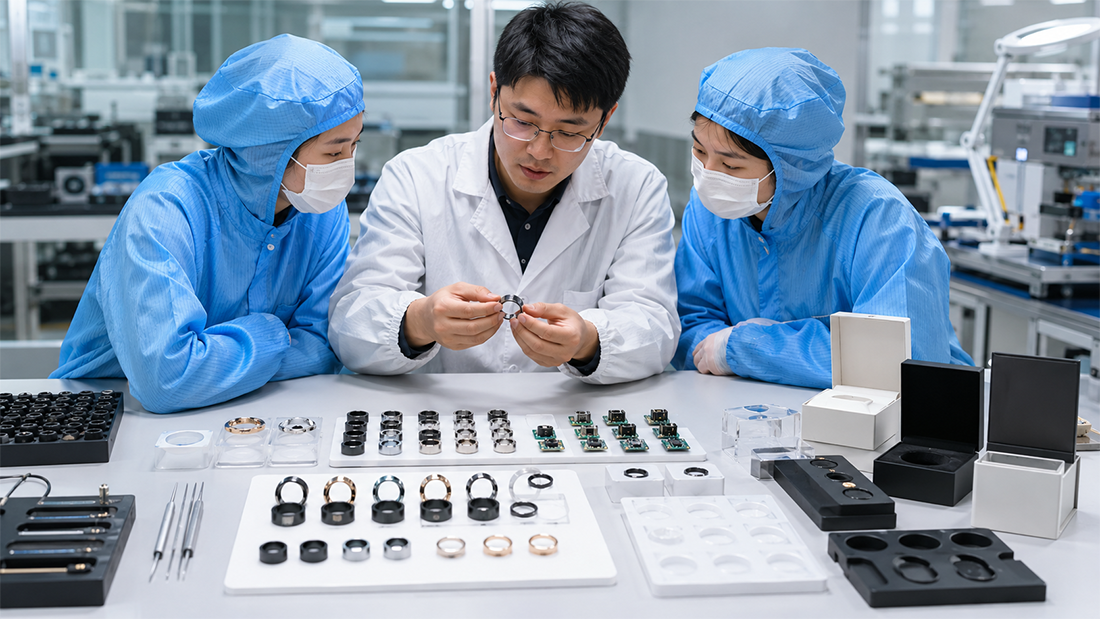
Key Facts for Buyers
| Evaluation Area | What to Verify | Typical Evidence |
|---|---|---|
| Manufacturing scope | In-house design, tooling, SMT, assembly, testing, packaging | Factory audit report, process flow, video walkthrough |
| Hardware and firmware | SoC platform, sensors, firmware customization terms | Datasheet, firmware change log, NDA and IP clause |
| Companion App | White-label App, account ownership, data flow | App demo account, API documentation outline |
| MOQ and tooling | Per-SKU MOQ, tooling fee, sample fee | Written quotation with tiered pricing |
| Quality system | IQC, in-line checks, aging, pre-shipment inspection | QC plan, AQL level, inspection reports |
| Certification | Reports matching your exact SKU and market | FCC ID or test report, CE, RoHS, UN38.3, MSDS |
| Logistics and support | Lead time, warranty, spare parts, EOL notice | Sales contract, warranty terms, service SLA |
What Makes a Qualified Private-Label Smart Watch Supplier?
A qualified supplier is one that can trace your order from industrial design through tooling, materials, assembly, testing, packaging and export documentation, and can name the party responsible for each step. Private-label smart watches suppliers sit in different positions on this chain. Some are full OEM/ODM manufacturers that control design and production. Others are trading companies or assemblers that outsource casing, straps, PCBA or finishing. The position matters because it determines who you negotiate with when a defect appears, when a component is discontinued, or when a certification update is required.
For a private-label brand in the United States, three questions separate a viable supplier from a risky one. First, can they build a watch that matches your price band without stripping features buyers notice, such as display type, battery life, charging method and water resistance rating? Second, can they put your brand on the product, packaging, App and manual consistently? Third, can they supply the documentation your retail or e-commerce channel expects? A supplier that answers all three with evidence is worth a sample order; one that answers with brochures is not.
Check 1 – Manufacturing Scope and Ownership
Start by mapping the supply chain. Ask which operations are performed in-house and which are subcontracted: industrial design, mold making, injection molding, SMT placement, display bonding, battery pack assembly, final assembly, waterproof testing, aging, and retail packaging. Request a process flow diagram and, if possible, a live or recorded walkthrough of the lines that will run your order.
Why scope affects your risk
If tooling is outsourced, mold ownership and lead time sit with a third party you cannot audit directly. If the companion App is licensed from another vendor, your customization window and data terms depend on that vendor’s roadmap. If testing is limited to a functional power-on check, defect escape rates rise and warranty costs land on you.
Evidence to request
- Mold ownership statement and whether tooling is dedicated to your program.
- List of in-house production and test equipment relevant to smart watches.
- Named subcontractors for PCBA, battery packs, displays and plating.
- Production capacity per month for the model family you are evaluating. [STAR KING TO CONFIRM]
Check 2 – Hardware and Firmware Roadmap
A smart watch program lives for several product cycles. Ask what SoC platform the supplier builds on, how long that platform will remain available, and how firmware updates are delivered. Consumer-grade wearable features such as heart rate, blood oxygen estimates, sleep staging and step counting are useful for wellness positioning, but they are not medical diagnostics and should not be marketed as such in the US.
Feature trade-offs to settle early
| Decision | Lower-Cost Option | Higher-Cost Option | Buyer Impact |
|---|---|---|---|
| Display | Basic LCD panel | AMOLED with higher brightness | Perceived quality, daylight readability |
| Charging | Pogo-pin dock | Magnetic wireless charging | Return rate, accessory cost |
| Water resistance | IP67 lifestyle rating | 5 ATM-class sealing | Warranty exposure, use cases |
| Battery | Smaller cell, shorter runtime | Larger cell, longer runtime | Reviews, charging frequency complaints |
| GNSS | Phone-connected GPS only | On-board GNSS | Running and outdoor positioning |
Firmware terms that belong in the contract
- Who owns custom firmware code written for your brand.
- How bug fixes and security patches are delivered after launch.
- Whether over-the-air update infrastructure is supplier-hosted or brand-hosted.
- Whether feature changes trigger re-testing and who pays for it.
If you are building a wellness-led assortment rather than a general fitness line, the same platform decisions apply, but sensor accuracy messaging and App reporting become more important; the health and fitness wearables solution page outlines how those requirements are typically scoped.
Check 3 – Companion App and Data Control
For most private-label brands, the companion App is the second product. Confirm whether the supplier offers a white-label App with your name and icon, whether a fully custom App is possible, and who holds the developer accounts. Ask where user data is stored, what the retention policy is, and how account deletion works, because US consumers and platforms increasingly expect clear data handling.
Practical App questions
- Is the App published under the brand’s developer account or the supplier’s?
- Can onboarding screens, units, language and branding be customized?
- Is there an API or SDK for exporting health and activity data?
- What happens to App access if the supplier relationship ends?
If your roadmap includes AI-driven features such as voice notes or translation accessories, check whether the supplier’s App ecosystem is designed to integrate additional devices; the AI office productivity solution describes how multi-device App architecture is usually structured.
Check 4 – MOQ, Tooling and Landed Cost
MOQ should never be read in isolation. A low unit MOQ paired with a high tooling fee and mandatory certification budget can cost more than a higher MOQ at a supplier that includes tooling in the program. Build a landed cost model with five lines: unit price, tooling amortization, certification and testing, freight and duties, and packaging.
Landed cost worksheet
| Cost Line | What to Ask | Common Pitfall |
|---|---|---|
| Unit price | Tiered pricing by quantity and configuration | Comparing prices for different feature sets |
| Tooling | One-time fee, ownership, reuse for future SKUs | Paying for tooling you do not own |
| Certification | Which reports exist, which must be added for your SKU | Assuming a report covers a new battery or radio module |
| Freight and duties | Incoterm, air vs sea, HS code, US tariff treatment | Quoting FOB prices as landed cost |
| Packaging | Custom box MOQ, inserts, manuals, barcodes | Underestimating retail-ready packaging cost |
Certification requirements and applicable duties change; buyers should verify current rules with the supplier, a customs broker and the relevant authority. Historically, US tariff treatment for consumer electronics has shifted with trade policy, so confirm the HS classification and duty rate for your specific configuration before finalizing retail pricing.
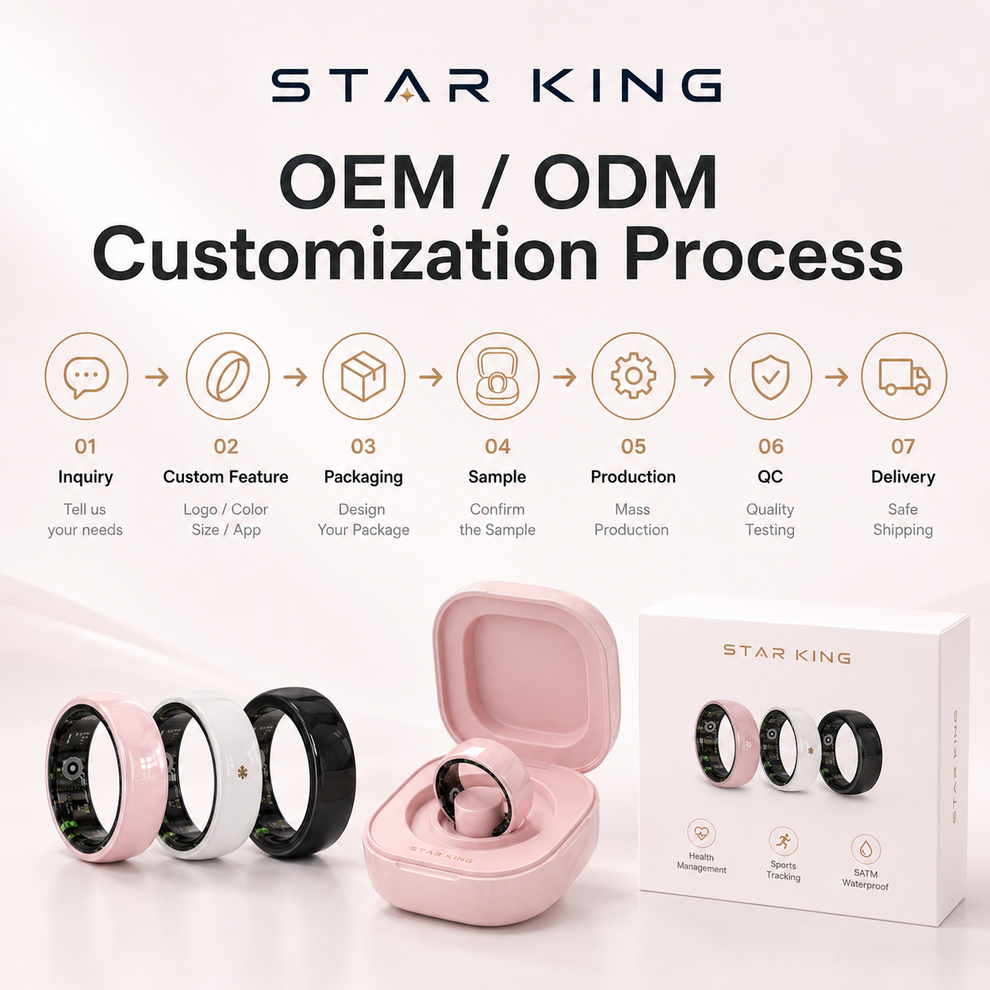
STAR KING’s private label OEM/ODM program structure is a useful reference when comparing how suppliers tier MOQ, tooling and customization options. [STAR KING TO CONFIRM MOQ tiers and tooling fees]
Check 5 – Quality Control and Pre-Shipment Inspection
Ask for the QC plan in writing and match it to the failure modes that generate returns: dead-on-arrival units, charging faults, screen defects, water ingress and strap breakage. A credible plan includes incoming material inspection, in-line assembly checks, functional testing, aging or burn-in for a defined period, waterproof testing where the rating claims it, and a final pre-shipment inspection at an agreed AQL level.
Testing items worth confirming
- Charging and discharge cycle test on every unit or by sampling.
- Waterproof or water-resistance test method matching the claimed rating.
- Drop and vibration testing for retail logistics.
- Battery safety testing consistent with UN38.3 for lithium cells in transport.
- Aging test duration and pass criteria.
For a broader view of how these checks fit together, the remote health wearables application page shows how reliability expectations rise when devices support ongoing monitoring use cases.
Soft CTA
If you are comparing suppliers and want to see how a sample plan, QC checklist and customization options are structured for a private-label smart watch program, you can review specifications and request samples through STAR KING’s smart watch line.
Check 6 – Certification and US Compliance
Certification is the single most misunderstood part of smart watch sourcing. A test report covers a specific model, radio module, battery configuration and sometimes a specific color or material variant. If any of those change, the report may no longer apply. Ask the supplier to name the exact reports available for your SKU and to confirm which additional tests would be required.
Certification and testing map
| Requirement | Typical Scope | Buyer Action |
|---|---|---|
| FCC | Radio-frequency devices sold in the US | Confirm FCC ID or test report applies to your model |
| CE | Products placed on the EU market | Request declaration and test reports if you sell in Europe |
| RoHS | Restricted substances in electrical equipment | Verify report covers the materials used in your SKU |
| UN38.3 | Lithium battery transport safety | Confirm cell and pack level documentation for shipping |
| MSDS | Safe handling and transport documentation | Request current documents for the battery used |
| Prop 65 | California chemical warning requirements | Ask about material declarations for straps and coatings |
For devices with radio transmitters, the FCC equipment authorization database allows buyers to search an FCC ID and confirm it exists and matches the applicant. For lithium battery transport rules, the IATA Dangerous Goods Regulations is the reference airlines and forwarders work from. Requirements vary by configuration and market, and buyers should verify with the supplier and a qualified compliance or customs professional. Health monitoring features are consumer-grade unless a product holds a specific clearance or registration; STAR KING does not market smart watches as medical diagnostic devices. [STAR KING TO CONFIRM certification coverage by SKU]
Check 7 – Lead Time, Warranty and Spare Parts
Production days are only part of lead time. Certification, packaging printing, and the Chinese New Year production pause all extend the calendar. Ask for a dated production schedule that separates sample approval, tooling, mass production, inspection and shipping, plus a buffer for re-testing.
Support terms to agree before mass production
- Warranty length and what it covers (defect vs wear-and-tear).
- Spare parts program: straps, chargers, batteries, displays.
- Component end-of-life notice period for key parts.
- RMA process, replacement ratio and shipping responsibility.
- Technical support channel and response expectations.
These terms carry more weight for programs built around continuous use, such as corporate wellness deployments, where downtime is visible to end users; the corporate wellness application page explains the operational expectations buyers typically set. [STAR KING TO CONFIRM warranty, spare parts and EOL policy]
Supplier Evaluation Scorecard
Score each supplier from 1 to 5 on the criteria below and weight the areas that drive your risk. Two suppliers with identical prices can score very differently once quality and support are included.
| Criterion | Weight | Score (1-5) | Weighted Result |
|---|---|---|---|
| Manufacturing scope and transparency | 20% | ||
| Hardware and firmware capability | 15% | ||
| App and data control | 15% | ||
| MOQ and landed cost competitiveness | 15% | ||
| Quality control and inspection | 15% | ||
| Certification coverage | 10% | ||
| Lead time, warranty and support | 10% |
Common Mistakes and Buyer Red Flags
- Comparing unit price only. Two quotes at the same price can differ by hundreds of dollars per order once tooling, testing and freight are included.
- Accepting a certification report by file name. Match the report to the model number, radio module and battery configuration.
- Ignoring App ownership. If the App lives under the supplier’s developer account, your brand’s continuity depends on the relationship.
- Skipping the sample validation stage. Wear test samples for at least several days and inspect charging, sealing and strap durability.
- Assuming tooling is transferable. Confirm in writing that molds built for your program belong to you.
- Overlooking component EOL. A display or SoC discontinued mid-program forces redesign or last-time-buy inventory.
- No written warranty terms. Verbal support commitments rarely survive staff changes.
Red flags include refusal to share process documentation, reluctance to name subcontractors, quotes that change between calls, and pressure to pay a large deposit before sample approval.
Practical Buyer Checklist
- Process flow diagram with responsible party per step.
- Mold ownership statement for your program.
- Firmware customization and IP clause in the contract.
- Companion App demo account and developer account ownership confirmed.
- Tiered quotation showing unit price, tooling, sample fee and packaging cost.
- QC plan with AQL level, aging duration and waterproof test method.
- Test reports matched to your exact model, module and battery.
- Dated production schedule including certification and shipping buffer.
- Warranty, spare parts and EOL terms in writing.
- Landed cost model including duty and freight, verified with a broker.
Buyers can also review STAR KING Smart Watches OEM/ODM options to compare product positioning, customization scope, and sample planning.
FAQ
What MOQ should a private-label brand expect for smart watches?
MOQ varies by supplier, model and customization level. Basic branded packaging programs typically start lower than full custom tooling programs. Ask for tiered pricing that shows how unit cost changes at each quantity step, and treat tooling fees separately from unit price. [STAR KING TO CONFIRM MOQ tiers]
Does a supplier’s FCC report cover my private-label version?
Only if your version uses the same radio module, enclosure design characteristics and battery configuration as the tested model. Changing the radio module, antenna or charger generally requires new testing. Verify the FCC ID in the FCC database and confirm the applicant and product description.
Can I have a fully custom companion App?
Many suppliers offer a white-label App with branding, and some support deeper customization or an API. Fully custom development usually increases cost and timeline. Confirm which developer account publishes the App and what happens to data access if the relationship ends.
How long does smart watch production and shipping take?
Sample approval, tooling, mass production, inspection and shipping each add time, and certification can extend the schedule further. Chinese New Year typically pauses production for several weeks. Ask for a dated schedule rather than a single lead-time number. [STAR KING TO CONFIRM typical lead time]
What documents should accompany a lithium-battery smart watch shipment?
Lithium batteries in transport commonly require UN38.3 test documentation and an MSDS, and air shipments follow dangerous goods rules. Confirm current requirements with your forwarder, since rules are updated periodically.
Are smart watch health features medical devices in the US?
Consumer wearable features such as heart rate and sleep estimates are generally marketed as wellness features, not diagnostics. A product would need specific clearance or registration before making medical claims. Buyers should verify claims language with a regulatory professional.
Who owns the molds and tooling paid for by the brand?
That depends on the contract. Buyers should require a written statement that tooling funded by the brand remains the brand’s property and is transferable, and should confirm where it is stored.
Conclusion
Supplier selection for private-label smart watches is a documentation exercise before it is a negotiation. Map the manufacturing scope, confirm firmware and App ownership, model the landed cost, verify the QC plan, match certification to your exact SKU, and lock down lead time, warranty and spare parts terms. Buyers who complete these checks before paying a deposit enter mass production with far fewer surprises than those who choose on price alone.
STAR KING CTA
Ready to move from shortlisting to sampling? Share your target features, packaging direction and expected volume with STAR KING, and request a quotation or an OEM/ODM project discussion covering customization options, sample lead time and certification requirements for your smart watch program.
Request a Quotation for Your Private-Label Smart Watch Program
Discuss Your Smart Wearable OEM/ODM Project
Planning a smart ring, smart watch, smart band, AI glasses, AI translator, or AI voice mouse project? Contact STAR KING to discuss product positioning, sample testing, customization scope, certification requirements, lead time, and quotation details.

Team Star King

Scan WhatsApp QR code
Leave a Reply