
Smart Ring Supplier Selection: 7 Checks for E-commerce Sellers to Vet a Manufacturer in 2026
Smart Ring Supplier Selection: 7 Checks for E-commerce Sellers to Vet a Manufacturer in 2026
The smart ring category is moving fast, and for e-commerce sellers the hardest part is not finding a factory but picking the right one. A smart ring supplier affects your product quality, brand reputation, return rate, ad performance, and listing compliance on Amazon, TikTok Shop, Shopify, or your own DTC store. When you evaluate a smart ring supplier in 2026, focus on seven checks: OEM/ODM or private label capability, product specification and sensor trade-offs, MOQ and price logic, sample testing and validation, quality control, certification and target-market compliance, and lead-time planning including lithium battery shipping. This guide gives you a practical framework to compare suppliers, ask the right questions, and reduce sourcing risk before you place a bulk order.
Table of Contents
Table of Contents
Table of Contents
- Direct Answer: What Should E-commerce Sellers Look For?
- Key Takeaways
- Key Facts for Buyers
- What a Smart Ring Manufacturer Actually Does
- 7 Checks to Vet a Smart Ring Supplier
- Comparison Table: Trading Company vs. Factory-Direct vs. Full-Service OEM
- Common Mistakes and Buyer Red Flags
- Practical Buyer Checklist
- FAQ
- Conclusion
Direct Answer: What Should E-commerce Sellers Look For?
When choosing a smart ring supplier, e-commerce sellers should evaluate seven areas: OEM/ODM and private label capability, product specification trade-offs, MOQ and price logic, sample testing, quality control process, certification and target-market compliance, and lead-time planning. The right supplier documents these points, offers clear sample programs, and can support app, firmware, logo, and packaging customization. Price alone should never be the deciding factor, because quality and compliance issues show up later as returns, account suspensions, or refund costs.
Key Takeaways
- Most smart ring deals fail in the first sample round, not in mass production. Buy and test samples before you commit.
- MOQ depends on tooling, packaging, firmware, and app configuration, not a single number.
- Sensor performance and battery life are linked. A smaller ring usually means less charge and shorter runtime.
- Certifications such as CE, FCC, RoHS, and UN38.3 typically depend on the exact product configuration and destination market.
- Plan for lithium battery shipping rules (UN 38.3, MSDS, carrier restrictions) from day one.
- Use a structured scorecard to compare suppliers side by side instead of comparing price only.

Key Facts for Buyers
| Decision Area | What to Confirm | Why It Matters |
|---|---|---|
| Business model | OEM, ODM, or private label | Determines customization scope, cost, and timeline |
| MOQ | Per SKU, per color, per packaging | Affects cash flow and inventory risk |
| Sample cost | Refundable or not, lead time | Confirms product fit before bulk order |
| App & firmware | Existing app or custom build | Impacts data ownership, privacy, and launch timing |
| Quality process | Aging, drop, waterproof, functional tests | Reduces return and 1-star review risk |
| Certifications | CE, FCC, RoHS, UN38.3 (configuration-dependent) | Determines market access and platform compliance |
| Lead time | Sample, production, battery shipping | Affects launch and restocking |

What a Smart Ring Manufacturer Actually Does
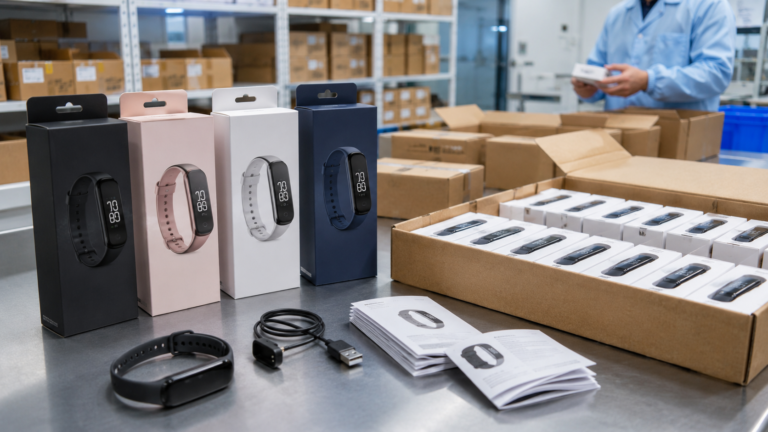
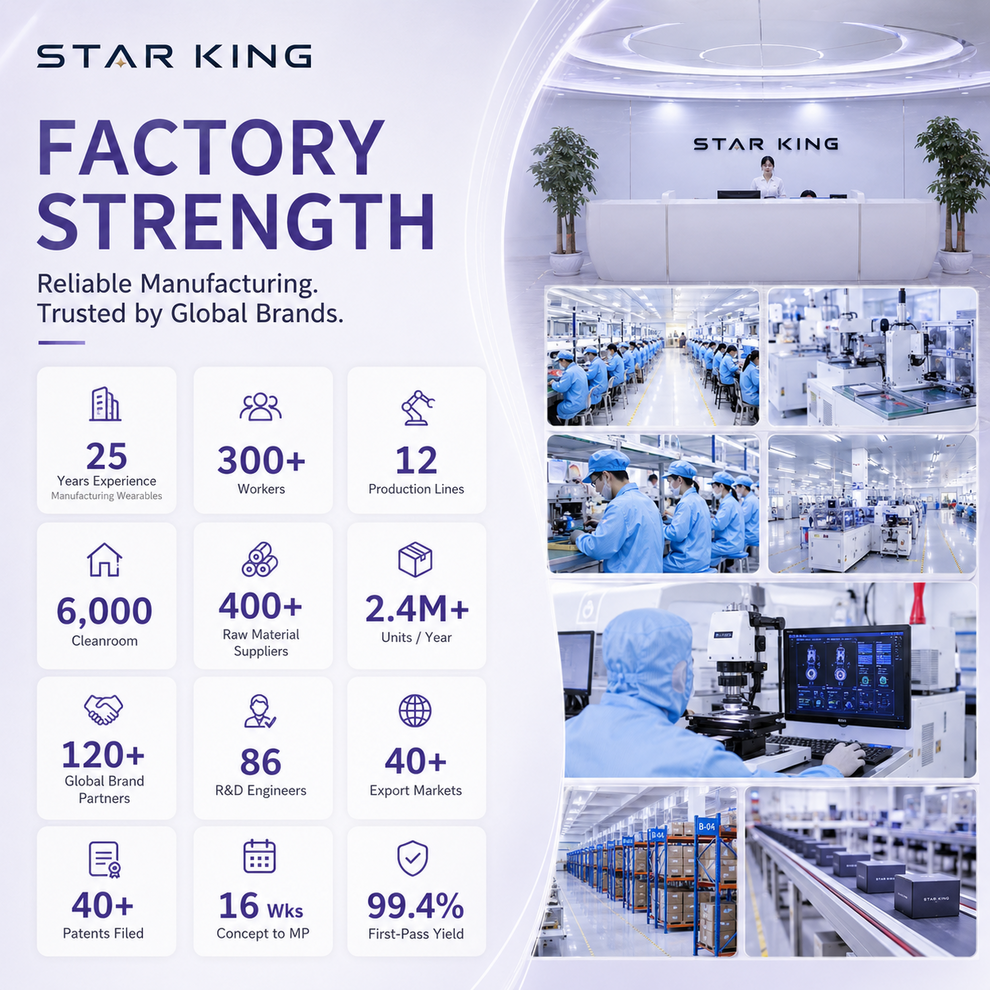
A smart ring manufacturer is not only an assembly line. A capable partner usually covers industrial design support, sensor and component sourcing, firmware and app integration, tooling, quality testing, packaging, and export documentation. Some suppliers offer only assembly on an existing design; others provide full ODM development with your logo, your app skin, and your packaging. For e-commerce sellers, the best fit depends on your launch stage. A startup brand launching a first SKU often benefits from a proven ODM platform with fast logo and packaging customization. A mature seller with an existing product line may want deeper firmware and app customization.
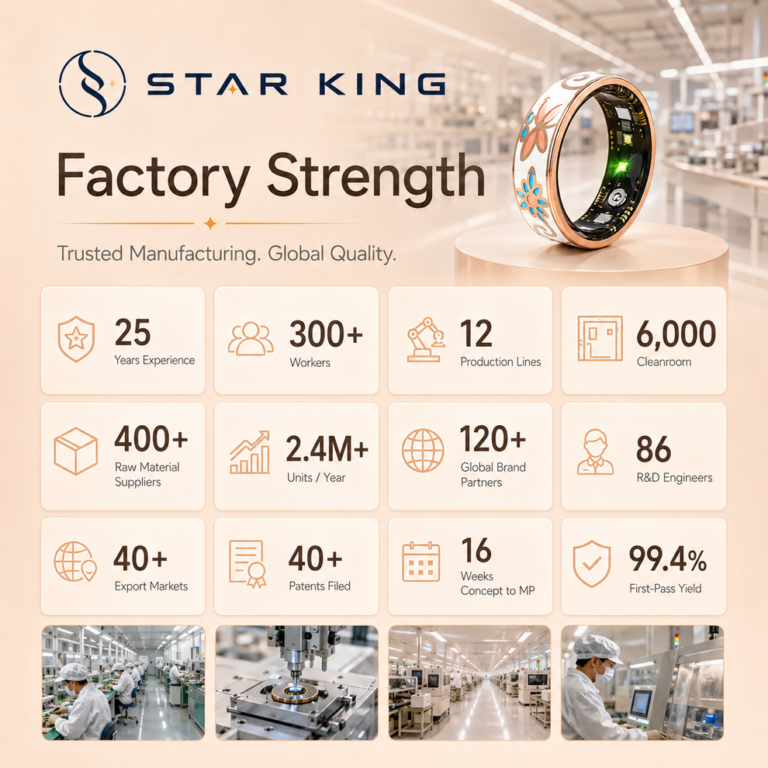
STAR KING supplies smart rings for OEM and private label programs and supports customization across firmware, app, logo, and packaging. The exact scope, MOQ, and timeline typically depend on the configuration you choose, so always confirm details during the quotation stage.
Hardware, Firmware, and App Are Three Separate Decisions
Many sellers treat a smart ring as one product. In practice there are three layers:
- Hardware: ring housing, sensor set, battery, charging method, and size options.
- Firmware: sampling rate, data smoothing, sleep and activity algorithms, Bluetooth behavior, and power management.
- App: user interface, account system, data storage, cloud sync, and privacy controls.
Each layer has its own cost and lead time. Decide early whether you will use the supplier’s standard app, a white-label version with your brand, or a fully custom app. This decision drives both MOQ and launch schedule.
7 Checks to Vet a Smart Ring Supplier
1. OEM, ODM, or Private Label Capability
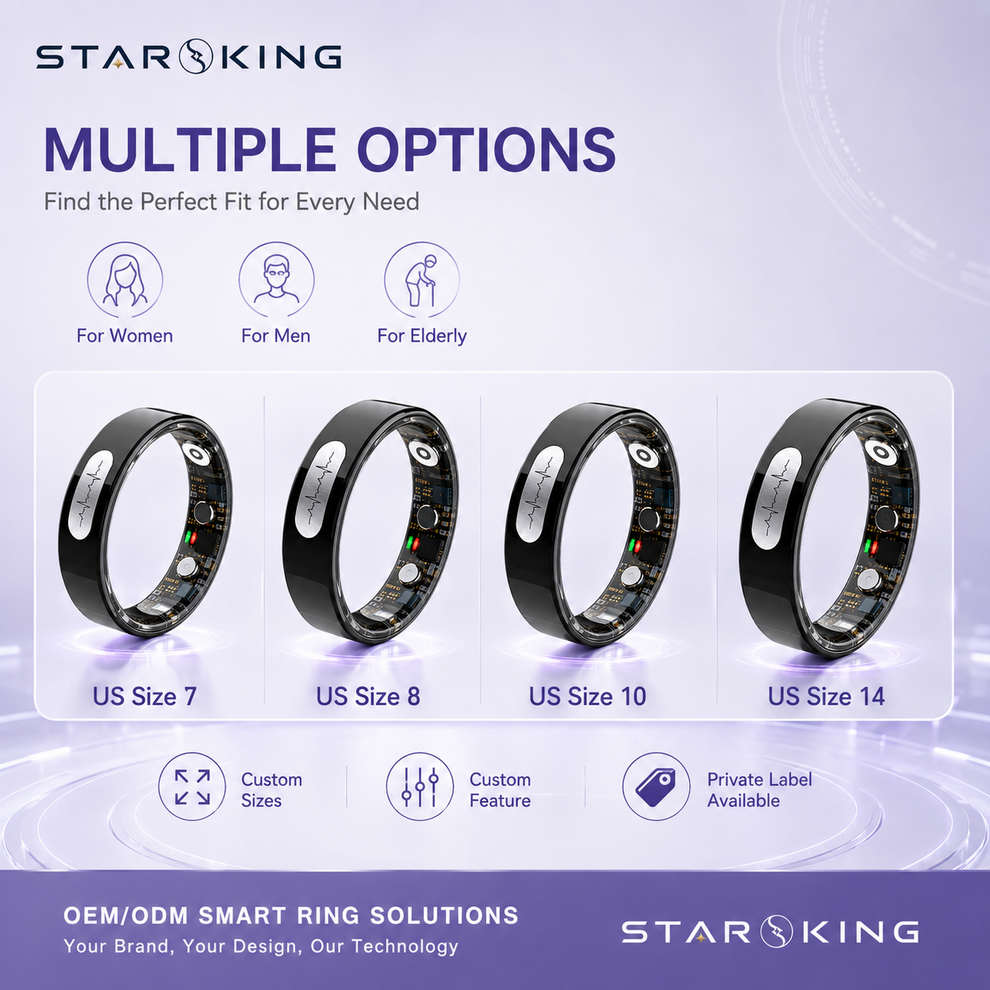
Ask the supplier to describe exactly what they can customize. Typical options include logo engraving, packaging, app branding, firmware tuning, and in some cases a fully custom design. For sellers, the trade-off is clear: deeper customization means higher cost, longer lead time, and often a higher MOQ. A supplier that can explain these trade-offs clearly is usually easier to work with.
2. Product Specification and Sensor Trade-offs
Ring size, battery capacity, sensor package, and waterproof rating are linked. A thin ring looks better but usually holds a smaller battery. Extra sensors add cost and can change the power profile. Ask for a specification sheet that lists:
- Ring sizes available and recommended fit range
- Battery capacity and typical usage time
- Charging method and time
- Water resistance rating
- Sensors included (for example heart rate or blood oxygen sensors, which are wellness features and not medical devices)
- App compatibility (iOS, Android) and minimum OS versions
3. MOQ and the Real Cost Drivers
MOQ is usually not one number. It may apply per SKU, per ring size, per color, and per packaging version. Cost is influenced by tooling, components, firmware development, app configuration, and packaging. Ask for a cost breakdown rather than a single unit price. This makes it easier to trade off features and to plan landed cost, including shipping, duties, and platform fees.
4. Sample Testing and Validation
Order samples and test them the way a customer would. Wear the ring for at least a week, check overnight sleep data, battery drain, Bluetooth stability, and app syncing. Test on both iOS and Android. Keep a written record of issues; a supplier that responds with fixes rather than excuses is worth keeping.
If you need samples or a quotation for a private label smart ring project, you can contact the STAR KING sales team and request a sample plan that matches your launch timeline.
5. Quality Control Process
Ask how the factory controls quality from incoming components to final packing. Common steps include incoming inspection, in-process checks, aging tests, drop tests, waterproof tests, and pre-shipment inspection. Ask whether they use an ISO 9001:2015 quality management system or an equivalent framework. A factory that can describe these steps in detail is usually more reliable than one that only shares a brochure.
6. Certification and Target-Market Compliance
Certification requirements typically depend on the product configuration and the destination market. For the United States, radio-frequency devices are usually subject to FCC rules. For the European Union, CE marking, RoHS, and WEEE are commonly relevant. For lithium batteries, UN 38.3 and an MSDS are usually required for shipping. Do not assume a supplier’s existing certificate covers your product; always confirm the exact model and configuration on the certificate. If a supplier claims blanket certification for all products, ask for the certificate numbers and verify them.
7. Lead Time and Production Planning
Ask for a written timeline covering sample approval, production, quality inspection, and shipping. Lithium battery products often require special handling and documentation, which can add days or even weeks. If you sell on marketplaces, plan a buffer before your peak season and confirm restock lead times in advance.
Comparison Table: Trading Company vs. Factory-Direct vs. Full-Service OEM
| Supplier Type | Typical Strength | Typical Risk | Best For |
|---|---|---|---|
| Trading company | Flexible communication and small lots | Limited control over production and customization | Sellers testing a category with low volume |
| Factory-direct | Lower unit cost at scale | May lack strong app or firmware development | Sellers with a proven product and stable demand |
| Full-service OEM/ODM | Customization across hardware, firmware, app, packaging | Higher setup cost and longer lead time | Brands building a differentiated product line |
Common Mistakes and Buyer Red Flags
Common Mistakes
- Choosing a supplier based on the lowest unit price without testing a sample.
- Assuming the supplier’s existing certification covers your customized product.
- Ignoring the app experience, which is often the top source of negative reviews.
- Underestimating lithium battery shipping requirements and related documentation.
- Failing to confirm MOQ per size, color, and packaging version.
Buyer Red Flags
- Cannot or will not provide a sample before a bulk order.
- Gives unclear answers about certification scope or test reports.
- Refuses to share a written quotation with cost breakdown and lead time.
- Pushes a large first order without a sample or pilot phase.
- Repeatedly avoids questions about app ownership, data handling, or firmware updates.
Practical Buyer Checklist
- Confirm business model: OEM, ODM, or private label.
- Request a full specification sheet and sample.
- Ask for MOQ details per SKU, size, color, and packaging.
- Get a written quotation with cost breakdown and lead time.
- Review quality control process and available test reports.
- Verify certification scope for your exact product and market.
- Confirm lithium battery shipping requirements and documentation.
- Clarify app, firmware, and data ownership terms in the contract.
- Plan a pilot order before scaling.
- Ask about warranty, spare parts, and after-sales support.
STAR KING works with sellers and brands to tailor private label wearable programs, including logo, packaging, and app customization. If your goal is to build a differentiated smart ring line, discussing your specification and target market early usually saves time later.
FAQ
What is the typical MOQ for a smart ring order?
MOQ varies by supplier and configuration. It usually depends on tooling, packaging, and whether firmware or app customization is involved. Ask for MOQ per SKU and per packaging version before quoting.
Are smart ring health features medical devices?
No. Most smart ring heart rate, blood oxygen, and sleep features are wellness and lifestyle measurements, not medical diagnostics. Sellers should avoid medical claims and confirm local advertising rules.
Which certifications should a smart ring supplier provide?
It depends on your destination market and product configuration. Common requirements include FCC for the US and CE, RoHS, and WEEE for the EU. Lithium batteries usually need UN 38.3 and an MSDS. Always verify that the certificate covers your exact model.
How long does smart ring production usually take?
Production lead time typically depends on component availability, order quantity, and customization scope. Add extra time for lithium battery shipping documentation and for peak-season demand.
Can I get a private label smart ring with my own app?
Many suppliers offer a white-label app with your branding, while fully custom app development is a larger project. Confirm data ownership, privacy terms, and update responsibility in the contract.
How do I test a smart ring sample properly?
Wear the ring for at least a week, test on both iOS and Android, and record battery drain, sync stability, and comfort across sizes. Compare results against the supplier’s specification sheet.
What affects the landed cost of smart rings?
Landed cost includes unit price, packaging, shipping, duties, taxes, and platform fees. Battery shipping rules and customs documentation can also affect cost and delivery time.
Conclusion
Vetting a smart ring supplier is a structured sourcing exercise, not a price comparison. The sellers who scale successfully test samples early, confirm MOQ and lead time in writing, verify certification scope for their exact product, and plan for lithium battery shipping. Use the seven checks and the buyer checklist in this guide as a scorecard for every supplier you evaluate.
Ready to Compare Smart Ring Suppliers?
Request a quotation, sample plan, or OEM/private label consultation from STAR KING. Share your target market, required features, and estimated order volume, and the team can respond with specification options, MOQ guidance, and lead-time estimates.
Request a Quotation or Sample Plan
Discuss Your Smart Wearable OEM/ODM Project
Planning a smart ring, smart watch, smart band, AI glasses, AI translator, or AI voice mouse project? Contact STAR KING to discuss product positioning, sample testing, customization scope, certification requirements, lead time, and quotation details.

Team Star King

Scan WhatsApp QR code