
smart band supplier selection: How Corporate Procurement Teams in the EU Should Select Smart Band Suppliers: 7 Essential Steps for 2026
How Corporate Procurement Teams in the EU Should Select Smart Band Suppliers: 7 Essential Steps for 2026
Smart band supplier selection is a structured process that helps EU corporate procurement teams avoid compliance, quality, and supply chain risks. It involves verifying a manufacturer’s certifications, quality systems, OEM/ODM capabilities, MOQ flexibility, and logistics support for lithium-battery devices. This guide outlines seven steps tailored to the European Union market, enabling buyers to make informed, risk-averse decisions for corporate wellness and employee health programs.
Table of Contents
Table of Contents
Table of Contents
- Short Answer
- Key Takeaways
- Key Facts for Buyers
- Step 1: Define Your Corporate Wellness Objectives
- Step 2: Map EU Compliance Requirements
- Step 3: Evaluate Manufacturing and Quality Systems
- Step 4: Assess OEM/ODM and Customization Capabilities
- Step 5: Request and Validate Samples
- Step 6: Clarify MOQ, Pricing, and Lead Times
- Step 7: Plan Logistics and After-Sales Support
- Comparison Table: Supplier Evaluation Criteria
- Common Mistakes in Smart Band Supplier Selection
- Practical Buyer Checklist
- FAQ
- Conclusion
Short Answer
EU corporate procurement teams should select smart band suppliers by verifying CE marking, RoHS compliance, REACH conformity, and UN38.3 certification; auditing quality control processes; confirming OEM/ODM capabilities; testing samples; and negotiating MOQ and lead times. Prioritize suppliers with transparent documentation, EU market experience, and robust after-sales support.
Key Takeaways
- Compliance is non-negotiable: smart bands for the EU typically require CE, RoHS, REACH, and UN38.3 compliance.
- Supplier selection should balance quality, cost, customization, and logistics support.
- Sample testing and factory audits reduce risks before mass production.
- Clear MOQ and lead time agreements protect your corporate wellness rollout schedule.
- After-sales support and spare parts availability are often overlooked but critical for long-term programs.
Key Facts for Buyers
| Factor | Details |
|---|---|
| Typical MOQ | 500–1,000 units for custom designs; lower for standard models |
| Lead Time | 30–60 days after sample approval, depending on customization |
| Required Certifications | CE, RoHS, REACH, UN38.3 (battery), WEEE |
| Key Testing | Battery safety, drop, waterproof, aging, EMC |
| Customization Options | Logo, packaging, firmware, app, straps |
| Payment Terms | Usually 30% deposit, 70% before shipment; negotiable |
Step 1: Define Your Corporate Wellness Objectives
Before contacting suppliers, clarify what your organization aims to achieve with smart bands. Are they for employee fitness tracking, sleep monitoring, stress management, or corporate wellness challenges? The features you prioritize—heart rate monitoring, blood oxygen monitoring, sleep tracking, or fitness tracking—will directly influence supplier shortlisting. For example, if your program focuses on corporate wellness, sensors for heart rate and sleep are essential. If you need to integrate with existing health platforms, remote health wearables capabilities matter. Defining objectives early ensures you evaluate suppliers against a clear feature set, not just price.
Step 2: Map EU Compliance Requirements
Smart bands are electronic devices with wireless connectivity and lithium batteries, so they fall under multiple EU regulations. At a minimum, you should verify CE marking, RoHS compliance (restriction of hazardous substances), REACH (chemical safety), and UN38.3 for battery transport. Depending on the radio module, RED (Radio Equipment Directive) compliance is also required. Always request test reports and declarations of conformity from the supplier.
For official references, see the EU CE marking guidelines and the FCC equipment authorization (if you also sell in the US). Compliance requirements depend on the specific product configuration and target markets; buyers should verify final documentation with a regulatory consultant or customs broker.
Image suggestion: [EU compliance documents for smart bands]
Step 3: Evaluate Manufacturing and Quality Systems
A supplier’s manufacturing and quality systems determine whether your order arrives on time and meets specifications. Request ISO 9001 certification, quality control procedures, and recent audit reports. Ask about in-house testing capabilities: aging tests, drop tests, waterproof testing, and battery safety tests. If the supplier outsources critical processes, understand their subcontractor management.
For smart bands, fitness tracking accuracy and battery life are common pain points. Discuss how the supplier calibrates sensors and validates battery performance. A factory audit—either by your team or a third-party inspector—can reveal gaps between sales claims and reality.
Step 4: Assess OEM/ODM and Customization Capabilities
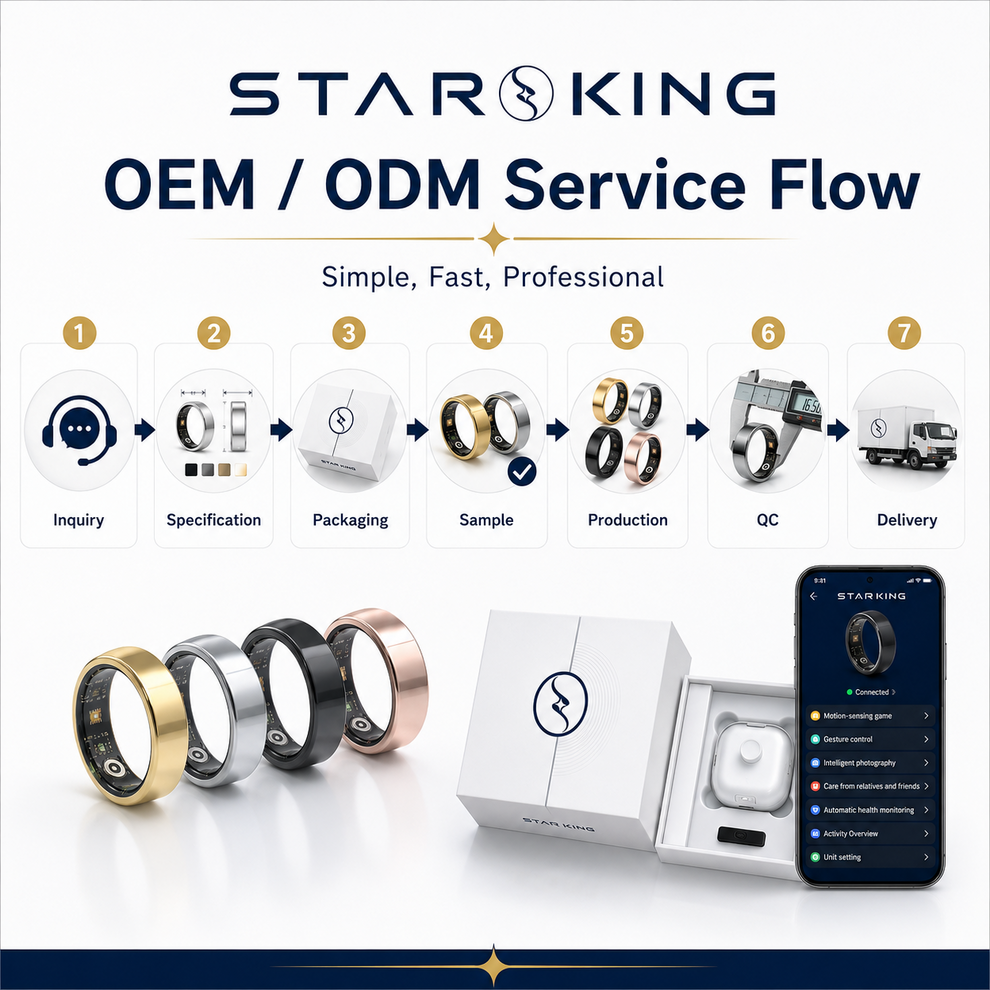
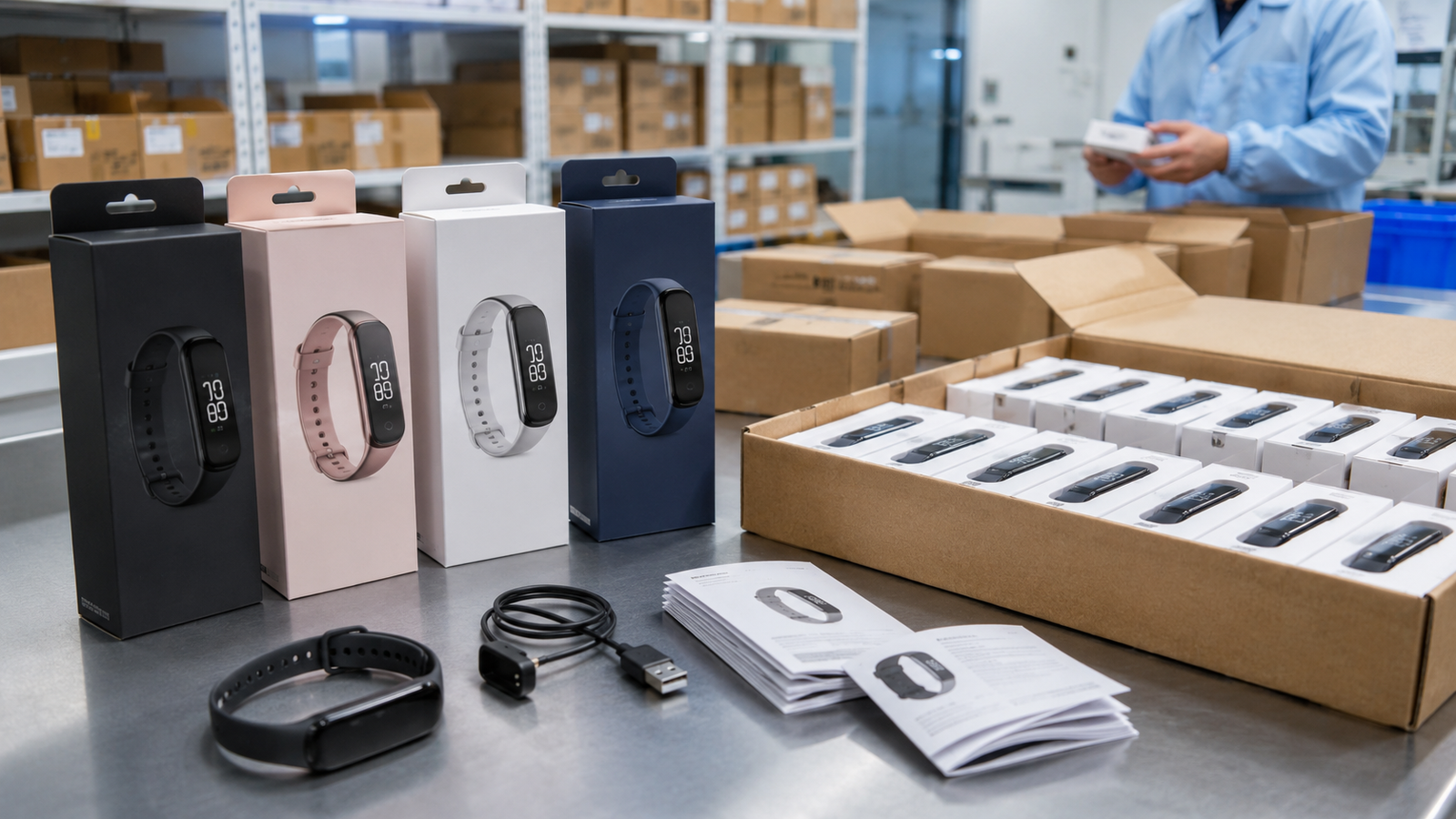
If you plan to distribute smart bands under your own brand, you’ll likely need OEM or ODM services. OEM (Original Equipment Manufacturer) means the supplier builds to your design; ODM (Original Design Manufacturer) means they offer a ready design you can customize. Key questions: Can they customize the logo, packaging, firmware, and companion app? Do they have experience with private label projects for EU clients? What is their MOQ for custom orders?
Customization extends to the app: can it be white-labeled? Does it support multiple languages and GDPR-compliant data handling? For corporate wellness, integration with HR platforms or health apps may be required. Discuss health and fitness wearables customization early to avoid costly redesigns later.
Step 5: Request and Validate Samples
Never select a supplier based solely on brochures or video calls. Request samples of the exact model you intend to order—ideally with your custom logo and packaging mockup. Test the samples rigorously: battery life, sensor accuracy, app connectivity, comfort, and durability. Compare against your requirements and a competitor’s product if possible.
During sample evaluation, check for build quality, firmware stability, and documentation. A supplier that provides detailed test reports and answers technical questions promptly is more likely to deliver consistent quality in mass production.
Step 6: Clarify MOQ, Pricing, and Lead Times
MOQ (Minimum Order Quantity) and lead times are critical for corporate procurement planning. Standard smart bands may have MOQs as low as 500 units, while fully custom designs often require 1,000 units or more. Pricing should be broken down: unit cost, tooling (if applicable), packaging, shipping, and any certification fees. Ask about payment terms and whether they offer volume discounts.
Lead time typically ranges from 30 to 60 days after sample approval, but can extend during peak seasons or if components are scarce. Always add buffer time to your internal rollout schedule. For detailed guidance, refer to our smart bands product page for baseline specifications, then discuss customization with the supplier.
Step 7: Plan Logistics and After-Sales Support
Shipping lithium-battery devices to the EU requires compliance with UN38.3 and IATA regulations. Confirm that the supplier provides MSDS, test summaries, and proper packaging for air or sea freight. Clarify Incoterms (e.g., FOB, CIF, DDP) and who handles customs clearance. For after-sales, ask about warranty periods, defective rate policies, and spare parts availability. A supplier with a European warehouse or local support can reduce downtime.
For corporate wellness programs, employee support is essential. Ensure the supplier offers user manuals, troubleshooting guides, and a clear RMA process. Discuss whether they can provide firmware updates and app maintenance over the product lifecycle.
Comparison Table: Supplier Evaluation Criteria
| Criteria | Weight (Example) | What to Check |
|---|---|---|
| Compliance | 25% | CE, RoHS, REACH, UN38.3, WEEE documents |
| Quality Systems | 20% | ISO 9001, testing reports, audit results |
| OEM/ODM Capability | 15% | Logo, packaging, firmware, app customization |
| Sample Performance | 15% | Battery life, sensor accuracy, build quality |
| MOQ & Pricing | 10% | Flexibility, cost breakdown, payment terms |
| Lead Time | 10% | Production and shipping schedule |
| After-Sales | 5% | Warranty, RMA, spare parts, firmware updates |
Common Mistakes in Smart Band Supplier Selection
- Ignoring compliance details: Assuming CE marking alone is sufficient; REACH and WEEE also apply.
- Skipping sample testing: Relying on specs without hands-on validation.
- Underestimating MOQ: Failing to negotiate or plan for minimum order quantities.
- Overlooking after-sales: Not clarifying warranty and spare parts before signing.
- Choosing on price alone: Cheap units may fail prematurely, increasing total cost of ownership.
Practical Buyer Checklist
- Define required features and compliance standards.
- Request ISO 9001 and product certifications.
- Ask for sample units for testing.
- Clarify MOQ, pricing, and lead time.
- Confirm customization options and costs.
- Verify shipping terms and battery documentation.
- Review warranty and after-sales support.
- Check references from EU clients if available.
FAQ
What certifications do smart bands need for the EU?
Smart bands typically require CE marking, RoHS, REACH, and UN38.3 for the battery. WEEE registration may also be necessary. Requirements can vary by product configuration and market; always verify with the supplier and a compliance expert.
How long does it take to manufacture custom smart bands?
After sample approval, mass production usually takes 30–60 days, depending on customization complexity and component availability. Shipping to the EU adds 5–15 days by air, longer by sea.
What is the typical MOQ for private label smart bands?
MOQs range from 500 to 1,000 units for custom branding and packaging. Some suppliers offer lower MOQs for standard models with logo printing only.
Can smart bands be integrated with corporate wellness platforms?
Yes, many suppliers offer app customization and API integration. Discuss your platform requirements early to ensure compatibility and data privacy compliance (GDPR).
How do I verify a supplier’s quality control?
Request ISO 9001 certification, audit reports, and test data. Consider a third-party inspection during production. Sample testing is also essential to validate real-world performance.
Conclusion
Smart band supplier selection for EU corporate procurement teams requires a methodical approach that balances compliance, quality, customization, and logistics. By following the seven steps outlined—defining objectives, mapping compliance, evaluating quality systems, assessing OEM/ODM capabilities, validating samples, clarifying MOQ and lead times, and planning logistics—you can mitigate risks and build a reliable supply chain for your corporate wellness initiatives. Remember that requirements are not one-size-fits-all; tailor your evaluation to your specific program goals and always verify compliance documentation.
STAR KING CTA
Ready to discuss your smart band requirements? Request a quotation or discuss an OEM/ODM project with STAR KING. Our team can provide samples, compliance documentation, and customization options tailored to EU corporate procurement needs.
Image suggestion: [Smart band supplier selection process]
Discuss Your Smart Wearable OEM/ODM Project
Planning a smart ring, smart watch, smart band, AI glasses, AI translator, or AI voice mouse project? Contact STAR KING to discuss product positioning, sample testing, customization scope, certification requirements, lead time, and quotation details.

Team Star King

Scan WhatsApp QR code