smart band suppliers: 2026 Smart Bands for EU Retail Chains: 7 Proven Steps to Evaluate an OEM Partner
smart band suppliers buyers need a supplier evaluation process that checks product fit, OEM/ODM capability, compliance documents, quality control, pricing, lead time, and after-sales support before placing a bulk order.
Table of Contents
Table of Contents
2026 Smart Bands for EU Retail Chains: 7 Proven Steps to Evaluate an OEM Partner
Smart bands for EU retail chains are best sourced by auditing a manufacturer across seven areas: product roadmap fit, customization capability (app, firmware, packaging, logo), MOQ and pricing logic, sample validation, quality control, EU compliance (notably CE, RED, RoHS, and battery rules), and logistics/after-sales support. For a retail chain, the real question is not which band looks best, but which supplier can deliver repeatable quality, compliant documentation, and predictable lead times at your price architecture across a category season.
smart band suppliers: Direct Answer: How Should EU Retail Chains Source Smart Bands in 2026?
Treat a smart band program as a supply chain decision, not a product decision. First screen manufacturers on category depth and EU documentation capability, then qualify them with a paid sample and small pilot run, then lock in MOQ, packaging, app onboarding, and warranty terms. Buyers who reverse that order — committing volumes before verifying compliance and quality — are the ones who absorb recalls, returns, and markdowns.

Table of Contents
- Why Smart Bands Still Matter for EU Retail Chains in 2026
- What a Smart Band OEM Partner Actually Does
- 7 Proven Steps to Evaluate a Smart Band OEM Partner
- OEM vs ODM vs Private Label Comparison Table
- Key Facts for Buyers
- Common Mistakes in Retail Chain Smart Band Sourcing
- Practical Buyer Checklist
- FAQ for EU Retail Chain Buyers
- Conclusion

Key Takeaways
- Smart bands for EU retail chains succeed when sourcing is treated as category management: repeatable SKUs, stable margins, and low return rates matter more than novel features.
- EU compliance is configuration-specific. A smart band sold with a specific charger, battery, and wireless module requires its own verification — buyers should request documentation per SKU and verify requirements with the manufacturer and, where relevant, with regulatory bodies.
- MOQ is negotiable but not arbitrary. It reflects tooling, PCBA setups, component minimums, and packaging runs — so understanding what drives MOQ helps you negotiate the right number.
- Samples are where supplier claims collapse or hold. Test battery claims, app pairing, IP protection, and strap durability before committing volumes.
- The strongest OEM partner is not the cheapest per unit but the one that is predictable across repeat orders.

Why Smart Bands Still Matter for EU Retail Chains in 2026
Smart bands occupy a durable position in European retail: they sit in a giftable, replaceable price band that supports accessory attachment (straps, chargers, bundling) and frequent replenishment. They also matter to private-label programs because the category has relatively low entry friction versus smart watches — tooling and industrial design costs are more accessible for a mid-size regional chain.
For a retail chain, the operational logic is different from a brand’s logic. Chains need SKU discipline: a small number of well-chosen models that hold their margin across 12–24 months, with packaging and language requirements met for each market they serve. That means your supplier evaluation should prioritize consistency, documentation, and after-sales logistics over feature density.
Feature-level consumer trends still inform the buying plan, but they should be filtered through retail constraints: shelf life of a hero claim (e.g., battery life), the cost of firmware updates, app ecosystem risk, and the willingness of a customer to return a band within statutory EU return windows. If your returns rate rises, margin improvement elsewhere rarely compensates.
What a Smart Band OEM Partner Actually Does
What is a smart band OEM partner? An OEM partner manufactures hardware to your specification or an agreed design, and supports the layers that make it sellable by your brand in your markets: industrial design adjustments, firmware configuration, companion app options, packaging and language localization, accessory bundling, and documentation for compliance and customs.
A capable OEM supplier typically covers:
- Industrial design: case shape, strap interface, colorways, and finishing to match your brand and price tier.
- Hardware development: sensor stack selection (heart rate, SpO2 monitoring where offered), display module, battery, and charging method.
- Firmware customization: UI language sets, training modes, notification behavior, and default settings for your market.
- App customization: white-label app splash and branding, account flows, data export support, and your jurisdiction’s privacy requirements.
- Packaging customization: retail carton, insert, multilingual manuals, barcode and retailer label specifications.
- Logistics engineering: battery transport documentation, carton dimensions, palletization plans, and shipping documentation support.
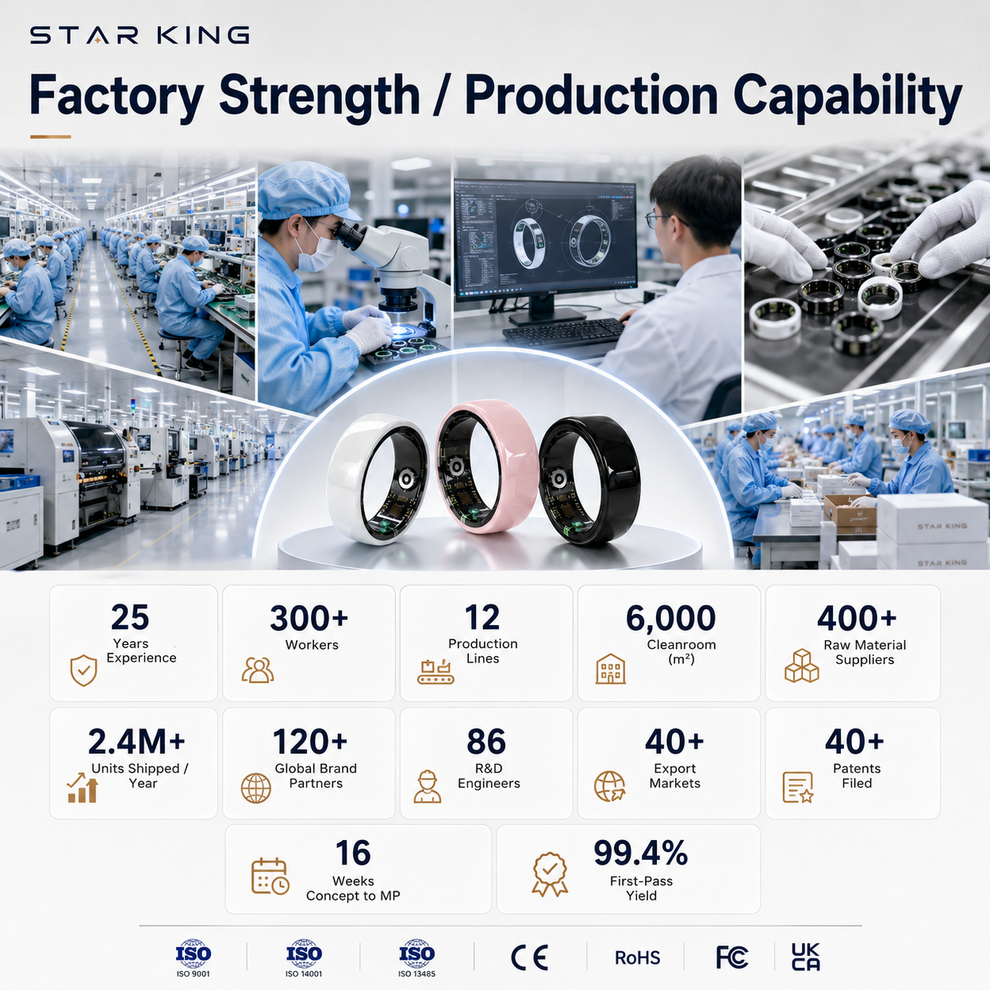
If you want to see how these layers are typically packaged into a single supply offer, review the STAR KING private label OEM/ODM solution. The important buyer takeaway: define which layers you own and which the supplier owns before you negotiate price, because ownership determines who carries cost and who carries risk.
7 Proven Steps to Evaluate a Smart Band OEM Partner
Step 1: Match the Manufacturer’s Portfolio to Your Retail Price Architecture
Start with your price ladder: opening price point, core price, and premium price — then ask the supplier which models fit each tier at a realistic landed cost. A partner who only offers one hardware generation will force you into a narrow margin structure across the whole category. Ask for the product roadmap by quarter, and ask directly which models are planned for discontinuation, because end-of-life surprises create markdown risk.
For a view of the category STAR KING positions for retail, see the smart bands product page and compare where each model sits by display type, battery life class, health-monitoring features, and accessory options.
Step 2: Check EU Compliance Capability Before Price
In the EU, a smart band is a multi-regulation product: radio equipment, battery, materials, and privacy all intersect. Compliance capability is a leading indicator of supplier quality, because manufacturers who understand it usually also have better change control.
Typical EU-relevant areas to discuss include:
- CE marking obligations and the underlying conformity assessment for the product as configured.
- Radio Equipment Directive (RED) for the Bluetooth link and, where applicable, any wireless charging feature.
- RoHS restrictions on hazardous substances in electrical equipment.
- Battery requirements for lithium cells, including transport documentation such as UN38.3 test summaries and MSDS.
- Data protection and privacy considerations for the companion app and any cloud features, which typically depend on the app provider and data flows.
For radio equipment, the EU’s official reference point is the Radio Equipment Directive page on the European Commission website. Buyers should verify which directives and standards apply to the exact configuration and target markets, because a change in charger, battery, or radio module can change the required test scope. STAR KING’s documented certification status per product configuration should be confirmed with the supplier team: [STAR KING TO CONFIRM].
Step 3: Understand What Actually Drives MOQ
MOQ is usually a function of production realities rather than a sales tactic: PCB assembly setups, component reel minimums, display and battery purchase lots, strap tooling, and packaging print runs. If you can accept a standard colorway and standard packaging, MOQ can often be lower than a fully customized SKU.
Negotiation levers that work in practice:
- Accept standard packaging for the pilot batch and customize from the second order.
- Limit colorways in the first season; expand after sell-through data.
- Share a 12-month volume forecast so the supplier can plan component purchases, which often supports better pricing.
- Bundle your smart band order with related accessories to reach a combined production lot.
Ask for a written MOQ matrix by customization level (logo only, packaging, firmware, full ODM) and by model. If a supplier gives one flat MOQ number for everything, the proposal is probably not yet engineered to your program.
Step 4: Validate Samples Like a Retail Buyer, Not a Reviewer
Consumer-style reviews do not predict retail performance. Sample testing should mirror how the product will fail in the field: returns, support tickets, and warranty claims. Build a sample scorecard and test at least two units per model, ideally from different production lots if available.
Practical sample tests:
- Battery behavior: verify stated battery life under your typical usage pattern (notifications, continuous heart-rate monitoring, screen brightness) and confirm charging behavior and connector or charging-pad durability.
- App experience: pairing reliability, account creation flow, language coverage, permission prompts, and whether the app is stable on common phone models in your markets.
- Water resistance: confirm the IP rating claimed for the SKU and the supplier’s internal test method. If the band is marketed for swimming, test strap retention and button or touch behavior when wet.
- Mechanical durability: strap attachment cycles, buckle or clasp life, and screen scratch behavior.
- Documentation check: manual language quality, regulatory statements in the printed materials, and whether packaging claims match tested capabilities.
Document each result and request corrective action in writing. A supplier’s response to a documented sample failure tells you more than any catalog.
OEM vs ODM vs Private Label: What Changes for a Retail Chain
| Model | What You Control | Typical Buyer | Trade-off |
|---|---|---|---|
| OEM (to your spec) | Design direction, features, app, packaging | Established chains with category strategy | Higher development cost and longer timeline |
| ODM (supplier design, your brand) | Branding, packaging, select firmware options | Retail chains scaling quickly | Less differentiation; more shared hardware |
| Private label | Logo, packaging, app skin, language set | Chains entering the category | Fastest to market; limited exclusivity |
Most EU retail chains start with private label or ODM to test sell-through, then move selected SKUs toward deeper customization once volume is proven. That staged approach reduces risk and keeps working capital efficient.
Step 5: Audit Quality Control and Change Control
Quality control is not a certificate; it is a process. Ask how the supplier controls incoming components, in-process assembly, and final testing, and how they handle engineering change notices after you approve a sample. A supplier that cannot describe change control will eventually ship you a version you did not approve.
Areas to verify:
- Incoming inspection criteria for displays, batteries, and sensors.
- In-process checks for sealing, button function, and assembly torque.
- Final functional test coverage and how failures are recorded.
- Aging or burn-in testing for electronics, where offered.
- Pre-shipment inspection options and who bears the cost.
See how STAR KING frames quality and compliance in an integrated way on the health and fitness wearables solution page, and treat any claimed test result as something to verify in your own sample plan.
Step 6: Plan Lead Times and the Production Calendar Backwards
For retail chains, the critical date is not the ship date — it is the shelf date. Work backwards from your in-store or online launch date: final artwork approval, packaging print, production, quality inspection, freight, customs clearance, and DC receipt. Then add buffer for Chinese New Year and other known production disruptions, which can shift timelines depending on the factory’s holiday schedule.
Ask the supplier for a timeline template by customization level and confirm it in the purchase order. Lead time planning should also cover firmware and app releases: if your app update is on the critical path, that is a retail risk, not an IT detail.
Step 7: Lock Down After-Sales, Warranty, and Spare Parts
Your returns process is a marketing channel. Define warranty terms, DOA handling, spare strap and charger availability, and the process for raising firmware issues. Ask whether the supplier supports regional service partners or whether replacements ship from the factory, because that determines your customer experience.
Also clarify who owns tooling and molds, and what happens to your design files, app configuration, and packaging artwork if the relationship ends. Intellectual property and tooling ownership terms belong in the contract, not in a verbal agreement.
Key Facts for Buyers
| Buyer Question | Practical Answer |
|---|---|
| Which compliance items matter most in the EU? | CE conformity for the product as configured, RED for the radio, RoHS for materials, and lithium battery transport documentation such as UN38.3 and MSDS. Final scope typically depends on the exact SKU and target markets. |
| What drives smart band MOQ? | Tooling, PCBA setups, component minimums, and packaging runs. Standard colorways and packaging usually lower MOQ versus fully custom SKUs. |
| What should be tested in samples? | Battery life claim, app pairing and stability, water resistance, strap durability, and printed documentation accuracy. |
| How long does development take? | Private label is typically fastest; ODM sits in the middle; full OEM to your spec is longest. Exact timelines depend on customization depth and should be confirmed in writing. |
| Who owns the tooling? | Negotiable, but it must be defined in the contract alongside design and app ownership. |
| What raises landed cost most? | Freight mode, battery handling requirements, packaging size, and duty classification. Buyers should verify tariff treatment with a customs broker. |
Common Mistakes in Retail Chain Smart Band Sourcing
- Choosing on unit price alone. A lower unit price with a higher return rate destroys category margin.
- Assuming one certification covers all SKUs. Changes in battery, charger, or radio module can change test scope; verify per configuration.
- Skipping the pilot order. Pilot runs surface packaging and app issues that samples do not.
- Under-specifying packaging. Multilingual manuals and retailer label requirements are common sources of delay.
- Ignoring app risk. If the app provider changes, your product experience can change after launch.
- No change control clause. Without it, unapproved component substitutions may appear in later shipments.
- Treating health monitoring as medical. Consumer smart bands are not medical devices; marketing claims should be qualified accordingly, and any medical positioning requires separate regulatory consideration.
Buyer Red Flags When Screening Suppliers
- Vague answers about which tests apply to the specific SKU.
- No documented sample approval process or version control.
- Reluctance to share battery transport documentation.
- Packaging and manual samples that do not match production quotes.
- Pressure to commit to annual volume before a pilot run.
- No clear answer on tooling and design ownership.
Practical Buyer Checklist
- Price ladder defined, with target landed cost per tier.
- Compliance documentation requested per SKU and per market.
- MOQ matrix obtained by customization level.
- Two samples per model tested against a written scorecard.
- Quality control process and change control described in writing.
- Lead time template mapped backwards from shelf date.
- Packaging, manual languages, and retailer label specifications approved.
- App and firmware customization scope defined.
- Warranty, DOA, and spare parts terms agreed.
- Tooling, design, and app IP ownership documented.
- Pilot order planned before full-season commitment.
If your team needs to close these items quickly, you can review customization options and request samples through the STAR KING team while your internal compliance review runs in parallel.
FAQ for EU Retail Chain Buyers
Do smart bands for EU retail chains need CE marking?
Radio-equipped products placed on the EU market generally require CE marking and conformity with applicable directives, but the exact scope depends on the product configuration and features. Buyers should verify the required directives and standards for each SKU with the manufacturer and, where needed, with regulatory bodies.
What is a realistic MOQ for a private label smart band?
MOQ varies widely with customization level. Standard colorway and standard packaging generally allow lower quantities than custom tooling and bespoke packaging. Ask for a written MOQ matrix rather than a single figure.
What battery documentation should a supplier provide?
For lithium battery products, buyers commonly request UN38.3 test summaries and MSDS for transport planning. The supplier should confirm what is available for the specific battery used in your SKU.
How do I evaluate the companion app before buying?
Test pairing reliability, language coverage, account flow, and stability on common phone models. Also clarify who maintains the app, how updates are handled, and what happens to user data under your market’s privacy rules.
Can a retail chain change packaging and logo on an ODM model?
Yes, this is a common private label or ODM request. The scope typically includes carton and insert design, logo placement, and multilingual manuals, and it should be confirmed in writing with the artwork approval process defined.
What lead time should we plan for a first smart band order?
First orders usually take longer because of sample approval, packaging artwork, and component purchasing. Build the timeline backwards from your shelf date and add buffer for production holidays. Exact lead times should be confirmed in the purchase order.
Are smart band health features medical devices?
Consumer smart bands are generally positioned as wellness and fitness products, not medical devices. Any medical claims require separate regulatory consideration, and buyers should keep marketing language aligned with the product’s intended use.
Conclusion
Smart bands remain a practical category for EU retail chains in 2026 because they support repeat purchase, accessory attachment, and private label differentiation at accessible entry costs. The differentiator is not the feature list — it is supplier predictability: documented compliance per SKU, controlled quality processes, realistic MOQ planning, and lead times that protect your shelf date. Run a pilot order before committing to a season, test samples against a written scorecard, and put ownership of tooling, design, and app configuration in the contract.
For a wider view of how wearables fit into retail and e-commerce channels, the STAR KING blog covers sourcing, compliance, and product planning topics in more depth.
STAR KING CTA
Ready to evaluate smart bands for your EU retail program? Request a quotation for your target price tiers, ask for product samples, and confirm the certification and documentation requirements for your specific SKU and target markets. You can also discuss an OEM/ODM or private label configuration with the STAR KING team.
Request a quote for smart bands and OEM/ODM options
Useful Official References for Buyers
- FCC equipment authorization guidance
- European Commission CE marking information
- Bluetooth SIG specifications
Discuss Your Smart Wearable OEM/ODM Project
Planning a smart ring, smart watch, smart band, AI glasses, AI translator, or AI voice mouse project? Contact STAR KING to discuss product positioning, sample testing, customization scope, certification requirements, lead time, and quotation details.

Team Star King

Scan WhatsApp QR code