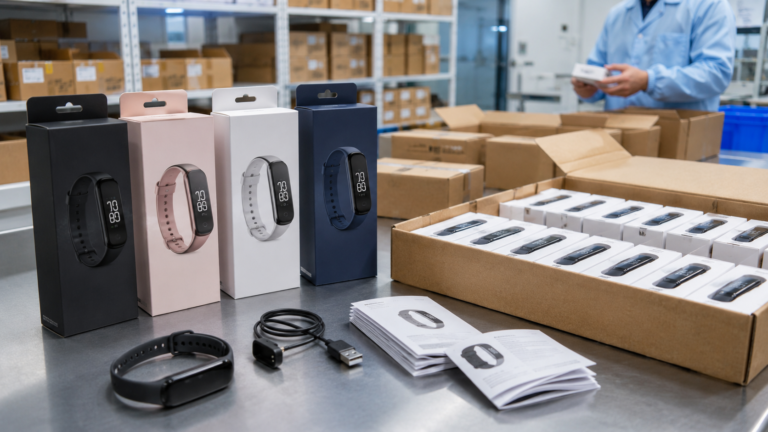

Smart Bands for EU E-commerce: 7 Sourcing & Compliance Checks Before You Buy from China
Smart Bands for EU E-commerce: 7 Sourcing and Compliance Checks Before You Buy from China
Smart bands for EU e-commerce demand rigorous attention to product compliance, battery safety, and supplier capability. This guide for e-commerce sellers outlines seven essential checks—from CE marking and EU RoHS to OEM/ODM validation and sample testing—so you can source smart bands from China with confidence and avoid costly market-entry delays.
Table of Contents
Table of Contents
Table of Contents
- Short Answer: Smart Bands for EU E-commerce
- Key Takeaways
- EU Compliance Overview for Smart Bands
- Check 1: CE Marking and EU Directives
- Check 2: RoHS and REACH
- Check 3: Battery Safety (UN38.3, MSDS)
- Check 4: Electromagnetic Compatibility (EMC) and Radio Equipment
- Check 5: Medical Device Classification Awareness
- Check 6: OEM/ODM Supplier Evaluation
- Check 7: Sample Testing and Pre-Shipment Inspection
- Common Mistakes and Red Flags
- Practical Buyer Checklist for EU Smart Band Sourcing
- FAQ
- Conclusion

Short Answer: Smart Bands for EU E-commerce
Smart bands are wearable devices that track fitness, heart rate, sleep, and activity. For EU e-commerce sellers, sourcing them from China requires ensuring CE marking (including RED, EMC, LVD, and RoHS compliance), battery certification (UN38.3 and MSDS), and a reliable supplier that offers OEM/ODM services and accepts pre-shipment inspections. Failing these checks can lead to import rejection, fines, or product recalls.

Key Takeaways
- CE marking is mandatory for smart bands sold in the EU, covering RED, EMC, LVD, and battery directives.
- RoHS and REACH restrict hazardous substances; iP67 waterproofing and battery safety must be verified.
- Battery cells require UN38.3 testing and MSDS for air transport of lithium-ion batteries.
- OEM/ODM suppliers must be vetted for certification capability, quality systems, and transparency.
- Always test samples and perform pre-shipment inspections to verify compliance and functionality.
Key Facts for Buyers
| EU Market Requirement | Typical Mandate | Relevant Document |
|---|---|---|
| CE Marking | Mandatory for any device using radio technology (Bluetooth) and/or electronics | EU RED 2014/53/EU, EMC 2014/30/EU, LVD 2014/35/EU |
| RoHS | Restricts hazardous substances in electronics | Directive 2011/65/EU |
| REACH | Regulates chemical safety (e.g., skin-contact materials) | Regulation (EC) 1907/2006 |
| Battery Transport | UN38.3 for lithium batteries; MSDS for transport | UN Manual of Tests and Criteria, IATA DGR |
| WEEE | Waste electrical and electronic equipment registration | Directive 2012/19/EU |

EU Compliance Overview for Smart Bands
Smart bands are classified as radio equipment because they use Bluetooth and often Wi-Fi. They must therefore meet the EU Radio Equipment Directive (RED) for RF safety, EMC, and spectrum use. In addition, they are electronic devices subject to the EU Restriction of Hazardous Substances (RoHS) Directive and the Waste Electrical and Electronic Equipment (WEEE) Directive. Because they are worn on the skin, the materials must also comply with the REACH regulation to avoid harmful chemicals.
For e-commerce sellers, the EU market can be particularly strict. Products sold on Amazon EU or through other marketplaces may be subject to spot checks. Sellers who cannot provide valid EU Declaration of Conformity (DoC) and technical documentation risk having their listings removed and may face fines.

Check 1: CE Marking and EU Directives
CE marking is a legal requirement for smart bands sold in the EU. It indicates that the product meets applicable harmonised directives. For smart bands, the most relevant directives are:
- Radio Equipment Directive (RED, 2014/53/EU) – covers RF safety and spectrum use.
- Electromagnetic Compatibility Directive (EMC, 2014/30/EU) – ensures the device does not interfere with other electronics.
- Low Voltage Directive (LVD, 2014/35/EU) – applies if the device operates on a battery over 75 V, but smart bands typically use lower voltage, so LVD may not apply. However, the battery charger may need LVD.
When sourcing, ask the manufacturer for the CE Declaration of Conformity and test reports from a recognised laboratory. Verify that the manufacturer has the technical file in place. If you are privately labeling, the importer or EU representative is usually the party responsible for CE compliance. For Amazon sellers, you may be considered the importer, which means you hold liability.
Practical advice: Work with suppliers that have already obtained CE certificates for similar smart bands. Request copies of certificates and cross-check they are issued for your exact model, not another product. Many manufacturers sell standard models with CE certification, but customised versions may require re-certification.
Check 2: RoHS and REACH
The EU RoHS Directive limits the use of hazardous substances (like lead, mercury, cadmium, etc.) in electrical and electronic equipment. Smart bands must comply with RoHS, and the manufacturer should provide RoHS test reports.
REACH (Registration, Evaluation, Authorisation and Restriction of Chemicals) affects materials in contact with skin, such as the band strap. For example, phthalates and some flame retardants may be restricted. You should request REACH compliance declarations for materials, especially if the band is made of silicone or TPU.
Many Chinese manufacturers familiar with EU export will provide these reports. If not, you may need to allocate budget for independent testing. Budget for testing to be the safest approach.
Check 3: Battery Safety (UN38.3, MSDS)
Smart bands contain lithium polymer batteries, which fall under dangerous goods regulations for transport and safety. Key requirements:
- UN38.3 – certification of battery cells and packs for transport safety. It tests thermal, impact, and short-circuit conditions.
- MSDS (Material Safety Data Sheet) – required for shipping lithium batteries by air and by sea.
- IEC 62133 – a safety standard for secondary cells and batteries. Many EU buyers expect this.
When sourcing, ask the supplier for UN38.3 test reports for the battery. Also, check the battery’s rated capacity and charging specifications. For e-commerce, you must ensure the battery is not damaged during shipping and that your logistics partner is aware of the classification.
Check 4: Electromagnetic Compatibility (EMC) and Radio Equipment
The EMC part of RED ensures that smart bands do not interfere with other devices. The supplier should have EMC and RED test reports from an accredited lab. Radio spectrum usage in the EU is harmonised under RED, so Bluetooth and Wi-Fi modules must comply with the specific frequency bands.
When you evaluate a smart band, review the test report for the exact model and band. Some manufacturers use a modular certification (like Bluetooth module certification), which may not cover the full device. Request the complete product’s RED test report.
Check 5: Medical Device Classification Awareness
e-commerce sellers must know that if a smart band provides health insights like heart rate or blood oxygen, it is not automatically a medical device. But if it claims to diagnose or treat any condition, it could fall under the EU Medical Device Regulation (MDR). For consumer fitness bands, you typically don’t need MDR, but you must avoid making medical claims.
Be careful with marketing language. “ECG” functions may require medical classification. In the EU, as of 2023, some wearables with ECG have obtained MDR certification, but that’s for specific products. For e-commerce, avoid words like “treat,” “diagnose,” or “prevent.” Use “wellness” rather than “medical.”
Check 6: OEM/ODM Supplier Evaluation
In the purchase phase of sourcing smart bands, you need to be thorough in supplier evaluation. Many suppliers in China claim to be manufacturers but are traders. Verify via:
- Factory visit or a third-party audit (like BSCI, ISO 9001).
- Check business license and patent status.
- Ask for client references (anonymized).
- Visit Alibaba or trade shows to cross-check.
Your questions should include:
- What certification documentation can you provide?
- What customization domains do you control (firmware, app, appearance)?
- What is your MOQ and lead time?
- Can you handle EU-specific packaging and user manuals?
Reliable suppliers will transparently answer and provide samples.
Check 7: Sample Testing and Pre-Shipment Inspection
Never skip sample testing and pre-shipment inspections before a bulk order. Even with a proven supplier, you want to verify that batch quality and compliance
Common Mistakes and Red Flags
When purchasing smart bands for EU e-commerce, watch for these pitfalls:
- Trusting the “CE” symbol without certificates.
- Assuming RoHS covers REACH.
- Ordering custom colours or materials without re-testing for REACH.
- Ignoring WEEE registration obligations for your brand in the EU.
- Shipping batteries with incorrect documentation.
- Choosing the lowest price over compliance readiness.
Practical Buyer Checklist for EU Smart Band Sourcing
- Confirm supplier’s CE documentation for the exact model.
- Verify RoHS and REACH test reports.
- Request UN38.3 and MSDS for battery transport.
- Check RED reports for Bluetooth and EMC.
- Plan for WEEE registration in the EU market.
- Review warranty and spare parts policy.
- Arrange third-party pre-shipment inspection.
Buyers can also review STAR KING Smart Bands OEM/ODM options to compare product positioning, customization scope, and sample planning.
FAQ
- 1. Do smart bands need CE marking to be sold on Amazon EU?
- Yes, any device with Bluetooth and electronics must have CE marking, as it is radio equipment under EU regulations.
- 2. Is CE marking enough, or do I need RoHS and REACH?
- CE marking covers RED and EMC parts, but RoHS and REACH are separate legal requirements. All are mandatory.
- 3. How much does it cost to get a smart band certified in the EU?
- Costs vary, but typically from €5,000 to €20,000 for CE and battery testing, depending on the app and functions.
- 4. What is the typical MOQ for smart bands from China?
- For customised OEM/ODM, the MOQ can range from 500 to 3,000 units, depending on complexity and manufacturer.
- 5. What documents should I request from the supplier?
- You should request the CE Declaration of Conformity, RED test reports, RoHS/REACH declarations, UN38.3 test summary, and MSDS.
- 6. Can I sell smart bands in the EU with a private label without being the manufacturer?
- Yes, but you are responsible as the importer or economic operator. Ensure all paperwork is in order and keep records for at least 10 years.
- 7. Are there any restrictions on health features like heart rate monitoring in the EU?
- Heart rate monitoring and blood oxygen are considered wellness features. If you make claims about diagnosing or treating disease, the product may become a medical device and require MDR compliance.
Conclusion
Sourcing smart bands for EU e-commerce requires compliance diligence beyond price and specs. By verifying CE, RoHS, REACH, battery certifications, and supplier capability, you can enter the EU market confidently and reduce your liability. Use the checklist above to structure your purchase review.
Ready to source compliant smart bands for your EU store? STAR KING offers OEM/ODM solutions with compliance documentation support. Request a quotation to discuss your project and certification requirements.
Useful Official References for Buyers
- FCC equipment authorization guidance
- European Commission CE marking information
- Bluetooth SIG specifications
Discuss Your Smart Wearable OEM/ODM Project
Planning a smart ring, smart watch, smart band, AI glasses, AI translator, or AI voice mouse project? Contact STAR KING to discuss product positioning, sample testing, customization scope, certification requirements, lead time, and quotation details.

Team Star King

Scan WhatsApp QR code