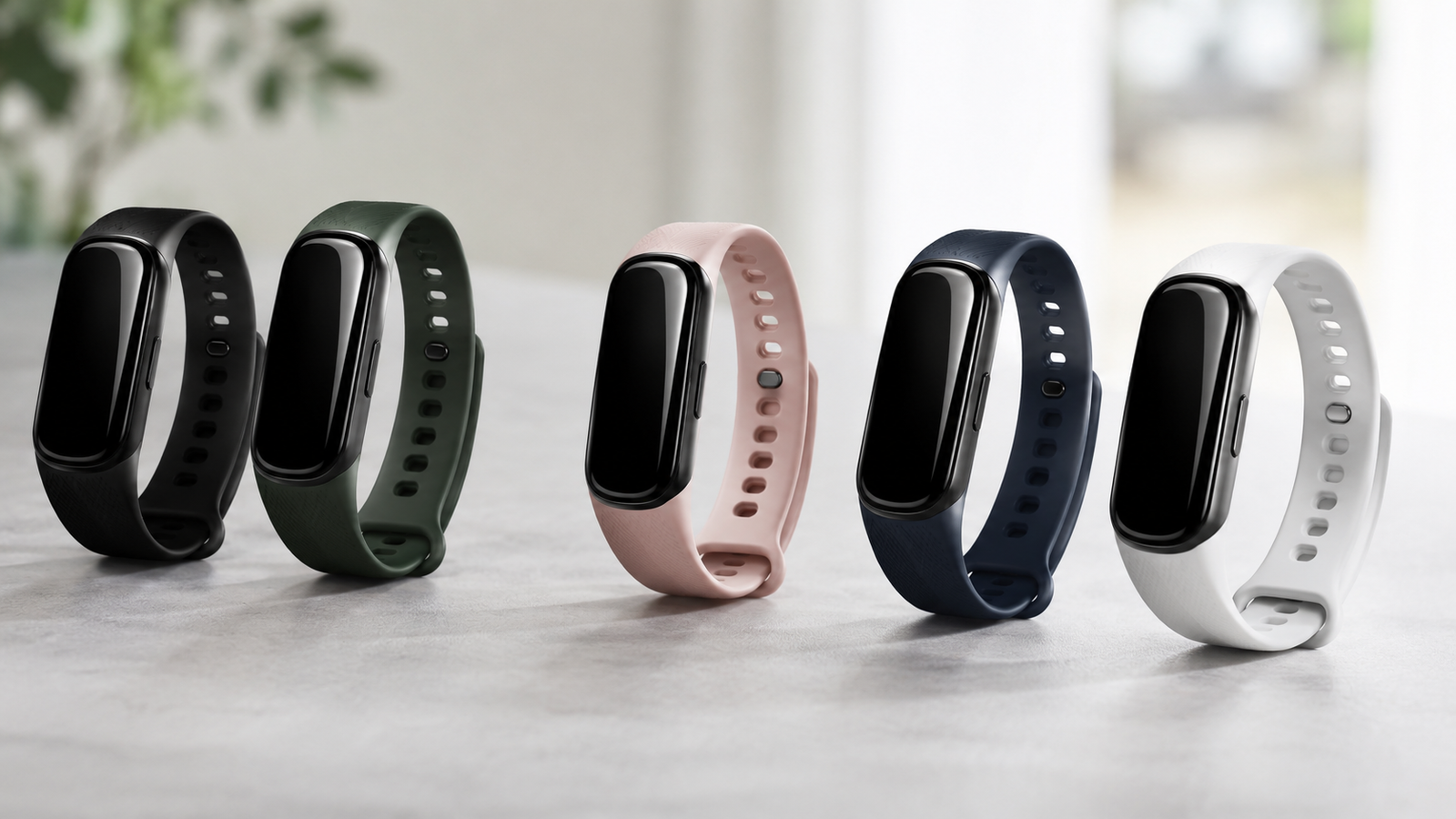
smart bands for private label: 7 Steps to Source Smart Bands for Private Label in the EU: A 2026 Buyer’s Guide
7 Steps to Source Smart Bands for Private Label in the EU: A 2026 Buyer’s Guide
Sourcing smart bands for private label in the EU means selecting a manufacturer, confirming CE and RoHS compliance, validating battery safety documents, and planning MOQ, lead time, and landed cost before you commit to a purchase order. Unlike consumer research, this is a procurement decision: it depends on your target market, your sales channel, and your ability to provide compliant documentation on demand. This guide walks European private-label brands through seven concrete steps, from defining specs to closing a purchase order with a qualified supplier.
Table of Contents
Table of Contents
smart bands for private label: Table of Contents
- Short Answer
- Key Takeaways
- Key Facts for Buyers
- Step 1 — Define Your Smart Band Specification
- Step 2 — Screen Suppliers for Private Label Capability
- Step 3 — Confirm EU Compliance and Battery Documentation
- Step 4 — Compare MOQ, Pricing, and Landed Cost
- Step 5 — Validate Samples Before Mass Production
- Step 6 — Plan Packaging, App, and Brand Customization
- Step 7 — Lock Lead Time, QC, and After-Sales
- Comparison Table: Sourcing Models
- Common Mistakes and Buyer Red Flags
- Practical Buyer Checklist
- FAQ
- Conclusion
Short Answer
To source smart bands for private label in the EU, shortlist manufacturers that already produce CE-, RoHS-, and UN38.3-documented wearable hardware, confirm MOQ and lead time in writing, validate a physical sample against your spec, and require the compliance file before shipment. Total landed cost, not unit price alone, should drive the final supplier choice.
Key Takeaways
- EU private-label buyers need a compliance file (CE, RoHS, battery transport documents) before goods enter the market.
- MOQ, tooling cost, app customization, and packaging drive the real per-unit cost more than the headline price.
- A physical pre-production sample is the only reliable way to confirm sensor accuracy, app stability, and finish quality.
- Lead time commitments should be split into tooling, sample, mass production, and shipping phases.
- Private-label smart bands sit inside a wider wearable range — compare them alongside smart rings and smart watches before finalizing your line.

Key Facts for Buyers
| Item | Typical EU Private-Label Range | What to Verify |
|---|---|---|
| MOQ per SKU | Often 500–3,000 units, model-dependent | Written quotation; per-color and per-model splits |
| Sample lead time | 7–21 days for stock hardware; longer if customized | Sample fee, whether it is credited against the order |
| Mass production lead time | 25–45 days after sample approval | Peak-season surcharge and capacity reservations |
| Compliance documents | CE Declaration of Conformity, RoHS, UN38.3 for lithium cells | Current, product-specific versions dated within the last 12–24 months |
| App customization | Logo/theme rebrand to full white-label app | Ownership, update cadence, data hosting region |
| Packaging | Custom box, manual, insert card | Print-ready artwork and language versions |
Exact figures depend on the model and configuration — request a written quotation and confirm each data point with the supplier.

Step 1 — Define Your Smart Band Specification
Before contacting any supplier, write a one-page specification. This document is your filter. Buyers who skip this step waste weeks comparing offers that answer different questions.
What to Specify
- Form factor and display: full-color AMOLED vs. monochrome LCD, screen size, touch behavior.
- Sensors: heart rate, blood oxygen (SpO2), accelerometer, sleep tracking. Do not assume every model carries every sensor.
- Connectivity: Bluetooth version, companion app requirements, phone OS support.
- Battery: typical capacity range and target days-per-charge at realistic usage.
- Water resistance: IP67 or 5ATM, and whether the claim is supported by test documentation.
- Target price band: retail price minus your margin and landed cost.
These parameters map directly to cost. A verified SpO2 sensor and an AMOLED panel will add material cost versus a basic tracker, and that difference should be reflected in your expected retail price.
Step 2 — Screen Suppliers for Private Label Capability
Not every wearable factory supports private-label work. Some sell only stock-branded units; others support partial customization but not app rebranding. Ask a consistent set of questions across shortlisted manufacturers so you can compare answers directly.
Supplier Screening Questions
- Do you offer OEM, ODM, and private-label options, or only one?
- Which smart band models are currently in production?
- Can you provide a current compliance file for the exact model quoted?
- What is the default MOQ per model, and does it vary by color?
- What customization is included at MOQ, and what costs extra?
- Do you own the tooling, or does the buyer?
A wholesale partner that handles both stock and private-label programs, such as Private Label OEM/ODM services, typically gives you more flexibility when your volumes ramp. If you are building a broader wearable line, reviewing your smart band product options alongside your supplier shortlist helps keep specs and price bands aligned.
Step 3 — Confirm EU Compliance and Battery Documentation
This is the step where the most EU private-label launches stall. Placing smart bands on the EU market typically requires a compliant technical file, and lithium-battery-containing electronics face additional transport and safety rules.
Documents You Should Expect
- CE Declaration of Conformity covering the relevant directives (for example, RED for radio equipment).
- RoHS evidence for restricted substances.
- UN38.3 test summary for the lithium cell or battery pack.
- MSDS for safe shipping and handling of the battery.
Requirements vary by product configuration and destination market, and buyers should independently verify with their compliance counsel or a notified body. As a reference, the European Commission CE marking page explains the general framework, while the IATA Dangerous Goods Regulations explain lithium-battery air transport rules. Under EU market surveillance rules, the seller or importer is also responsible for ensuring an EU-based responsible economic operator is identifiable — confirm this before you commit.
Step 4 — Compare MOQ, Pricing, and Landed Cost
Unit price is the least useful number on a quotation. Build a landed-cost model instead.
| Cost Component | What It Includes | Buyer Risk if Ignored |
|---|---|---|
| Unit FOB price | Hardware at agreed spec | Overpaying for features you do not need |
| Tooling / mold cost | One-time if custom enclosure | Hidden fee on first PO |
| App / firmware fee | Rebrand or customization | Unbudgeted recurring cost |
| Packaging | Box, manual, inserts | Minimum print runs above your MOQ |
| Freight and duty | Air/sea, EU import duty, VAT | Margin erosion at 15–30% |
| Compliance testing | Any buyer-requested extra tests | Customs hold if documents missing |
MOQ is usually the largest lever. If a supplier will not quote below 1,000 units, you may need to combine SKUs, accept stock colorways for the first run, or phase the launch. If your first order is small, treat it as a pilot and plan a second order that justifies better tooling and pricing.
Step 5 — Validate Samples Before Mass Production
Sample validation is where you catch problems cheaply. A pre-production sample should be tested against a written checklist, not just unpacked and worn.
Sample Validation Checklist
- Sensor readings track against a reference device during a controlled test.
- App pairing works on both iOS and Android, including a low-end phone.
- Charging, standby, and realistic-use battery life meet the spec within tolerance.
- Water-resistance sample from the production line is tested, not just the marketing unit.
- Logo, finish, and packaging quality match the approved artwork.
Ask for a golden sample — a sealed reference unit from the first approved batch — so you can compare later mass-production output against it. Sample development usually takes one to three weeks for stock hardware and longer for modified enclosures.
Step 6 — Plan Packaging, App, and Brand Customization
Private-label value comes from the parts of the product the customer actually sees. Confirm exactly what is included at MOQ and what triggers an additional charge.
Customization Tiers to Confirm in Writing
| Layer | Typical Option | Commercial Impact |
|---|---|---|
| Logo | Laser or print on band / case | Low cost, minimum tooling |
| Packaging | Custom box, manual, insert | Print minimums apply |
| App | Rebranded SDK to white-label app | Highest cost, highest brand value |
| Firmware | UI theme, metrics screens | Affects development timeline |
If app ownership and data hosting are unclear, stop and clarify. Data protection expectations in the EU mean the hosting region and data flows matter, and your app agreement should state who owns the code and the user data. Reviewing an established Health & Fitness Wearables solution can help you understand what app-level features are realistic for a smart band line.
Step 7 — Lock Lead Time, QC, and After-Sales
Once specifications, compliance, and pricing are settled, document the operational terms in the purchase agreement.
Terms to Put in Writing
- Lead time: split into sample, tooling, production, and shipping windows.
- QC plan: in-line checks plus pre-shipment inspection.
- Defect thresholds: acceptable quality limits and remedies.
- Warranty: duration, return process, and who pays reverse freight.
- Spare parts: bands, chargers, and packaging for replacements.
A pre-shipment inspection on the actual production run is standard practice for wearable programs and should be written into the order rather than assumed. For context, the U.S. FCC publishes equipment authorization guidance that many global suppliers reference, though the EU places primary weight on CE and RED compliance.
Comparison Table: Sourcing Models for Private Label
| Model | Typical MOQ | Customization Depth | Best For |
|---|---|---|---|
| Stock product + logo | Lowest | Logo, packaging | Fast market test |
| Semi-custom | Moderate | Color, packaging, app theme | Growing private-label line |
| Full ODM | Higher | Enclosure, firmware, white-label app | Committed brands with a roadmap |
Common Mistakes and Buyer Red Flags
- Accepting a generic compliance file. It must match the exact model and configuration you order.
- Ignoring app ownership. If the supplier owns the app, your brand is dependent on their roadmap.
- Comparing FOB price only. Freight, duty, VAT, and compliance testing change the real number.
- Skipping the golden sample. Without a sealed reference, you cannot prove a mass-production defect.
- Assuming a sensor claim is validated. Request the test report, not a marketing sheet.
- Confirming MOQ verbally. MOQ is a commercial term and belongs in the quotation.
- Not identifying an EU responsible operator. This can block market access for the whole shipment.
Practical Buyer Checklist for EU Private-Label Smart Bands
- [ ] One-page specification signed off internally
- [ ] Supplier shortlist screened for OEM/ODM/private-label capability
- [ ] Quotation received with MOQ, tooling, and app fees itemized
- [ ] CE Declaration, RoHS, UN38.3, and MSDS reviewed by your compliance adviser
- [ ] Landed-cost model covering freight, duty, and VAT
- [ ] Pre-production sample tested and golden sample retained
- [ ] Packaging and manual artwork approved in language versions for target markets
- [ ] Lead time, QC, warranty, and spare-part terms in the PO
- [ ] EU responsible operator confirmed before shipment
FAQ
What is the typical MOQ for private-label smart bands?
MOQ depends on the model, color, and level of customization. Quotations commonly start from a few hundred units for stock-plus-logo programs and rise for full ODM. Always confirm MOQ per SKU in writing.
Do smart bands need CE marking for the EU?
Radio-enabled smart bands typically fall under the Radio Equipment Directive and require CE marking. The exact requirements depend on your product configuration and target market, so verify with your compliance adviser.
Can I brand the companion app?
Yes, many suppliers offer app rebranding or a white-label app. Confirm who owns the code and where data is hosted, and get update commitments in the contract.
How long does production take?
Typical mass-production lead time runs 25–45 days after sample approval, longer for customized enclosures. Peak-season demand can extend this, so reserve capacity early.
What documents ship with a compliant order?
Expect a CE Declaration of Conformity, RoHS evidence, UN38.3 test summary, MSDS for the battery, and an inspection report. The exact set depends on the configuration.
How should I compare supplier quotations?
Compare landed cost, compliance file currency, app ownership terms, and QC plan — not just unit price. A slightly higher unit cost with a complete compliance file is usually the safer commercial choice.
Can I request samples before committing?
Yes, pre-production or stock samples are standard. Ask whether the sample fee is credited against your first purchase order.
Conclusion
Sourcing smart bands for private label in the EU is a compliance-led process as much as a commercial one. Define your spec, screen for private-label capability, secure the compliance file, model landed cost, validate a golden sample, and contract the operational terms. Buyers who follow these seven steps enter production with fewer surprises on price, timeline, and market access.
Request a Quotation for Your Private-Label Smart Band Program
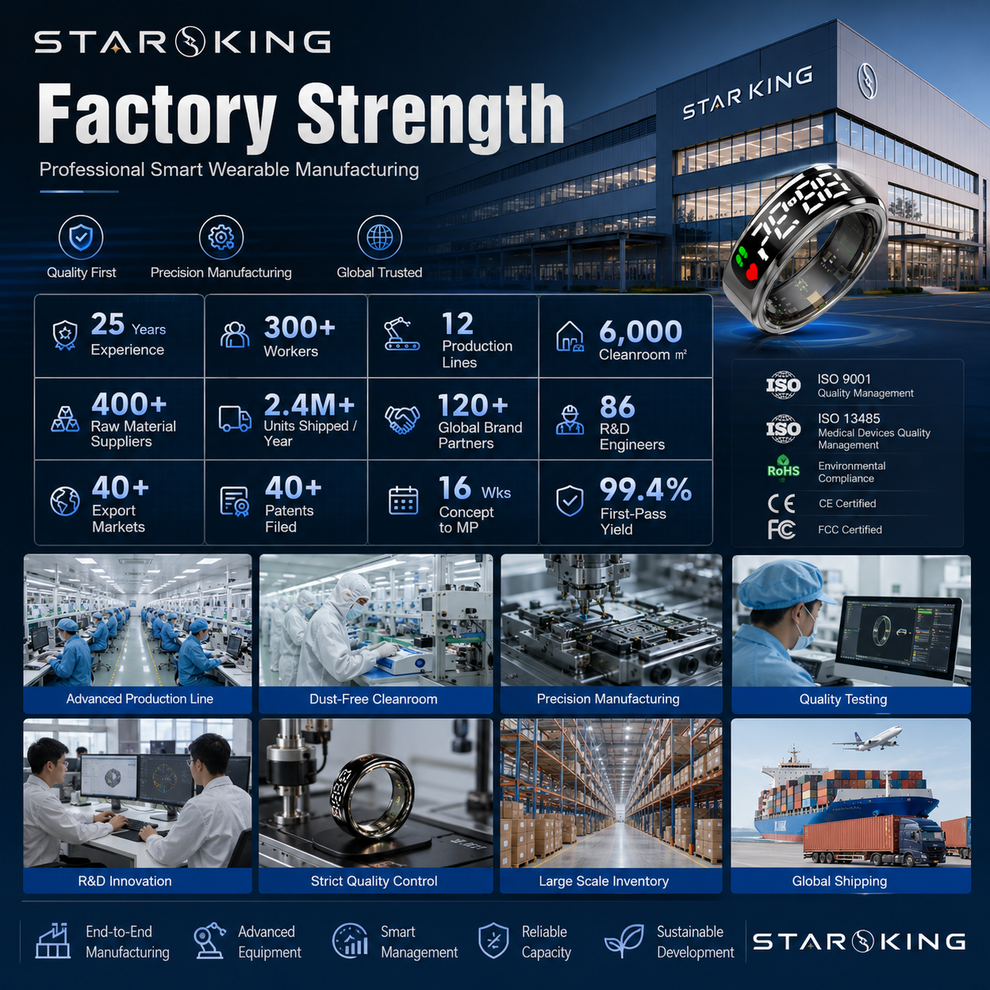
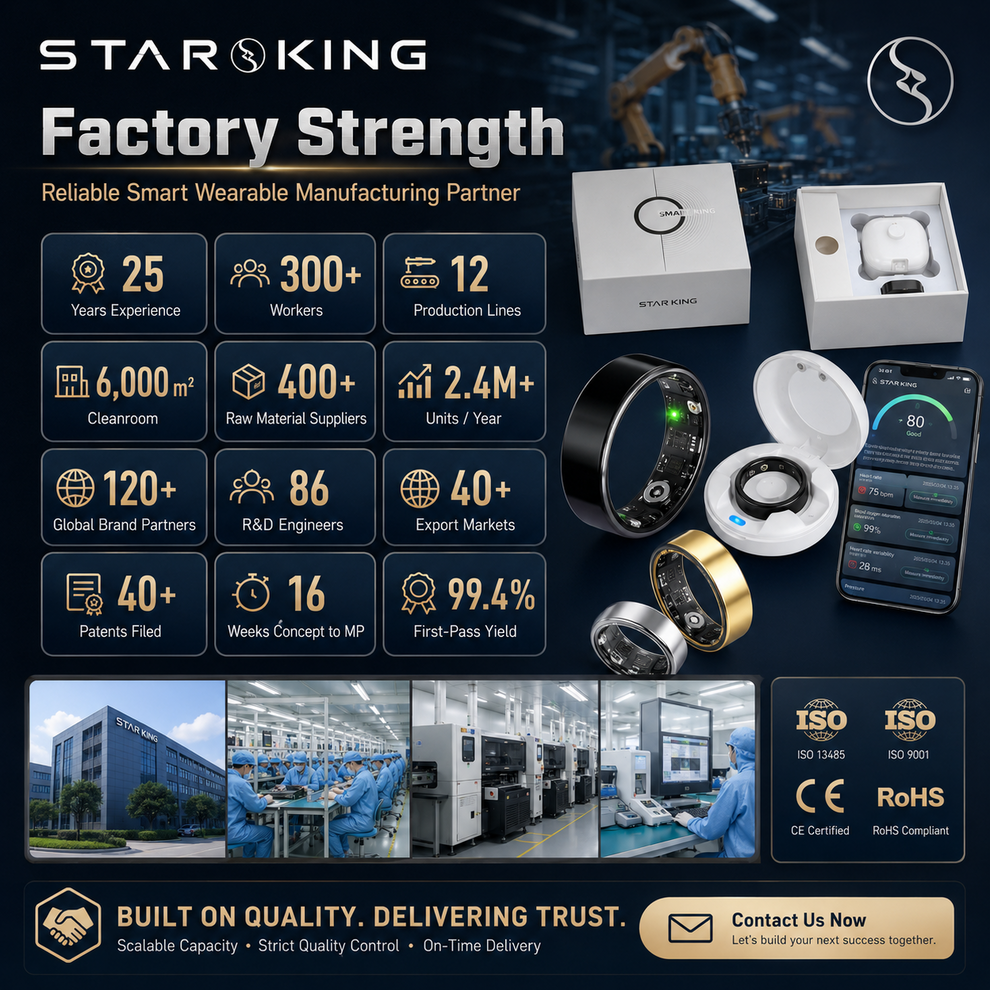
If you are ready to move from shortlist to purchase order, STAR KING can support your EU private-label smart band program with OEM, ODM, and private-label options. Request a quotation with your target spec, volume, and market, and our team will follow up with model options and next steps.
Discuss Your Smart Wearable OEM/ODM Project
Planning a smart ring, smart watch, smart band, AI glasses, AI translator, or AI voice mouse project? Contact STAR KING to discuss product positioning, sample testing, customization scope, certification requirements, lead time, and quotation details.

Team Star King

Scan WhatsApp QR code