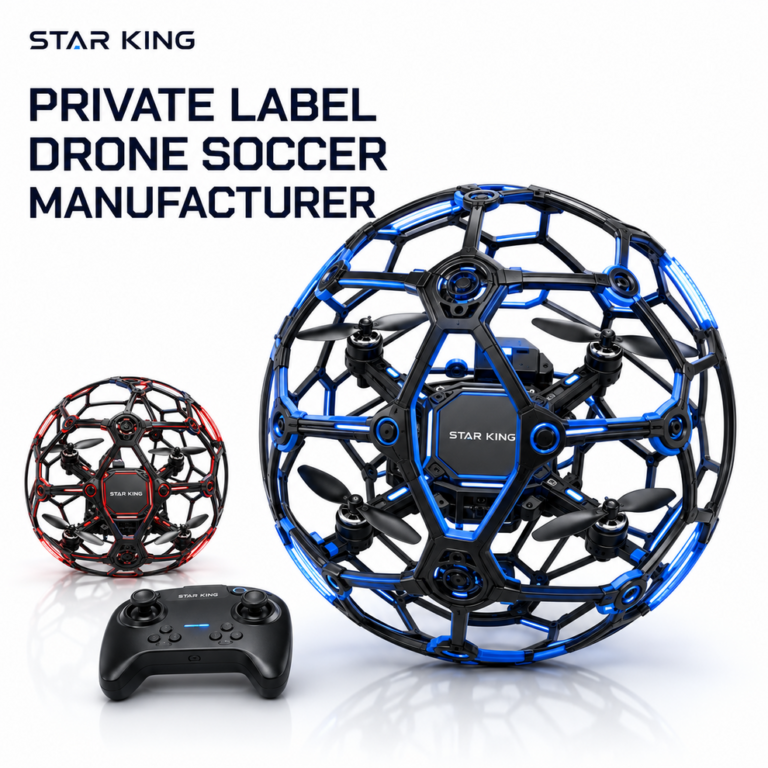
How to Start a Private Label Drone Soccer Business: A Complete B2B Sourcing Guide
How to Start a Private Label Drone Soccer Business: A Complete B2B Sourcing Guide
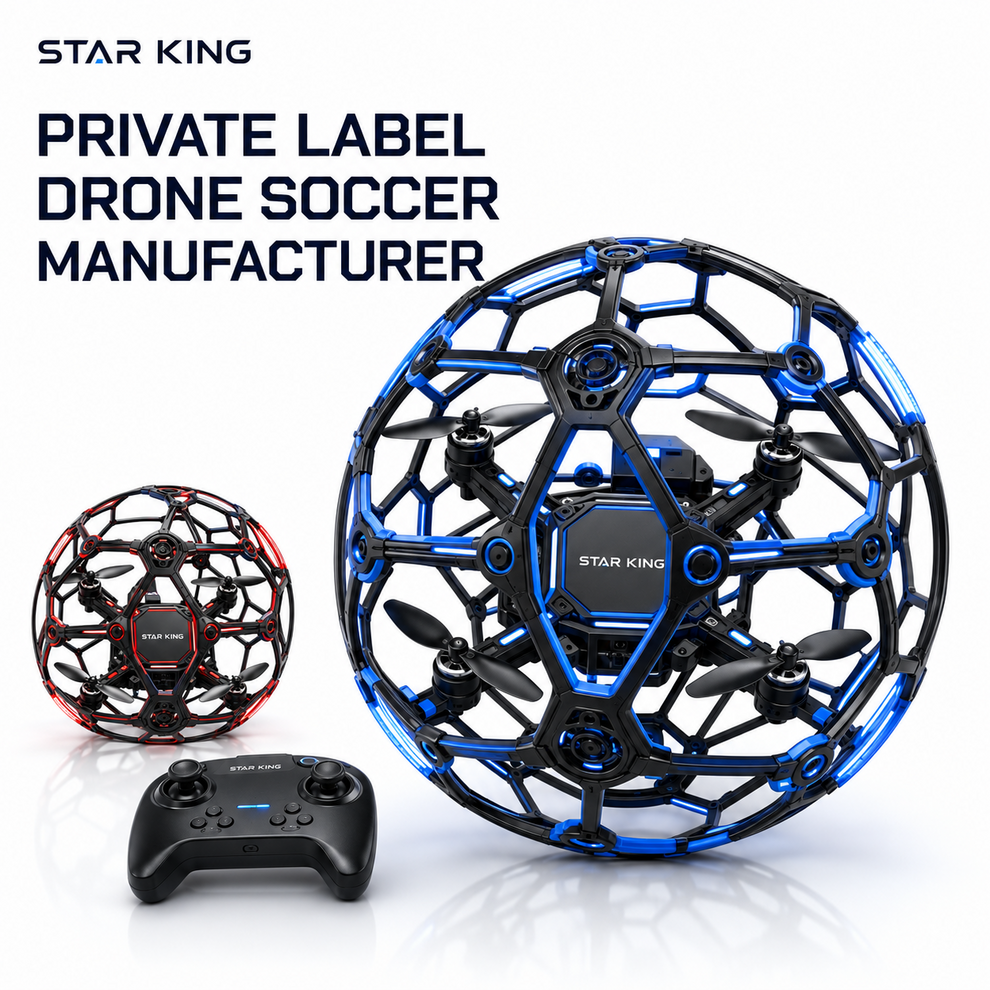
Drone soccer is an emerging sport that combines drone piloting skills with team competition, rapidly gaining traction in schools, sports clubs, and entertainment venues worldwide. For private-label brands and distributors, this presents a unique opportunity to enter a growing niche market. This guide walks you through the essential steps to source, customize, and launch your own branded drone soccer product, covering OEM/ODM manufacturing, certification requirements, packaging, and supplier evaluation.
Key Takeaways
- Drone soccer uses protective spherical frames for safe indoor/outdoor competition.
- Private-label brands can differentiate through design, app features, and educational packages.
- Supplier vetting, certification, and MOQ negotiation are critical for a successful launch.
- STAR KING offers end-to-end OEM/ODM services for drone soccer products.
What Is Drone Soccer?
Drone soccer is a team sport where pilots control drones inside large protective spheres (called “cages”) to score goals. The drones are typically small, agile, and equipped with LED lights for visibility. The sport originated in South Korea and has expanded globally, with leagues forming in Europe, the Middle East, and the Americas. For manufacturers, this means a standardized product platform that can be adapted for different markets.
Why Private-Label Drone Soccer?
As a private-label brand, you can capitalize on the sport’s growing popularity without designing from scratch. Key advantages include:
- Low product development cost by using proven OEM designs.
- Ability to customize branding, packaging, and even software (e.g., scoring apps).
- High perceived value in the education and sports tech sectors.
- First-mover advantage in many regional markets.
Choosing Between OEM and ODM for Drone Soccer
Understanding the two manufacturing models is crucial:
| Factor | OEM (Original Equipment Manufacturing) | ODM (Original Design Manufacturing) |
|---|---|---|
| Design | Your custom specifications | Supplier’s existing design with modifications |
| Development Time | 3-6 months | 1-3 months |
| Tooling Cost | $5,000-$20,000+ | $0-$5,000 |
| MOQ | 1,000+ units | 300-500 units |
| IP Ownership | You own the design | Shared or supplier-owned design |
For most private-label entrants, starting with an ODM approach is recommended to reduce risk and time-to-market. STAR KING offers both options; discuss your needs during initial contact.
Key Product Specifications to Evaluate
When sourcing drone soccer units, pay attention to these specifications:
- Drone size and weight: Must fit within standard spherical frames (typically 80-150 grams).
- Flight time: At least 6-8 minutes per battery for competitive play.
- Durability: The cage must withstand collisions; drones should have replaceable parts.
- LEDs: Multicolor LEDs for team identification and visibility.
- Remote control: 2.4GHz frequency, mode 2 (left stick throttle) is standard.
- Battery: LiPo 1S 3.7V, with UN38.3 certification for shipping.
Customization Options for Private Label
With STAR KING, you can customize:
- Brand logo on the drone body, transmitter, and packaging.
- Color schemes for the cage and LED patterns.
- Custom mobile app for scorekeeping or flight training.
- Bundled educational curriculum for school programs.
Certification Requirements for Global Markets
Drone soccer products must comply with drone and toy safety regulations depending on the target country. Common certifications include:
- CE (Europe): Mandatory for market access; covers radio, safety, and EMC.
- FCC (USA): Required for wireless devices (2.4GHz transmitters).
- RoHS: For electronic components shipped to EU.
- UN38.3 / MSDS: Essential for air transport of lithium batteries.
- EN 71 (EU) or ASTM F963 (US) if marketed as a toy.
Note: Certification costs and requirements vary. Always confirm with your supplier which certifications are included. For example, STAR KING typically provides CE, FCC, and RoHS for drone soccer products, but buyers should verify for specific configurations. Some markets (e.g., Japan, Australia) may require additional testing.
Common Buyer Mistakes When Sourcing Drone Soccer
- Overlooking battery shipping restrictions: LiPo batteries require special packaging and documentation. Work with a supplier experienced in drone logistics.
- Ignoring controller frequency compliance: 2.4GHz is global, but some countries limit output power. Ensure the transmitter is adjustable or certified locally.
- Focusing only on drone specs, not the cage: The spherical cage is a structural component; poor material can lead to early breakage.
- Assuming all drone soccer products are the same: Different leagues may have specific size or weight limits. Clarify your target league requirements.
- Not planning for spare parts: Drones crash; ensure your supplier offers replacement cages, propellers, and batteries.
Practical Buyer Checklist for Private-Label Drone Soccer
- [ ] Confirm target market and applicable certifications (CE, FCC, etc.).
- [ ] Request product samples from at least two suppliers.
- [ ] Test sample durability, flight time, and controller range.
- [ ] Clarify MOQ, lead time, and payment terms (typically 30% deposit).
- [ ] Discuss packaging design (retail vs. bulk).
- [ ] Obtain UN38.3/MSDS certificates for battery shipping.
- [ ] Review supplier’s after-sales warranty policy (1 year standard).
- [ ] Confirm mold ownership if OEM design is chosen.
- [ ] Plan for customs clearance: use HS code 9503.00 (toys) or 8526.91 (radio control).
- [ ] Verify the supplier’s factory audit report or visit in person.
FAQ – Private-Label Drone Soccer Sourcing
- What is the typical MOQ for private-label drone soccer?
MOQ ranges from 300-500 units for ODM (using existing design) to 1,000+ units for OEM (custom design). STAR KING can discuss lower MOQs for first-time buyers. - How long does it take to develop a custom drone soccer product?
ODM customization (logo, packaging) takes 4-6 weeks. Full OEM development can take 3-6 months depending on complexity. - Do I need to purchase separate tools (injection molds)?
For ODM, no tooling is required. For OEM, you will pay for molds, which you own after production. - Can I sell drone soccer as a toy in the US/EU?
Yes, but it must meet toy safety standards (ASTM F963 or EN 71). Confirm with your supplier if the product is tested accordingly. - What batteries are used in drone soccer drones?
Typically 1S 3.7V 300-600mAh LiPo batteries. They must have UN38.3 certification for shipping. - Can I customize the mobile app for scoring?
Yes, STAR KING offers app customization for branding and features. Discuss during project kickoff. - What is the price range for a drone soccer unit (FOB)?
FOB prices vary by order quantity and features. Expect $10-$25 per complete set (drone + cage + transmitter). Request a quote for exact pricing.
Conclusion
Launching a private-label drone soccer brand is a strategic move in the growing sports tech market. By partnering with an experienced manufacturer like STAR KING, you can navigate sourcing, certification, and customization with confidence. Use this guide to make informed decisions and avoid common pitfalls. Your next step is to request product samples and initiate an OEM/ODM discussion.
Ready to bring your drone soccer brand to market? Contact STAR KING today to discuss your project requirements, request samples, or receive a customized quotation. Request a sample or quote now.