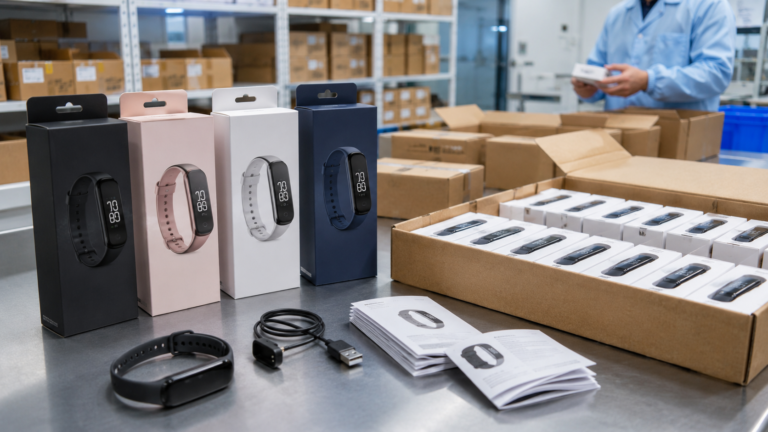

smart band suppliers: Smart Bands for Healthcare Solution Providers: 7-Point EU Procurement Guide for 2026
smart band suppliers buyers need a supplier evaluation process that checks product fit, OEM/ODM capability, compliance documents, quality control, pricing, lead time, and after-sales support before placing a bulk order.
Table of Contents
Table of Contents
Smart Bands for Healthcare Solution Providers: 7-Point EU Procurement Guide for 2026
Smart bands for healthcare solution providers in the EU must be evaluated on regulatory classification, data governance, accuracy, battery transport rules, and supply reliability — not on consumer fitness features. The most common mistake is treating a lifestyle wearable as a clinical-grade remote monitoring device. This guide gives healthcare buyers a 7-point evaluation framework covering MDR classification, CE marking, sensor accuracy, app and API integration, UN38.3 battery documentation, MOQ, and European after-sales support.
smart band suppliers: Table of Contents
- Short Answer: How Should Healthcare Buyers Evaluate Smart Bands?
- Key Takeaways
- Key Facts for Buyers
- 1. Intended Use and MDR Classification
- 2. CE Marking and Technical Documentation
- 3. Sensor Accuracy and Data Quality
- 4. App, API, and Data Governance
- 5. Battery, Transport, and UN38.3
- 6. Supplier Evaluation and OEM/ODM
- 7. MOQ, Lead Time, and After-Sales in the EU
- Comparison Table: Smart Band Configurations for Healthcare Programs
- Common Mistakes and Buyer Red Flags
- Practical Buyer Checklist
- FAQ
- Conclusion
- Next Step

Short Answer: How Should Healthcare Buyers Evaluate Smart Bands?
Smart bands for healthcare solution providers in the EU should be evaluated against the program’s intended use, because that determines whether the device is a general lifestyle wearable or a medical device. Buyers should request the EU Declaration of Conformity, test reports, battery transport documents, and details on data storage and APIs before committing. A wrist wearable that reports heart rate or SpO2 for wellness use is not the same as a certified monitoring device, and suppliers should be able to explain the difference in writing.

Key Takeaways
- Intended use drives MDR classification — define it before sourcing.
- CE marking is not one certificate; it is a set of directives and standards the supplier must document.
- Wellness smart bands cannot be marketed for diagnosis or treatment in the EU.
- Data residency, encryption, and API access are procurement issues, not IT afterthoughts.
- Lithium-polymer batteries inside smart bands require UN38.3 test summaries and, in most cases, MSDS.
- Pilot a small batch — typically 50–200 units — before a program rollout.
Key Facts for Buyers
| Procurement Factor | What to Verify | Typical EU Requirement |
|---|---|---|
| Intended use | Wellness vs. monitoring claims | Determines MDR applicability |
| CE marking | EU Declaration of Conformity | Required for covered directives |
| Radio equipment | Bluetooth, Wi-Fi modules | RED 2014/53/EU typically applies |
| Battery transport | UN38.3 test summary, MSDS | Required for air freight of lithium batteries |
| Data protection | Data flow, storage location | GDPR obligations depend on role |
| Warranty | EU repair/support policy | Negotiated in OEM contracts |
Health programs across Europe are expanding wrist-worn monitoring into senior care, chronic-condition coaching, and corporate wellness. If you are mapping device categories, our overview of smart bands and the health and fitness wearables solution show the configurations typically available. This article focuses on what healthcare buyers should verify before signing a purchase order.

1. Intended Use and MDR Classification
Under the EU Medical Device Regulation (MDR) 2017/745, a product’s classification depends on its intended purpose as stated by the manufacturer — not on the sensor it contains. A smart band marketed for general wellness, activity tracking, and sleep insights is usually outside MDR scope. A smart band marketed to detect atrial fibrillation, monitor a clinical condition, or support diagnosis is likely to fall inside MDR scope and require a conformity assessment route that may include a Notified Body.
Buyers should ask the supplier to state the intended use in writing, and to confirm whether the software that interprets the data makes medical claims. In practice, most wrist-worn general wellness devices sold in the EU avoid diagnostic wording. If your healthcare program requires clinical claims, you should expect a longer regulatory path, higher cost, and a different supplier category.
For reference, the European Commission maintains a overview of EU medical device rules that buyers can use to align intended use with regulatory expectations.
How to phrase intended use for procurement
- Wellness program: “supports general activity and sleep awareness; not for diagnosis.”
- Monitoring program: define the parameter, population, and supervision model.
- Always document the claim in the purchase specification, not only in marketing copy.
2. CE Marking and Technical Documentation
CE marking is often misunderstood in procurement. It is not a single certificate issued by one authority. It is a declaration that the product meets the applicable EU directives and regulations, supported by technical documentation and, where relevant, test reports from accredited labs.
For a Bluetooth smart band, the Radio Equipment Directive (RED) 2014/53/EU typically applies. EMC, RoHS, and REACH considerations may also apply depending on the configuration. The supplier should be able to provide an EU Declaration of Conformity listing the directives and standards used, plus test reports that match the exact model you are buying.
Buyers should verify that the model number on the test report matches the model number on the quote, the packaging, and the device label. A common red flag is a certificate issued for a different hardware revision. For background, the EU’s official CE marking guidance explains the manufacturer’s obligations.
Documents to request before sampling
- EU Declaration of Conformity with directive list
- RED test report (radio, EMC, safety) for the exact model
- RoHS and REACH statements
- Battery UN38.3 test summary and MSDS
- Optional: IP rating test evidence if waterproofing is claimed
3. Sensor Accuracy and Data Quality
Healthcare buyers often ask for a “medical-grade smart band.” It is more useful to ask about sensor configuration, sampling rate, firmware version, and how the supplier validates accuracy. A PPG-based heart rate sensor can perform well for trend monitoring but may be less reliable during high-motion activities or for users with certain skin tones or peripheral circulation conditions.
Procurement teams should request the validation method, not just a claims sheet. Useful questions include:
- Was accuracy validated against a reference device, and under what protocol?
- What firmware version was tested, and how are updates managed?
- How does the device behave when signal quality is poor?
Note that consumer-grade SpO2 and heart rate readings are not diagnostic. In the EU, marketing them as clinical measurements without the appropriate conformity route creates legal risk for the brand owner.
4. App, API, and Data Governance
For healthcare solution providers, the smart band is only half the product. The other half is the app, cloud, and integration layer that turns raw sensor data into usable information. This is where GDPR and program design meet.
Ask the supplier whether the companion app is white-label, whether data can be stored in EU regions, whether an API is available for your platform, and how user consent and deletion requests are handled. If your organization acts as a data controller, the supplier may act as a processor — a relationship that should be documented in a data processing agreement.
App and firmware customization is discussed in more detail in our private label OEM/ODM overview.
Integration questions that affect cost
| Requirement | Impact | Typical Lead Time |
|---|---|---|
| White-label app | Moderate | 4–8 weeks |
| Custom API for your platform | Higher | 6–12 weeks |
| EU data residency | Depends on infra | Varies by provider |
| Firmware feature changes | Higher, needs testing | 8–16 weeks |
If your program spans multiple sites or countries, it is worth aligning device choices with a broader remote health wearables application strategy so that devices, apps, and reporting remain consistent.
5. Battery, Transport, and UN38.3
Smart bands contain lithium-polymer cells. When shipped by air, they are subject to dangerous goods rules, and carriers typically require a UN38.3 test summary. A Material Safety Data Sheet (MSDS) is also commonly requested by freight forwarders and customs brokers. These documents should be valid for the exact battery model in the product you purchase.
Buyers should confirm:
- Battery capacity and whether it meets EU battery regulations in force at the time of order
- UN38.3 test summary validity and battery model match
- Charging safety features documented by the supplier
- Warranty terms for battery capacity degradation
The regulatory picture for batteries in the EU is evolving, including the EU Batteries Regulation. Buyers should verify current obligations with their compliance advisor before placing large orders. For a general reference on lithium battery transport requirements, see the IATA Dangerous Goods guidance.
6. Supplier Evaluation and OEM/ODM
Not every wearable factory is set up for healthcare customers, and the difference shows up in documentation, change control, and communication. A consumer-focused supplier may be fast and cheap but may not be able to support EU regulatory documentation or custom app development.
During evaluation, separate marketing claims from verifiable evidence. Ask for:
- Existing EU customers or references (if the supplier can share them)
- Quality management approach and inspection reports
- Ability to sign an NDA and a quality agreement
- Sample units for internal validation before mass production
OEM and ODM are different commercial models. In OEM, you typically bring the specification; in ODM, you adapt an existing platform. Both are viable for healthcare solution providers, but ODM usually shortens development time while limiting deep customization. Confirm tooling ownership and IP terms in writing.
Evaluation scorecard (0–5 per row)
| Criteria | Weight | What to Score |
|---|---|---|
| Regulatory documentation | High | DoC, test reports, battery docs |
| App/API flexibility | High | White-label, API, data location |
| Sample quality | Medium | Build, sensor stability, comfort |
| MOQ and cost | Medium | Fit with pilot size and scale plan |
| After-sales | Medium | Warranty, spares, EU support |
7. MOQ, Lead Time, and After-Sales in the EU
MOQ on smart bands typically depends on whether you use an existing ODM platform or request custom tooling, packaging, and firmware. Small pilot runs are often possible on standard platforms, while full customization usually raises MOQ. Lead time is driven by component availability, app work, and shipping mode.
After-sales is often underestimated. Healthcare programs need predictable replacement cycles, warranty handling, and spare parts. Ask how returns are processed, whether replacement units are stocked, and what the expected battery service life is. For EU deployments, clarify who handles first-line support — your team, the supplier, or a local partner.
Soft CTA
If you are comparing platforms, our team can help you map device configurations, app options, and documentation needs against your program’s intended use. It is worth reviewing the specification options before you set your own RFQ.
Comparison Table: Smart Band Configurations for Healthcare Programs
| Configuration | Typical Use | Customization | MOQ Tendency | Key Considerations |
|---|---|---|---|---|
| Standard ODM band | Corporate wellness, activity programs | Logo, packaging | Lower | Fastest route; limited app changes |
| ODM + white-label app | Branded wellness programs | App skinning, dashboard | Medium | GDPR and data flow review needed |
| OEM customized band | Specific monitoring workflows | Hardware, firmware, app | Higher | Longer development and validation |
| Medical-claim device route | Clinical monitoring under MDR | Full regulatory program | Highest | Notified Body involvement likely |
Common Mistakes and Buyer Red Flags
Common mistakes
- Assuming “CE” automatically means the device is approved for medical use.
- Ordering before defining intended use and data claims.
- Skipping data protection review until after app development.
- Accepting test reports that do not match the purchased model number.
- Underestimating battery documentation for air freight.
Buyer red flags
- Supplier cannot produce an EU Declaration of Conformity.
- Claims of “FDA approved” or “CE medical” without documentation.
- No clear answer on data storage location.
- Reluctance to sign an NDA or quality agreement.
- MOQ or lead time changes repeatedly during quoting.
Practical Buyer Checklist
- Write the intended use statement before contacting suppliers.
- Request EU DoC, RED test report, RoHS/REACH statements, UN38.3 summary, and MSDS.
- Confirm the model number matches across quote, report, label, and packaging.
- Validate sensor performance on pilot units in your target population.
- Review app data flow, storage region, consent, and deletion process.
- Confirm tooling ownership, IP terms, and firmware update policy.
- Agree warranty, spare parts, and EU support responsibilities.
- Pilot 50–200 units before a large rollout.
FAQ
Do smart bands for healthcare solution providers in the EU need to be medical devices?
Only if the manufacturer’s intended use includes medical purposes. General wellness wearable
Discuss Your Smart Wearable OEM/ODM Project
Planning a smart ring, smart watch, smart band, AI glasses, AI translator, or AI voice mouse project? Contact STAR KING to discuss product positioning, sample testing, customization scope, certification requirements, lead time, and quotation details.

Team Star King

Scan WhatsApp QR code