
EU-compliant smart bands for healthcare: 7 Steps to Source EU-Compliant Smart Bands for Healthcare Providers
7 Steps to Source EU-Compliant Smart Bands for Healthcare Providers
Healthcare providers looking to integrate smart bands into patient monitoring or corporate wellness programs need to source devices that meet EU regulations and data privacy standards. This guide outlines seven critical steps for procuring EU-compliant smart bands, focusing on certification, security, and supplier due diligence.
Table of Contents
Table of Contents
Table of Contents
EU-compliant smart bands for healthcare are wearable devices that track health metrics like heart rate and activity while adhering to EU regulations, including CE marking, RoHS, and GDPR.

Short Answer: How to Source EU-Compliant Smart Bands
To source EU-compliant smart bands for healthcare, providers must first identify required health features, then verify that the device has CE marking, complies with the EU Medical Device Regulation (if applicable), and ensure that data handling meets GDPR standards. Finally, they must work with a supplier that offers full documentation and proves manufacturing compliance through audits and certifications.

Key Takeaways for Healthcare Buyers
- EU compliance involves multiple directives: CE (RED, LVD, EMC), RoHS, REACH, and potentially MDR for medical claims.
- Healthcare providers must critically assess data privacy and security, especially under GDPR.
- Smart bands that are not medical devices may still fall under the General Product Safety Directive and require risk assessments.
- OEM/ODM partnerships allow customization for healthcare programs but demand rigorous supplier qualification.

Key Facts for Buyers: EU-Compliant Smart Bands
| Consideration | What Buyers Need to Know |
|---|---|
| CE Marking | Not a single certification; includes RED, EMC, LVD. Confirm the product carries CE mark and obtains EU Declaration of Conformity. |
| Medical Device Status | If the smart band is marketed for medical purposes (e.g., detecting arrhythmia), it must meet MDR requirements. Wellness tracking is typically not medical. |
| RoHS/REACH | Restrictions on hazardous substances; sellers must provide compliance documentation. |
| Data Privacy | GDPR applies to health data; ensure encryption, data minimization and user consent mechanisms. |
| Supply Chain Transparency | Suppliers should provide test reports and allow factory audits. |

7 Steps to Source EU-Compliant Smart Bands for Healthcare
Step 1: Clarify Your Use Case and Health Claims
Define whether the smart band will be used for general wellness (e.g., steps, sleep) or for managing a specific health condition. If you intend to use heart rate or blood oxygen data to screen or monitor patients, the device may be classified as a medical device under the EU MDR. In that case, the device itself – not just the band – may require CE marking under MDR. If you are using the device only for wellness, you can avoid MDR but must still ensure that no medical claims are made.
Action: Document exactly what data you will collect and how it will be used. This determines your regulatory pathway.
Step 2: Verify EU Regulatory Compliance (CE, RoHS, REACH)
EU-compliant smart bands must bear the CE mark, which demonstrates conformity with applicable directives: Radio Equipment Directive (RED) for wireless, EMC, and safety; Low Voltage Directive if applicable; RoHS restricting hazardous substances; and REACH for chemical safety. For products sold in the EU, the manufacturer or importer must issue a Declaration of Conformity. Healthcare buyers should request this document and copies of test reports from accredited labs. Note that even if the supplier is based in China, the EU importer (or the EU Authorized Representative) is legally responsible for ensuring compliance.
Action: Ask the supplier for a full technical file, including test reports and a sample of the Declaration of Conformity.
Step 3: Evaluate Data Privacy and Cybersecurity (GDPR)
Health data is considered sensitive under GDPR. When you source smart bands, you must ensure that the device and ecosystem comply with GDPR principles: data minimization, purpose limitation, storage limitation, and consent. The device should offer local data processing at least for sensitive data, allow the user to control data sharing, and provide transparent privacy policy. If the supplier provides an app or cloud service, check where data is stored (EU vs. third countries) and whether there are appropriate safeguards.
Action: Request a Data Processing Agreement from the supplier, and conduct a DPIA for your project.
Step 4: Assess Battery and Material Safety
Batteries in smart bands must comply with the EU Battery Regulation (EU) 2023/1542, which addresses safety, sustainability, and labelling. Look for UN38.3 certification, which covers transport safety of lithium batteries. For the device, also verify that materials are skin-friendly and comply with REACH, especially for prolonged skin contact. Additional standards like EN 62209 for SAR may apply to wearables with wireless transmission.
Action: Ask for battery test reports and confirm that the device has passed safety tests for charging and temperature.
Step 5: Choose an OEM/ODM Partner with Verified Manufacturing Capabilities
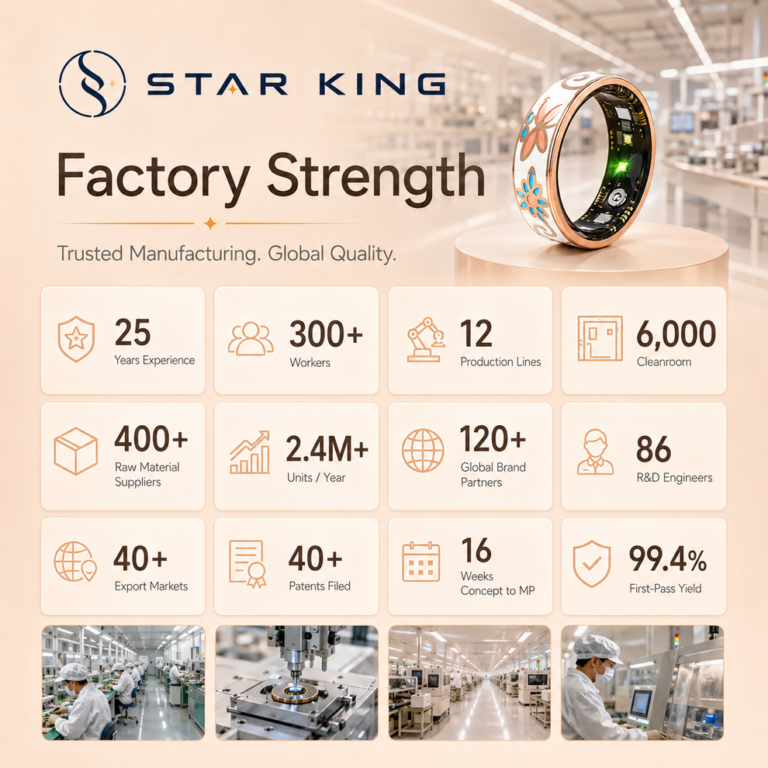
Healthcare providers rarely have the capacity to design a smart band from scratch, so partnering with an OEM/ODM is the common route. However, you must conduct due diligence: visit the factory or request virtual audits, check certifications like ISO 13485 for medical devices, ISO 9001 for quality management, and ask about quality control procedures. A reliable manufacturer will allow you to review their quality manual and test processes.
Action: Shortlist suppliers that are transparent about their production and testing capacity.
Step 6: Plan for Firmware/App Customization and Integration
To meet the specific needs of your healthcare program, you may need to customize the firmware or app. This could include adjusting algorithms for your population (e.g., seniors) or integrating data into your existing EHR systems. When sourcing, confirm that the supplier offers API access and firmware/ app customization. Also, verify that they will update software for security patches and compliance changes.
Action: Ask about customization options and their software update policy – both are critical for long-term use.
Step 7: Secure Your Supply Chain and IP Rights
You must protect your brand and any customizations. If you choose private label, ensure you have the right to use your own logo and packaging. If you co-develop features, negotiate ownership of intellectual property. Also, secure a stable supply chain with consistent lead times and a plan for spare parts. Consider how the device will be repaired or replaced under warranty – this is vital for healthcare deployments.
Action: Sign a detailed agreement covering IP ownership, quality warranties, and after-sales support.
Common Mistakes to Avoid When Sourcing Smart Bands for Healthcare
- Assuming all CE marks are equal: CE is a self-declaration but may involve Notified Bodies for medical devices. Verify the route.
- Ignoring GDPR implications: You may be a data controller, liable for health data mishandling.
- Skipping factory audits: Photos and certificates can be misleading. Audit or use a third party.
- Overlooking long-term support: Having a device that works, but no software updates or spare parts, can lead to operational failure.
Practical Buyer Checklist for Sourcing EU-Compliant Smart Bands
- ☐ Define if the device is medical or wellness.
- ☐ Review CE Declaration of Conformity and test reports.
- ☐ Request RoHS & REACH certificates.
- ☐ Confirm GDPR compliance of the app and cloud.
- ☐ Check battery safety certificates (UN38.3).
- ☐ Visit or audit the manufacturer (ISO 13485 if medical).
- ☐ Ensure API access and software update roadmap.
- ☐ Negotiate IP ownership and NDA.
- ☐ Plan for spare parts and repair within EU.
Buyer FAQs
Do smart bands require CE marking to sell in the EU?
Yes, they must be CE marked under the Radio Equipment Directive (and possibly others). The manufacturer or importer provides the Declaration of Conformity.
Are smart bands considered medical devices in the EU?
Only if they are intended for medical purposes. For wellness tracking, they are not; medical-intended devices must meet MDR requirements.
How can I verify a supplier’s compliance claims?
Ask for test reports from accredited labs and the technical file. For peace of mind, consider an independent audit.
What are the common battery regulations for these devices?
UN38.3 for transport safety, plus possibly the new EU Battery Regulation. Check the product’s documentation.
Can I get custom branding on smart bands?
Yes, private label options allow logo and packaging customization, subject to MOQ. Many OEM/ODM manufacturers offer this.
What is the typical MOQ for OEM smart bands?
MOQs vary widely, often from 500 to 1,000 units for custom firmware, but lower for private label. Confirm with suppliers.
Conclusion and Next Steps
Sourcing EU-compliant smart bands for healthcare requires deliberate planning around compliance, data privacy, and supplier reliability. By following these seven steps, healthcare providers can reduce regulatory risk and ensure a solid deployment. STAR KING offers a range of smart bands that can be customized for your program; our team can help you navigate certification questions.
Request samples of smart bands for your healthcare initiative to evaluate their integration potential.
Buyers can also review STAR KING Smart Bands OEM/ODM options to compare product positioning, customization scope, and sample planning.
Useful Official References for Buyers
- FCC equipment authorization guidance
- European Commission CE marking information
- Bluetooth SIG specifications
Discuss Your Smart Wearable OEM/ODM Project
Planning a smart ring, smart watch, smart band, AI glasses, AI translator, or AI voice mouse project? Contact STAR KING to discuss product positioning, sample testing, customization scope, certification requirements, lead time, and quotation details.

Team Star King

Scan WhatsApp QR code