
Smart Rings OEM/ODM: The 7-Point RFQ Guide for Private-Label Brands
October 12, 2026 · Team Star King
Smart Rings OEM/ODM: The 7-Point RFQ Guide for Private-Label Brands
Smart Rings OEM/ODM sourcing works best when you send a structured RFQ instead of a one-line price request. A complete brief covering product scope, sensor and firmware features, MOQ, tooling, app ownership, compliance and logistics lets a factory quote accurately, reduces back-and-forth, and protects your brand from hidden cost and delay. This guide gives private-label brands a seven-point framework to evaluate suppliers, compare quotes on equal terms, and move from sample to mass production with fewer surprises.
Table of Contents
Table of Contents
Direct Answer
To run a smart ring OEM/ODM project, define seven items before requesting quotes: target market and use case, product configuration, MOQ and pricing tiers, tooling and IP ownership, app and firmware scope, certifications required for your sales channels, and delivery plus after-sales terms. Suppliers that can answer all seven in writing with verifiable evidence are lower-risk partners than those competing only on unit price.
Table of Contents
- Why a structured RFQ matters for Smart Rings OEM/ODM
- Key Facts for Buyers
- Key Takeaways
- 1. Define the market, use case and product configuration
- 2. Choose OEM, ODM or hybrid scope
- 3. Understand MOQ, tooling and price drivers
- 4. Specify firmware, sensors and app integration
- 5. Lock compliance and certification scope per market
- 6. Plan samples, validation and pilot production
- 7. Agree lead time, packaging, shipping and after-sales
- RFQ comparison table: what to score, not just price
- Common Mistakes and Buyer Red Flags
- Practical Buyer Checklist
- FAQ
- Conclusion
Image Suggestion 1
Placement: below this paragraph, full width.
File name: smart-rings-oem-odm-rfq-guide-banner.jpg
Alt text: Smart Rings OEM/ODM RFQ guide for private-label brands, showing smart ring samples and a sourcing checklist
Caption: A structured RFQ lets smart ring suppliers quote accurately and compare on equal terms.
Why a structured RFQ matters for Smart Rings OEM/ODM
Smart rings sit in a category where small design decisions change cost, compliance and user experience. A ring is not a watch with fewer parts — it packs a battery, sensors, an antenna, a charging path and firmware into a few cubic centimeters. That density makes vague briefs expensive. If you ask five factories for “the price of a smart ring,” you will receive five quotes that cover different sensors, different battery capacities, different app arrangements and different certification assumptions. The numbers will look comparable but are not.
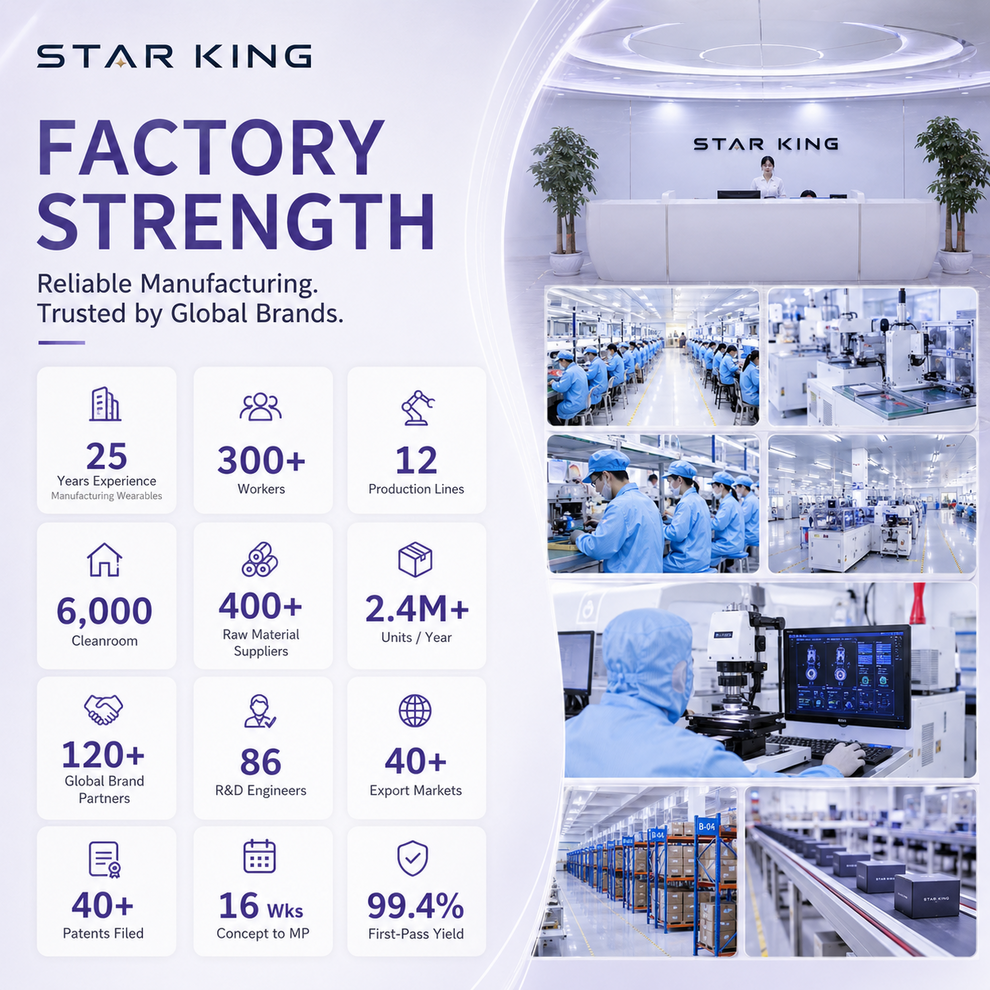
A structured RFQ forces the comparison onto the same baseline. It also surfaces the supplier’s engineering depth early. A trading intermediary will usually route your questions and take days to answer; a manufacturer with in-house hardware, firmware and assembly teams can respond with drawings, firmware capability notes and test plans.
For private-label brands specifically, the RFQ is also your brand-protection document. It captures what is customized (logo, packaging, app, firmware defaults), who owns tooling and molds, and what happens at the end of a project. Getting those terms written down at RFQ stage is far cheaper than negotiating them after you have committed to a purchase order.
Key Facts for Buyers
| RFQ element | Why it matters | What to put in the brief |
|---|---|---|
| Target market and use case | Drives certification, language, battery and feature priorities | Countries, sales channels, primary use case (sleep, fitness, general wellness) |
| Product configuration | Ring sizes, finishes, sensors and battery determine feasibility and cost | Ring size range, material/finish, sensor set, battery life target |
| MOQ and price tiers | Defines unit economics and cash commitment | Target first-order quantity and annual volume plan |
| Tooling and IP ownership | Protects your investment and mold access | Who owns molds, tooling and design files; transfer terms |
| App and firmware scope | Determines whether your brand owns the software experience | White-label app, custom app, SDK/API access, data handling |
| Certifications | Gatekeeper for retail and cross-border shipping | CE, FCC, RoHS, UN38.3, MSDS and any market-specific approvals |
| Delivery and after-sales | Protects margin and brand reputation | Lead time, packaging, shipping terms, warranty, spare parts |

Key Takeaways
- A smart ring RFQ should cover seven areas: market, configuration, MOQ and pricing, tooling and IP, app and firmware, certifications, and delivery and after-sales.
- Compare supplier quotes on identical specifications; different sensor sets, battery sizes and app arrangements make headline prices misleading.
- MOQ is usually a function of tooling, component purchasing and test capacity, not an arbitrary number — ask what drives the tier.
- Certification scope should be confirmed per configuration and per market; do not assume one certificate covers every variant.
- Sample and pilot validation reduces mass-production risk more than any price negotiation.
- Clarify tooling and mold ownership in writing before paying for development.
- Plan packaging, lithium battery shipping documents and after-sales terms at RFQ stage, not after production.

1. Define the market, use case and product configuration
Start with where the ring will be sold and what the user will do with it. A ring sold mainly as a sleep and recovery tracker needs different firmware tuning and app screens than one positioned for everyday activity tracking or general wellness. Market also determines which certifications and languages matter.
What to specify
- Target countries and sales channels (retail, Amazon, DTC, distributor networks).
- Primary use case: sleep and recovery, fitness tracking, general wellness, or a mixed positioning.
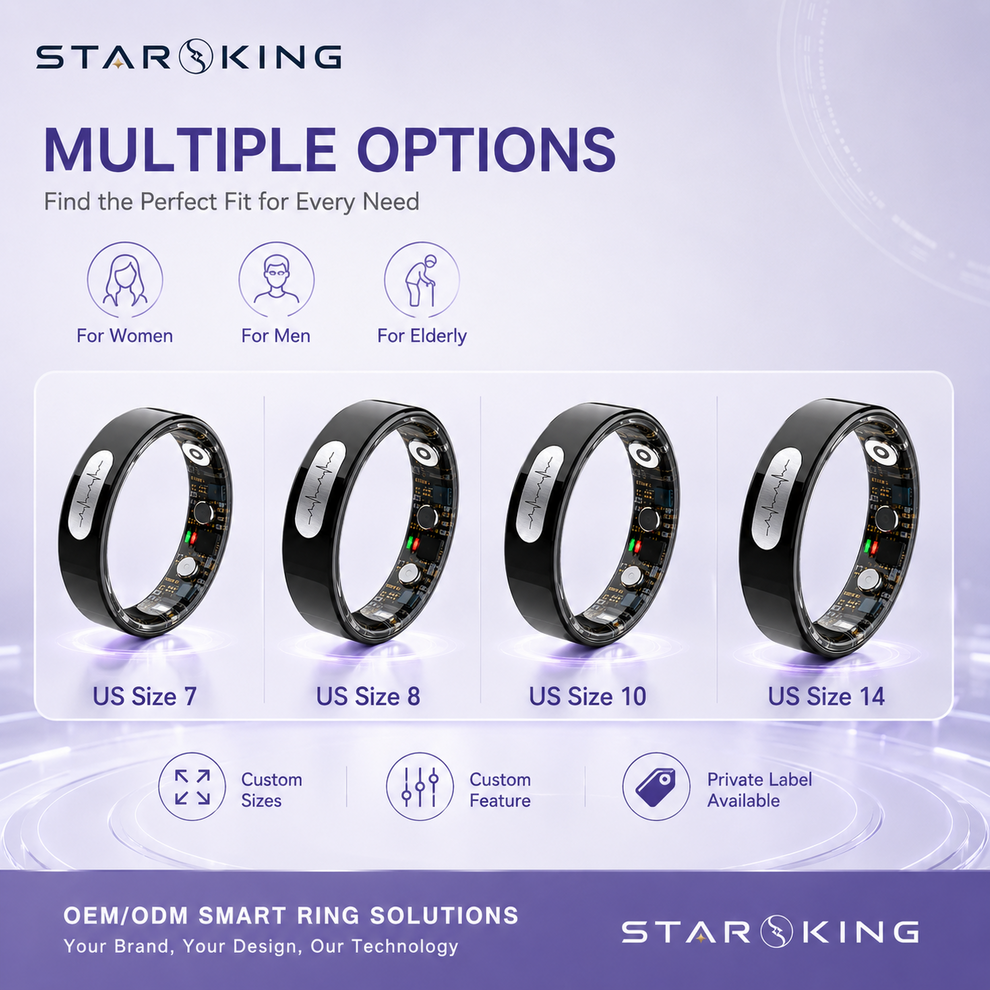
- Ring size range you intend to stock, including whether you need a sizing kit for end customers.
- Material and finish: coating type, color options, and whether finishes must match existing brand hardware.
- Battery life target, expressed as a realistic range under stated usage conditions.
- Water resistance expectations, with the understanding that ratings depend on design and testing.
Buyers should verify how the supplier states battery life — whether it is measured under a defined configuration such as screen-free tracking with specific sensor duty cycles. A number without a test condition is not a specification.
If your brand already sells smart watches or bands, list them in the brief. Many buyers want the ring to share app infrastructure, account systems and visual language with existing wearable lines, and suppliers can advise on feasibility.
2. Choose OEM, ODM or hybrid scope
In practice, most smart ring projects fall into three models. Understanding which one you are buying prevents mismatched expectations on cost and timeline.
| Model | What is customized | Typical buyer situation |
|---|---|---|
| Private label / light OEM | Logo, packaging, app skin, some firmware defaults | Fast market entry; brand is building a wearable lineup |
| Hybrid / mid-level OEM | Above plus selected hardware changes and app features | Buyer needs differentiation but wants a proven platform |
| Full ODM / custom development | Industrial design, electronics, firmware, app and tooling | Buyer has a distinct product vision, budget and timeline |
Ask the supplier to describe where their standard platform ends and customization begins. This is the single most useful question in early sourcing conversations, because it tells you how much engineering work sits behind the quote. For brands exploring this route, the private label OEM/ODM solution overview is a useful reference for scoping.
If your project involves app or firmware customization, request a written scope statement: what the supplier will build, what remains configurable, and what requires a separate statement of work.
3. Understand MOQ, tooling and price drivers
MOQ for smart rings is not a single fixed number. It usually reflects a combination of tooling amortization, minimum component order quantities, production line setup and test capacity. Asking “what is your MOQ?” without context often produces either an inflated number or a promise that cannot be honored at the quoted price.
Questions that reveal the real cost structure
- Is the quoted MOQ per ring size, per color, or per total order?
- Which components are shared with your existing platform and which require new tooling?
- How does unit price change across quantity tiers, and where do the step changes come from?
- Are there separate charges for tooling, sample development, packaging artwork or certification?
- What is the payment schedule and how does it align with sample approval and mass production?
Tooling deserves its own line item. If new molds or fixtures are required for a custom design, the buyer should understand the cost, the lead time and the ownership terms. A supplier that treats tooling as an unexplained surcharge is harder to audit than one that itemizes it.
Price should always be read together with what is included. Two quotes at similar unit prices can differ substantially once you add certification, packaging development, app work and freight. For a broader view of how wearable programs are structured, the health and fitness wearables solution page outlines how configuration choices map to end use.
If you need help translating your target volumes and features into a comparable cost structure, you can request a quotation with your specification and expected quantities.
Image Suggestion 2
Placement: beside the MOQ section or directly below it.
File name: smart-ring-oem-moq-and-tooling-planning.jpg
Alt text: Smart Rings OEM/ODM MOQ and tooling planning chart for private-label brands
Caption: MOQ and tooling charges usually move together — ask what drives each tier.
4. Specify firmware, sensors and app integration
The visible product is the ring; the experience is the app. Private-label buyers should decide early how much of that experience they want to own.
Firmware and sensor scope
- Which sensor set is included and what data it produces.
- How often data syncs, and how the ring behaves when disconnected from the phone.
- Whether sensor settings, sampling rates or algorithms can be configured for your brand.
- How firmware updates are delivered and whether they require app-side changes.
App options
- White-label app with your brand assets, or a co-branded app.
- Custom app built on the supplier’s SDK/API, if available.
- Integration into an existing app you already operate.
Health data handling deserves specific attention. Buyers should ask how data is stored, whether it leaves the user’s device by default, and what the supplier’s data policies are. Requirements differ by market, and buyers should verify obligations that apply to their own business rather than relying on general statements.
If your roadmap includes AI-assisted features or adjacent hardware, note that in the brief; the smart rings product page and related hardware pages show how a ring can sit inside a wider connected lineup.
5. Lock compliance and certification scope per market
Certification is where sourcing projects most often lose time. Radio equipment, batteries and health-adjacent data features each bring their own requirements, and these differ by market.
Commonly discussed items for smart rings include CE marking for the EU, FCC rules for the United States, RoHS for restricted substances, UN38.3 for lithium battery transport, and MSDS documentation for shipping. Additional requirements may apply depending on your sales channel, country and the exact configuration of the product.
Buyers should treat certification as configuration-specific. A certificate issued for one ring model, battery or radio module does not automatically cover a variant with different components. Ask the supplier to state, in writing, which certifications are already available for the exact configuration you are ordering, and which would need to be obtained.
- FCC equipment authorization procedures for radio-frequency devices.
- European Commission guidance on CE marking.
- IATA lithium battery shipping guidance for transport documentation context.
Do not accept verbal assurances such as “our products are certified.” Request document numbers, test reports and the configuration each document covers. Where a claim cannot be verified, plan to verify it through your own test house or an accredited laboratory.
6. Plan samples, validation and pilot production
Samples are a working tool, not a formality. Build a validation plan around the questions that matter to your business.
Sample-stage validation plan
- Fit and comfort across your planned ring size range.
- Sensor data consistency across repeated sessions.
- Battery endurance under your stated usage profile.
- App pairing, sync reliability and firmware update behavior.
- Finish durability and appearance after normal wear.
- Charging behavior and connector or dock reliability.
Where possible, progress from engineering samples to pilot production before committing to full volume. Pilot runs expose assembly and test issues that samples built by hand may not reveal. Agree in advance on the acceptance criteria for each stage, and who pays for rework if a stage fails.
For sleep-focused or recovery-focused positioning, buyers often validate with a small user group before launch. This is a product-validation exercise; consumer wellness features are not medical diagnostics, and marketing claims should stay within what the product and applicable regulations allow. The sleep and recovery application page shows how brands typically position these features.
7. Agree lead time, packaging, shipping and after-sales
Commercial terms decide whether a good product also becomes a good business.
Lead time
Break lead time into stages: sample development, tooling if required, component procurement, mass production and testing, and freight. Total lead time is the sum, and buyers should ask which stage drives the critical path.
Packaging and branding
- Retail box structure, artwork responsibilities and print approval cycles.
- Insert cards, sizing kits, charging accessories and quick-start documentation.
- Whether packaging changes affect shipping weight and freight cost.
Shipping
Lithium battery products usually require specific documentation and may be subject to carrier restrictions. Confirm what documents the supplier provides, and which party handles customs clearance and duties. Landed cost, not unit price, is the number that should drive your margin model.
After-sales
- Warranty length and what it covers.
- Spare parts availability, especially for rings returned by end customers.
- Replacement unit policy and how defective returns are processed.
- Firmware support window and how updates are delivered post-launch.
Image Suggestion 3
Placement: within the lead time and logistics section.
File name: smart-ring-packaging-and-private-label-branding.jpg
Alt text: Smart Rings OEM/ODM private-label packaging and branding options prepared for mass production
Caption: Packaging and lithium battery documentation should be planned alongside production, not after it.
RFQ comparison table: what to score, not just price
Use the same scorecard for every supplier so the comparison is fair.
| Criterion | What good looks like | Weight (example) |
|---|---|---|
| Specification clarity | Itemized configuration with test conditions | High |
| OEM/ODM flexibility | Clear statement of standard vs customized scope | High |
| MOQ and pricing logic | Explained tiers and itemized tooling | High |
| Firmware and app capability | Documented SDK/API or customization process | High |
| Certification evidence | Reports mapped to configuration and market | High |
| Sample and pilot process | Defined stages with acceptance criteria | Medium |
| Lead time breakdown | Stage-by-stage schedule | Medium |
| After-sales terms | Written warranty and spare parts policy | Medium |
| Communication speed | Answers within an agreed response window | Medium |
Common Mistakes and Buyer Red Flags
Common mistakes
- Requesting price before defining configuration, then comparing non-comparable quotes.
- Assuming one certification covers every ring variant and every market.
- Leaving tooling and mold ownership undefined until after payment.
- Skipping pilot production and moving straight from sample to full order.
- Ignoring landed cost, packaging weight, and lithium battery documentation in margin calculations.
- Treating consumer wellness features as medical functions in marketing copy.
Buyer red flags
- Quotes that omit test conditions, battery definitions or sensor details.
- Unwillingness to put OEM versus ODM scope in writing.
- Certification claims with no document numbers or configuration mapping.
- Refusal to allow a pilot run or third-party inspection before shipment.
- Vague after-sales terms or no spare parts pathway.
- Pressure to pay a large deposit before sample approval is complete.
Practical Buyer Checklist
- Market, sales channels and primary use case confirmed in writing.
- Ring size range, finishes and battery target documented.
- OEM, ODM or hybrid scope defined by both parties.
- MOQ stated per size, color and total order; tooling itemized.
- Firmware and app scope agreed, including SDK/API availability.
- Certification requirements listed per market and per configuration, with evidence requested.
- Sample and pilot acceptance criteria agreed.
- Packaging, artwork and sizing kit responsibilities assigned.
- Shipping documents, Incoterms and duties responsibility confirmed.
- Warranty, spare parts and firmware support terms in the agreement.
- Tooling and mold ownership terms documented.
- Payment schedule tied to milestones.
For more sourcing and manufacturing guidance, review the STAR KING resources blog before finalizing your supplier shortlist.
FAQ
What is a realistic MOQ for a private-label smart ring order?
MOQ varies with tooling, component purchasing and test capacity, and it is often quoted per size or color rather than per order. Ask the supplier to explain which factors drive the tier you are being quoted. A higher quantity at a lower unit price may reflect amortized tooling rather than genuine volume savings, so compare the cost structure, not the headline number.
Can a smart ring be produced with our own app?
Many programs support a white-label app, a co-branded app, or a custom build on the supplier’s SDK or API if one is available. Scope, timeline and cost depend on the supplier’s platform and how much of the data layer they expose. Request a written scope statement covering what is configurable and what is custom development.
Which certifications should we plan for?
Requirements typically depend on your target market and the exact product configuration. Commonly discussed items include CE, FCC, RoHS, UN38.3 and MSDS. Buyers should verify current requirements with the supplier, an accredited test house and their own compliance advisor, because obligations change and vary by channel and country.
How long does tooling and mass production take?
Lead time is a sum of stages: design and tooling if required, component procurement, production, testing and freight. Buyers should ask which stage drives the critical path and build buffer into launch planning. For a configuration that reuses an existing platform, timelines are shorter than for a fully custom design.
Who owns the molds and tooling if we fund them?
Ownership should be stated explicitly in the purchase or development agreement, including whether tooling stays with the supplier, how it is maintained, and what happens if you change suppliers. Do not rely on verbal assurances. Buyers should verify the terms with their legal counsel before paying development fees.
How do we control quality before shipment?
Define acceptance criteria at sample and pilot stages, agree on testing scope, and consider pre-shipment inspection. Ask what the supplier tests at each production stage and how results are documented. Third-party inspection can add independent verification, and its terms should be agreed before production starts.
What shipping documents are needed for lithium battery products?
Lithium battery products may require documentation such as UN38.3 test summaries and MSDS, and carriers may apply specific handling rules. Confirm with the supplier which documents are provided and verify current transport requirements with your freight forwarder, as rules vary by mode and destination.
Conclusion
For private-label brands, a smart ring project succeeds or fails on the quality of the brief. The seven-point RFQ framework — market and configuration, OEM/ODM scope, MOQ and tooling logic, firmware and app integration, certification scope, sample validation, and delivery with after-sales terms — turns a vague price request into a comparable, defensible sourcing decision.
Prioritize suppliers that answer in writing, explain their cost structure, map certifications to specific configurations, and support pilot production. Compare quotes on identical specifications rather than headline unit prices, and plan packaging, lithium battery documentation and warranty terms before production begins. That discipline protects your brand, your margin and your launch date.
STAR KING CTA
Ready to move your smart ring program to RFQ? Share your target market, configuration, expected volumes and customization requirements, and STAR KING can help you compare options and structure a clear quotation. Request a quotation or discuss your OEM/ODM project, or ask for product samples to begin validation.
Discuss Your Smart Wearable OEM/ODM Project
Planning a smart ring, smart watch, smart band, AI glasses, AI translator, or AI voice mouse project? Contact STAR KING to discuss product positioning, sample testing, customization scope, certification requirements, lead time, and quotation details.

Team Star King

Scan WhatsApp QR code
Leave a Reply