
smart bands sourcing: Smart Bands for Amazon EU Sellers: 7 Checks Before You Source in 2026
October 28, 2026 · Team Star King
Smart Bands for Amazon EU Sellers: 7 Checks Before You Source in 2026
Smart bands sourcing for Amazon EU sellers in 2026 comes down to seven pre-order checks: product–market fit, supplier capability, OEM/private-label options, MOQ and landed cost, sample validation, EU compliance evidence, and after-sales readiness. This guide explains how to work through each check so you can shortlist suppliers with confidence before committing to a purchase order.
Table of Contents
Table of Contents
Amazon’s EU marketplaces (Germany, France, Italy, Spain, the Netherlands, Poland, and others) reward sellers who can document compliance and respond quickly to listing issues. A band that sells well in one country may fail another on language support, battery documentation, or label requirements. The checks below help you to compare smart band manufacturers on verifiable facts rather than sales claims.
Short Answer (Direct Answer)
To source smart bands for Amazon EU, sellers should confirm four things before ordering: that the supplier can provide CE, RoHS, REACH, and UN38.3 evidence for the exact SKU; that firmware and app support cover EU languages and GDPR hosting; that MOQ and lead time fit a launch plan; and that samples pass your own battery, pairing, and packaging tests. Without these, low unit price rarely compensates for listing suspensions or returns.
smart bands sourcing: Table of Contents
- Key Takeaways
- Key Facts for Buyers
- Check 1: Product–Market Fit for EU Amazon Listings
- Check 2: Supplier Capability and Verification
- Check 3: OEM, ODM, or Private Label — Which Model Fits
- Check 4: MOQ, Landed Cost, and Margin Planning
- Check 5: Sample Testing and Validation
- Check 6: EU Compliance and Certification Evidence
- Check 7: After-Sales, Warranty, and Spare Parts
- Comparison Table: Sourcing Models at a Glance
- Common Mistakes and Buyer Red Flags
- Practical Buyer Checklist
- FAQ
- Conclusion
Key Takeaways
- For Amazon EU, compliance documentation is a listing prerequisite, not a differentiator. Ask for evidence per SKU.
- Smart bands sourcing should start with a spec you can test and document, not with the supplier’s catalogue.
- Private label and OEM paths differ mainly in firmware/app control and tooling ownership — clarify both in writing.
- MOQ, lead time, and battery shipping rules often decide whether a launch date is realistic.
- Samples must be validated against your own checklist: battery, pairing, app, languages, packaging, and drop/water resistance claims.

Key Facts for Buyers
| Factor | What Amazon EU Sellers Should Confirm | Where Evidence Comes From |
|---|---|---|
| Certification | CE, RoHS, REACH, UN38.3, and WEEE as applicable to the SKU; DoC on file | Supplier compliance pack; test report PDFs |
| Battery shipping | UN38.3 report and MSDS; packaging compliant with carrier rules | Supplier documents; freight forwarder review |
| App & data | EU languages; GDPR-compliant hosting; app store policy compliance | App listings; data processing agreement [STAR KING TO CONFIRM] |
| MOQ | Minimum quantities per SKU and per colorway; tooling amortisation | Supplier quotation sheet [STAR KING TO CONFIRM] |
| Lead time | Sample, production, and freight buffers | Supplier schedule [STAR KING TO CONFIRM] |
| Warranty | Terms, spare parts availability, replacement policy | Supplier warranty document [STAR KING TO CONFIRM] |
Each check below follows the same logic: what to ask, why it matters for an Amazon EU listing, and how a buyer can verify the answer. Where a claim cannot be verified from documentation, treat it as a question for the next sample round rather than a fact to publish.
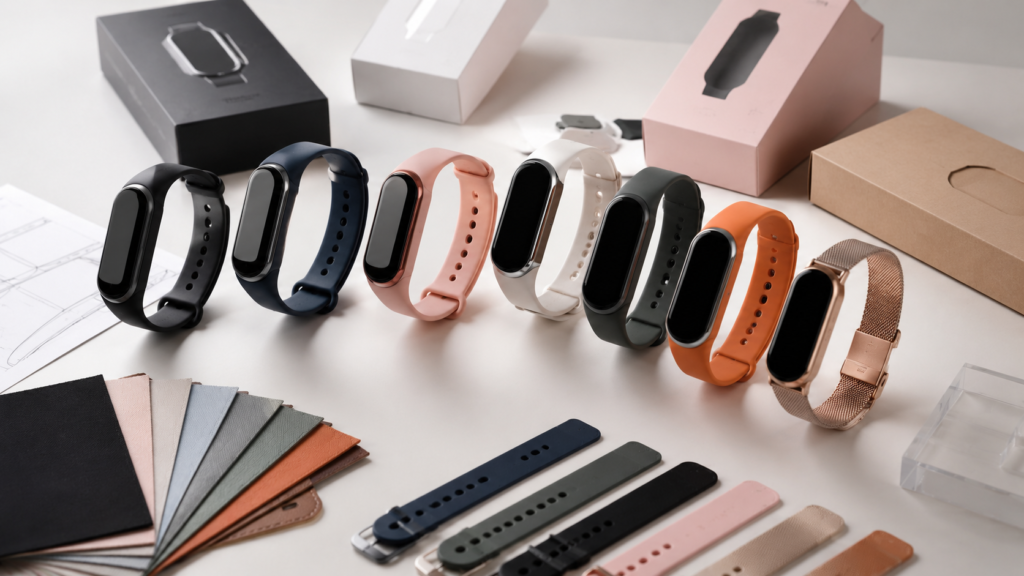
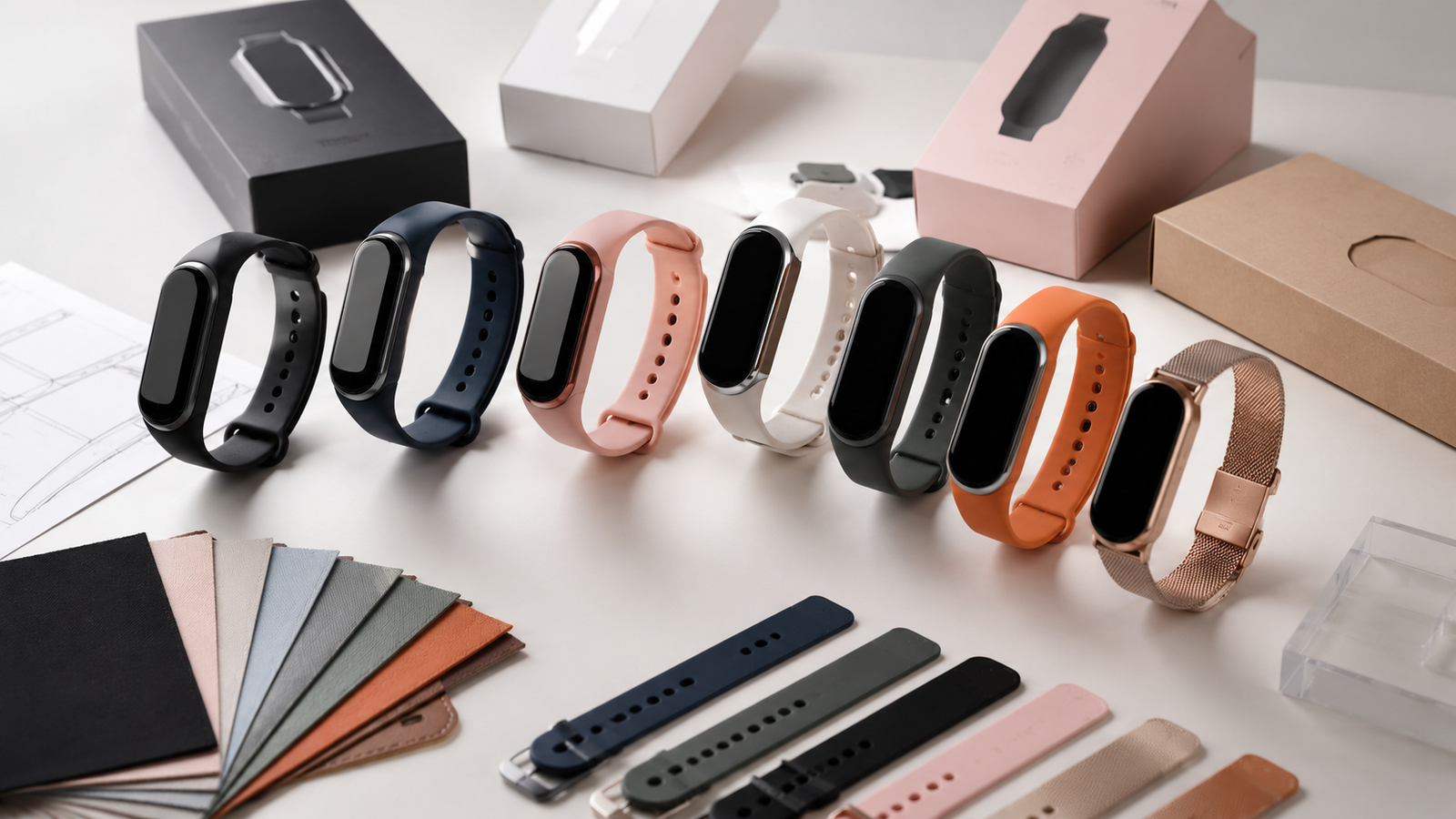
Image suggestion 1: Insert a photo of smart bands lined up by model with packaging in the background. Suggested ALT: “Smart bands sourcing options for Amazon EU sellers, shown with packaging samples.”

Check 1: Product–Market Fit for EU Amazon Listings
Before contacting suppliers, define the smart band you intend to sell. Amazon EU buyers expect accurate listing claims, including battery life, water resistance ratings, and supported languages. A fitness band marketed on 14-day battery life but tested at 7 days under similar conditions will generate returns and listing complaints.
Questions to answer internally
- Which EU countries will you sell in first, and what language support does the app require?
- Are you targeting fitness tracking, sleep tracking, heart rate monitoring, or basic notifications?
- Will the app be the supplier’s branded app, or will you offer a custom-branded app?
- Will the product ship with an EU-specific plug, packaging, and manual, or will it share a global SKU?
These answers determine whether a standard catalogue model is sufficient or whether you should pursue a Private Label OEM/ODM solution with firmware and packaging adjustments.
Check 2: Supplier Capability and Verification
A supplier that only resells smart bands will struggle with firmware fixes, app updates, and compliance requests. For EU-facing businesses, the supplier relationship must survive the full product life cycle, including warranty replacements in a fast-moving marketplace.
What to verify
- Does the supplier develop or directly assemble the product, or resell it?
- Can the supplier explain the firmware update process, and who is responsible for bug fixes after launch?
- Does the supplier provide a compliance contact for marketplace and customs queries?
- Are samples shipped from the same factory that will manufacture your order?
If a supplier cannot answer these questions in writing, escalate before sharing artwork or ordering samples. For a wider view of the smart band range and configurations, see the smart bands product category.
Check 3: OEM, ODM, or Private Label — Which Model Fits
Buyers often use these terms loosely. In practice, the model chosen determines how much control you have over firmware, app, packaging, and tooling.
Definitions in supply chain terms
Private label typically means an existing product is branded with your logo, packaging, and manual. The app may remain the supplier’s.
OEM manufacturing means the supplier builds to your specification, with agreed firmware, app, and labelling changes.
ODM manufacturing means the supplier designs the product and customises it for you, often with more limited firmware changes unless negotiated.
- Startups and new Amazon sellers often begin with private label and move to OEM after validating demand.
- Established sellers with an existing app ecosystem should discuss app customisation and API access early.
- If you plan to resell through distributors, clarify whether branding and packaging changes affect warranty support.
A sample-based review usually reveals which model the supplier can actually support. Request a written scope covering logo, packaging, app, firmware, and documentation.
Image suggestion 2: Insert an image of a sample smart band with branded packaging. Suggested ALT: “Private label smart bands sourcing sample with custom packaging for EU Amazon sellers.”
Check 4: MOQ, Landed Cost, and Margin Planning
Amazon EU sellers often underestimate the cost of compliance documentation, packaging localisation, warranty replacements, and battery shipping. Landed cost should include unit price, freight, duties, VAT regimes, packaging, samples, and expected return rate.
Items to request in the quotation
- Unit cost by quantity band and by colorway
- Tooling or setup charges, if any, and who owns them
- Packaging and manual costs for EU languages
- Incoterms, packing method, and carton dimensions
- Sample cost and whether it is deductible from the first order
- Payment terms and deposit structure
MOQ varies with product configuration, colour mix, packaging changes, and the level of firmware customisation. For an accurate figure for your specification, request a written quotation rather than relying on a catalogue number. Related sourcing questions are covered in the STAR KING resources blog.
Check 5: Sample Testing and Validation
Samples should confirm that the product meets your claims before you order. Plan sample testing against your own checklist, document results, and keep evidence for warranty disputes.
Sample validation checklist
- Battery life under realistic settings, with the conditions documented
- Charging performance and connector durability
- Bluetooth pairing across iOS and Android, including reconnection
- App installation, language switching, and notification display
- Accuracy of step, heart rate, and sleep measurements under repeatable conditions
- Water resistance claims tested against the supplier’s stated rating
- Packaging, manual accuracy, and EU label content
Testing hundreds of bands is not realistic for most sellers, but testing 3–5 samples across the SKU range is. Where a claim cannot be verified, request test evidence or adjust the listing claim.
Check 6: EU Compliance and Certification Evidence
For Amazon EU, compliance documentation should be available for the exact product you purchase. CE marking, RoHS, REACH, UN38.3, and WEEE obligations may apply, depending on the product, packaging, and the market in which you sell. Buyers should verify obligations with their compliance advisor or a notified body for the relevant directives.
Documents to collect
- EU Declaration of Conformity for the specific SKU
- RoHS test report from an accredited lab
- REACH declaration for materials and packaging
- UN38.3 report and MSDS for the battery
- WEEE and packaging registration guidance for the seller’s country
It is safer to ask for evidence per SKU than to rely on a general statement that a supplier’s products are “CE certified.” Where certification is not yet available for a new configuration, confirm the timeline and factor it into your launch plan. Reference material is available from the European Commission’s CE marking guidance and the IEC standards body for the test standards that may be referenced.
Image suggestion 3: Insert a photo of the compliance document set or battery test report on a desk. Suggested ALT: “Smart bands sourcing compliance documents for EU Amazon listings, including UN38.3.”
Check 7: After-Sales, Warranty, and Spare Parts
On Amazon, an unfulfilled warranty claim becomes a negative review. Before ordering, confirm how the supplier handles replacements, spare parts, and app support after launch.
Points to confirm in writing
- Warranty duration and what it covers
- Replacement shipping method and who pays
- Availability of spare straps, chargers, and packaging for replacements
- App support in EU time zones
- Firmware update responsibility after launch
For sellers building a long-term range, these commitments should appear in the purchase agreement alongside the product specification.
Comparison Table: Sourcing Models at a Glance
| Model | Control Over Branding | Control Over Firmware/App | Typical Fit |
|---|---|---|---|
| Private label | Logo, packaging, manual | Limited; often supplier app | First-time Amazon sellers validating demand |
| OEM manufacturing | Logo, packaging, labelling | Negotiated scope | Sellers with an existing app or ecosystem |
| ODM manufacturing | Supplier design plus brand | Supplier-led, limited changes | Buyers who need speed to market |
Common Mistakes and Buyer Red Flags
- Choosing a supplier based on unit price alone, without landing cost and compliance costs.
- Relying on a verbal promise that products are “CE certified” without SKU-specific evidence.
- Ordering a large first run before testing samples across languages and platforms.
- Assuming the battery is compliant with air freight rules without UN38.3 and MSDS documents.
- Ignoring app store policies and GDPR data handling, which can affect listing approvals and risk.
- Not documenting firmware and app support responsibilities after launch.
- Assuming MOQ and lead time are fixed; they often move with configuration and packaging changes.
Practical Buyer Checklist
- Define the SKU, target EU countries, languages, and listing claims.
- Request a capability and process overview from at least three suppliers.
- Confirm which sourcing model (private label, OEM, ODM) the supplier can support.
- Request samples with the exact configuration and packaging you plan to sell.
- Collect compliance documents for the SKU and battery.
- Test the app, language support, and pairing on both platforms.
- Ask for a written quotation with MOQ, lead time, Incoterms, and packaging costs.
- Confirm warranty, spare parts, and firmware support after launch.
- Document everything before issuing a purchase order.
For buyers comparing models, the smart watch range and smart rings product page illustrate how the same compliance thinking applies across wearable formats.
If your launch plan depends on a specific compliance timeline, raising questions early in the sample round is more effective than discovering the gap at shipment. For context on how smart band applications map to supply chains, the fitness tracking applications page illustrates typical end-user use cases.
FAQ
1. Do Amazon EU sellers need CE certification for smart bands?
CE marking generally applies to electrical/electronic products covered by EU directives, and smart bands usually fall within scope. The exact requirements depend on the product configuration and the directives that apply. Confirm with your compliance advisor and request SKU-specific evidence.
2. What is the usual MOQ for private label smart bands?
MOQ varies with configuration, packaging, and firmware changes. Common ranges exist, but published figures can become outdated. Request a quotation for your specification [STAR KING TO CONFIRM].
3. How long does smart bands sourcing usually take?
Sample rounds, compliance documentation, and production typically add several weeks beyond the production itself. Timelines depend on configuration and packaging. Confirm with your supplier for your exact SKU.
4. Can suppliers brand the app for EU sellers?
App customisation depends on the supplier’s platform and the scope of your project. Ask about app customization, language support, and GDPR hosting before ordering [STAR KING TO CONFIRM].
5. What documents should accompany battery-powered smart bands?
UN38.3 and MSDS are commonly required for air transport. Sellers may also need WEEE and packaging registration in their EU country. Requirements may differ by carrier and destination country — verify before booking freight.
6. How should I compare suppliers?
Compare documentation evidence, sample performance, app support, MOQ, lead time, and warranty terms. Price is only one input into landed cost.
7. Can Amazon EU listings use health claims on smart bands?
Consumer wearable measurements are not medical diagnoses. Avoid claiming treatment, diagnosis, or medical benefit unless the device is specifically regulated for that use. Verify claims against the product’s intended use and target market.
Conclusion
For Amazon EU, smart bands sourcing is a documentation and planning exercise as much as a product selection exercise. The seven checks above — fit, capability, model, cost, samples, compliance, and support — give you a structured way to compare suppliers and reduce listing risk. Begin with the checks that can be verified quickly: sample testing, document collection, and a written quotation for your exact SKU.
STAR KING CTA
If you are planning a smart band launch for the EU and need clarity on configuration, packaging, or compliance documentation, you can request product samples to evaluate fit against your own checklist before committing to volume.
Discuss Your Smart Wearable OEM/ODM Project
Planning a smart ring, smart watch, smart band, AI glasses, AI translator, or AI voice mouse project? Contact STAR KING to discuss product positioning, sample testing, customization scope, certification requirements, lead time, and quotation details.

Team Star King

Scan WhatsApp QR code
Leave a Reply