
Smart Bands OEM for EU Startup Brands: 7-Step Sourcing Guide for 2026
November 1, 2026 · Team Star King

Smart Bands OEM for EU Startup Brands: 7-Step Sourcing Guide for 2026
Smart bands OEM sourcing lets EU startup brands launch a fitness tracker under their own logo without owning a factory. This guide gives you a seven-step purchasing process: define specs, select a manufacturer, verify samples, plan MOQ and tooling, confirm EU compliance, lock packaging, and schedule delivery. Each step includes buyer checks and red flags so you can move from inquiry to purchase order with clear data.
Table of Contents
Table of Contents
smart bands OEM: Short Answer
To source smart bands OEM for the EU market, shortlist manufacturers with wearable experience, request samples with your firmware and app requirements, confirm CE and RoHS documentation for the exact configuration, and agree on MOQ, lead time, and battery shipping data before paying a deposit. Start with a small pilot order, verify pre-shipment inspection results, and scale after the first batch passes your quality checks.
Table of Contents
- Step 1: Define Your Smart Band Product Brief
- Step 2: Shortlist Smart Band OEM Suppliers
- Step 3: Evaluate Samples and Firmware
- Step 4: Understand MOQ, Tooling, and Cost Drivers
- Step 5: Confirm EU Compliance and Battery Documents
- Step 6: Plan Packaging and Private Label Branding
- Step 7: Lock Lead Time, Inspection, and Warranty
- Common Mistakes and Buyer Red Flags
- Practical Buyer Checklist
- FAQ
- Conclusion
Key Takeaways
- Smart bands OEM works best when you specify sensors, battery life, app behavior, and packaging before requesting quotes.
- EU startup brands should treat CE, RoHS, and battery documentation as purchase-order conditions, not afterthoughts.
- MOQ, tooling amortization, and lead time are linked; changing the enclosure or display late raises cost and delays delivery.
- A pilot batch with pre-shipment inspection reduces risk before you commit to scale production.
- Document ownership, warranty, and spare parts terms in the contract to protect your brand after launch.
Key Facts for Buyers
| Item | Typical Buyer Consideration | What to Verify |
|---|---|---|
| Product type | Fitness band with heart rate, SpO2, sleep tracking | Sensor model, firmware version, app compatibility |
| MOQ | Often a few hundred to a few thousand units; varies by customization | Written MOQ per SKU and per color; tooling cost separate |
| Certifications | CE, RoHS, REACH, WEEE, battery UN38.3, MSDS | Test reports for the exact model and accessory set |
| Lead time | Sample: 7–15 days; mass production: 30–60 days after deposit | Written schedule with milestones and inspection points |
| Packaging | Custom box, manual, label, barcode | Print proofs, language versions, recycling marks |
| Warranty | 12 months typical; batteries may differ | Defect rate policy, spare parts availability, RMA process |
Step 1: Define Your Smart Band Product Brief
A clear brief shortens quotation cycles. Write down the screen size, display type, sensor set, battery capacity, water resistance target, app platform, and packaging language. EU startup brands often underestimate how sensor choices affect price and compliance documentation. For example, adding SpO2 or a larger AMOLED screen changes the bill of materials and may require updated test reports.
Decide whether you need a standard smart band platform with your logo or a custom enclosure. Standard platforms reduce tooling cost and lead time; custom enclosures increase differentiation but require mold investment and longer validation. If you are still comparing wearable formats, review smart bands for OEM projects alongside smart watches to see which form factor matches your channel.
Specification Decisions That Change Cost
- Display: TFT versus AMOLED affects unit price and battery life.
- Sensors: Heart rate, SpO2, accelerometer, and temperature each add cost and test scope.
- Battery: Capacity drives runtime, thickness, and UN38.3 shipping documentation.
- Connectivity: Bluetooth version and companion app requirements affect firmware work.
- Water resistance: IP67 or IP68 claims require test evidence and process control.
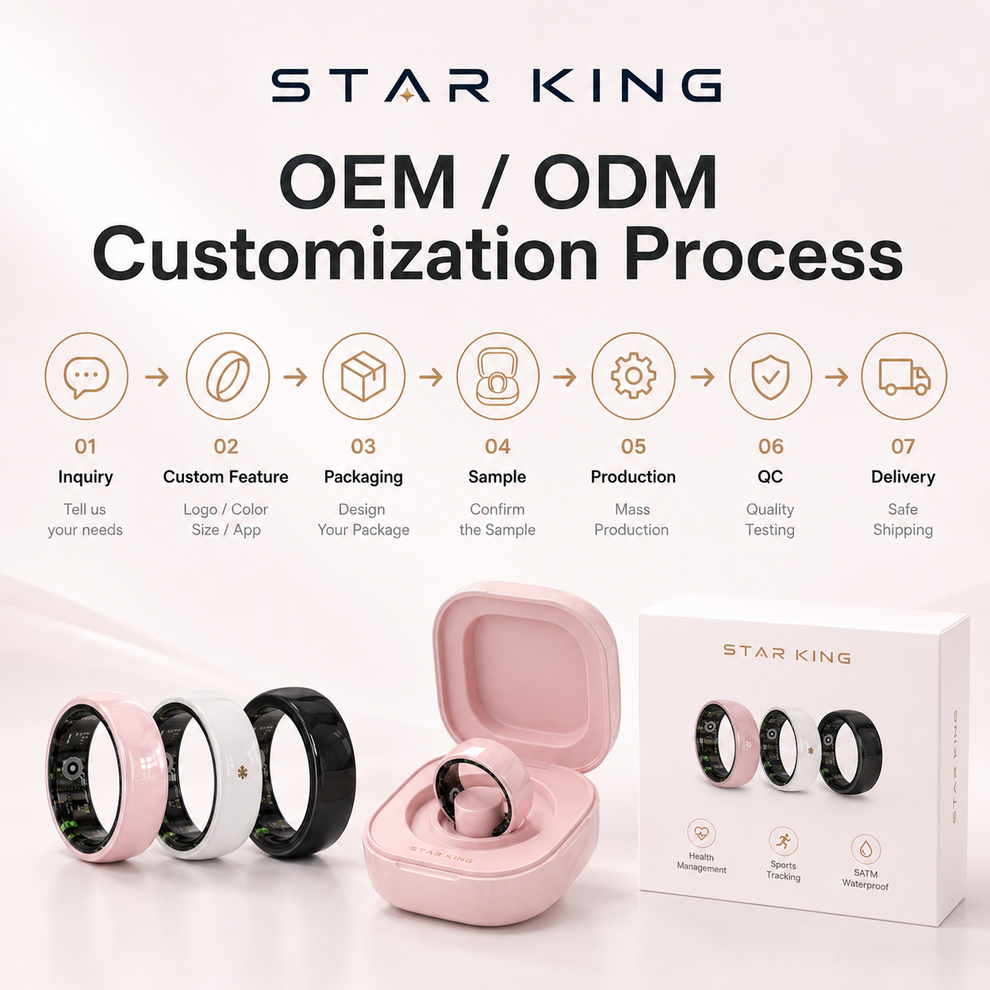
For private-label programs that combine bands and rings, the private label OEM/ODM solution explains how branding, packaging, and app customization fit together.
If you already have a draft brief, you can share it with STAR KING to get a specification review and a preliminary quotation before committing to tooling.
Step 2: Shortlist Smart Band OEM Suppliers
Not every wearable factory is set up for startup-brand orders. Evaluate suppliers on four criteria: wearable production experience, firmware and app support, documentation readiness, and communication speed. Ask for the exact model numbers they produce and the certifications tied to those models. A supplier that only offers finished consumer products may not support logo, packaging, or app changes.
Supplier Evaluation Questions
- Which smart band models are currently in mass production?
- Can you customize the logo, packaging, and app name?
- Who owns the firmware and app source code, and what customization is allowed?
- Which test reports exist for CE, RoHS, REACH, and battery transport?
- What is the MOQ for standard and customized configurations?
- How do you handle pre-shipment inspection and defect claims?
For broader supplier screening guidance, see the STAR KING resources blog and compare how manufacturers document quality control and lead times. If your roadmap includes AI office devices, the AI voice mouse product page shows the type of customization questions to ask across categories.
Step 3: Evaluate Samples and Firmware
Samples are a purchase decision tool, not a formality. Test the band with your own phone, in your target language, and with your intended use cases. Check Bluetooth pairing stability, app onboarding, notification display, sleep and heart-rate data consistency, and battery drain over several days. Record firmware version and app version so mass production matches what you approved.
Sample Validation Checklist
- Pairing and reconnection after phone restart.
- Language support for EU markets.
- Data sync accuracy against a reference device.
- Charging time and real battery runtime.
- Water resistance behavior under normal use.
- App account creation, privacy notices, and data deletion options.
EU buyers should also confirm how the app handles personal data, because GDPR obligations may apply depending on the data collected and the entities involved. Buyers should verify data-processing terms with the supplier and their legal advisor.
Step 4: Understand MOQ, Tooling, and Cost Drivers
Smart bands OEM pricing is built from hardware, tooling, packaging, certification, and logistics. MOQ depends on whether you accept a standard enclosure or request a new mold. Standard platforms typically allow lower MOQs; custom tooling usually requires higher commitments to amortize mold cost. Ask for a cost breakdown that separates unit price, tooling, sample fees, packaging plates, and test reports.
| Cost Element | What Affects It | Buyer Action |
|---|---|---|
| Unit hardware cost | Display, sensors, battery, enclosure material | Freeze the BOM before comparing quotes |
| Tooling | New enclosure, strap mold, packaging die | Clarify ownership and amortization terms |
| Certification | Model variants, radio modules, battery | Confirm which reports are included |
| Packaging | Box structure, printing, manuals, labels | Request print proofs and language checks |
| Logistics | Battery shipping class, Incoterms, destination | Compare landed cost, not unit price alone |
MOQ negotiations work best when you offer a clear rollout plan: a pilot batch first, then scale. Suppliers can sometimes support lower first orders if the model is standard and packaging is simple. Get every concession in writing.
Step 5: Confirm EU Compliance and Battery Documents
EU market access depends on the product configuration. Radio equipment generally falls under the Radio Equipment Directive, and buyers should verify CE marking, the EU declaration of conformity, and test reports for the exact model. RoHS and REACH restrictions apply to materials, while WEEE and battery rules depend on the country and producer responsibility registration. None of these should be assumed; request documents and check they match the model you are buying.
For lithium batteries, UN38.3 test summaries and MSDS documents are typically required for air transport. Confirm the battery model and capacity on the documents match the product. Official references include the European Commission Radio Equipment Directive page and the FCC equipment authorization procedures if you also sell in the United States.
Compliance Documents to Request
- EU declaration of conformity for the exact model.
- CE test reports covering radio, EMC, and safety.
- RoHS and REACH declarations.
- UN38.3 test summary and MSDS for the battery.
- Packaging recycling and WEEE registration guidance.
Certification requirements typically depend on the product’s radio modules, battery, and target countries. Buyers should verify with a compliance lab or consultant before placing a mass-production order.
Step 6: Plan Packaging and Private Label Branding
Packaging is part of the product in the EU retail channel. Plan the box, quick-start guide, safety information, and label languages early. Ask for digital proofs and, for larger orders, a physical pre-production sample. Confirm barcode format, country of origin marking, and recycling symbols required by your channel or importer.
Logo customization can be applied to the strap, buckle, display boot screen, and packaging. App name and icon customization depends on the supplier’s app platform and may involve additional fees or review time. Clarify who owns the custom artwork and molds, and include that in the contract.
Step 7: Lock Lead Time, Inspection, and Warranty
Ask for a production schedule with dates for sample approval, deposit, materials, assembly, testing, inspection, and shipping. Include a pre-shipment inspection clause and agree on the acceptable quality level. For startup brands, a third-party inspection on the first batch is a low-cost risk control.
Contract Terms to Confirm
- Payment milestones tied to production stages.
- Pre-shipment inspection standard and defect handling.
- Warranty period, RMA process, and spare parts availability.
- Tooling and artwork ownership.
- Firmware update policy and app support duration.
- Shipping terms and battery documentation responsibility.
Common Mistakes and Buyer Red Flags
- Comparing unit price only: landed cost includes certification, packaging, and battery shipping.
- Accepting certification copies without model matching: reports must match the exact product.
- Changing specs after tooling: late changes raise cost and delay delivery.
- No written MOQ or lead time: verbal promises are hard to enforce.
- Ignoring app and data terms: GDPR obligations may apply to fitness and health data.
- No pilot inspection: first-batch defects can damage your brand and returns budget.
Practical Buyer Checklist
| Area | Check | Status |
|---|---|---|
| Specification | BOM, sensors, firmware, app version frozen | ☐ |
| Supplier | Wearable experience and references verified | ☐ |
| Samples | Tested in target language and use case | ☐ |
| MOQ | Written MOQ for standard and custom options | ☐ |
| Compliance | CE, RoHS, REACH, UN38.3, MSDS for exact model | ☐ |
| Packaging | Proofs approved, label languages checked | ☐ |
| Lead time | Schedule with inspection and shipping dates | ☐ |
| Warranty | RMA and spare parts terms agreed | ☐ |
FAQ
What is the typical MOQ for smart bands OEM?
MOQ depends on whether you use a standard enclosure or a custom mold. Standard platforms may allow lower first orders, while custom tooling usually requires a higher commitment. Ask for MOQ per SKU and per color in writing.
How long does smart bands OEM production take?
Samples often take 7–15 days. Mass production typically takes 30–60 days after deposit and sample approval, depending on component availability, packaging, and inspection schedule.
Which certifications do EU buyers need for smart bands?
Radio equipment generally requires CE marking and an EU declaration of conformity. RoHS and REACH apply to materials, and UN38.3 plus MSDS are typically needed for lithium battery shipping. Requirements depend on configuration and market; verify with a lab.
Can startup brands customize the app and packaging?
Many OEM suppliers support logo, packaging, and app name customization. The scope depends on the supplier’s firmware and app platform. Confirm fees, review time, and who owns the custom assets.
What should I check in a smart band sample?
Test Bluetooth pairing, app onboarding, language support, data sync, battery runtime, and water resistance under normal use. Record firmware and app versions so mass production matches the approved sample.
How do I reduce risk on my first order?
Start with a pilot batch, use a pre-shipment inspection, and require compliance documents before deposit. Agree on warranty and spare parts terms so post-launch returns are manageable.
Conclusion
Smart bands OEM sourcing is a sequence of verifiable decisions, not a single price negotiation. EU startup brands that define specs early, validate samples, match certification documents to the exact model, and lock lead time and inspection terms can launch with fewer surprises. Use the checklist above as your purchase file, and scale only after the first batch meets your quality standard.
Ready to move from research to quotation? Request a smart bands OEM quotation and share your target specs, MOQ, and EU market requirements.
Discuss Your Smart Wearable OEM/ODM Project
Planning a smart ring, smart watch, smart band, AI glasses, AI translator, or AI voice mouse project? Contact STAR KING to discuss product positioning, sample testing, customization scope, certification requirements, lead time, and quotation details.

Team Star King

Scan WhatsApp QR code
Leave a Reply